
Terrarium Light Requirements: Where a Closed Jar Should Go

A closed terrarium needs bright, indirect light and no direct sun on the glass. The best spot is usually near a window but out of the sun’s direct path, so the jar gets plenty of daylight without heating up. Direct sun turns a sealed container into a small greenhouse and can cook the plants, while a dim corner slowly starves them. If your home has no suitable window, a plug-in grow light can supply what daylight does not.
That is the short version, and it matches what university extension guides say. The harder part is turning “bright, indirect” into a real spot in a real room, and that is what the rest of this guide is for.
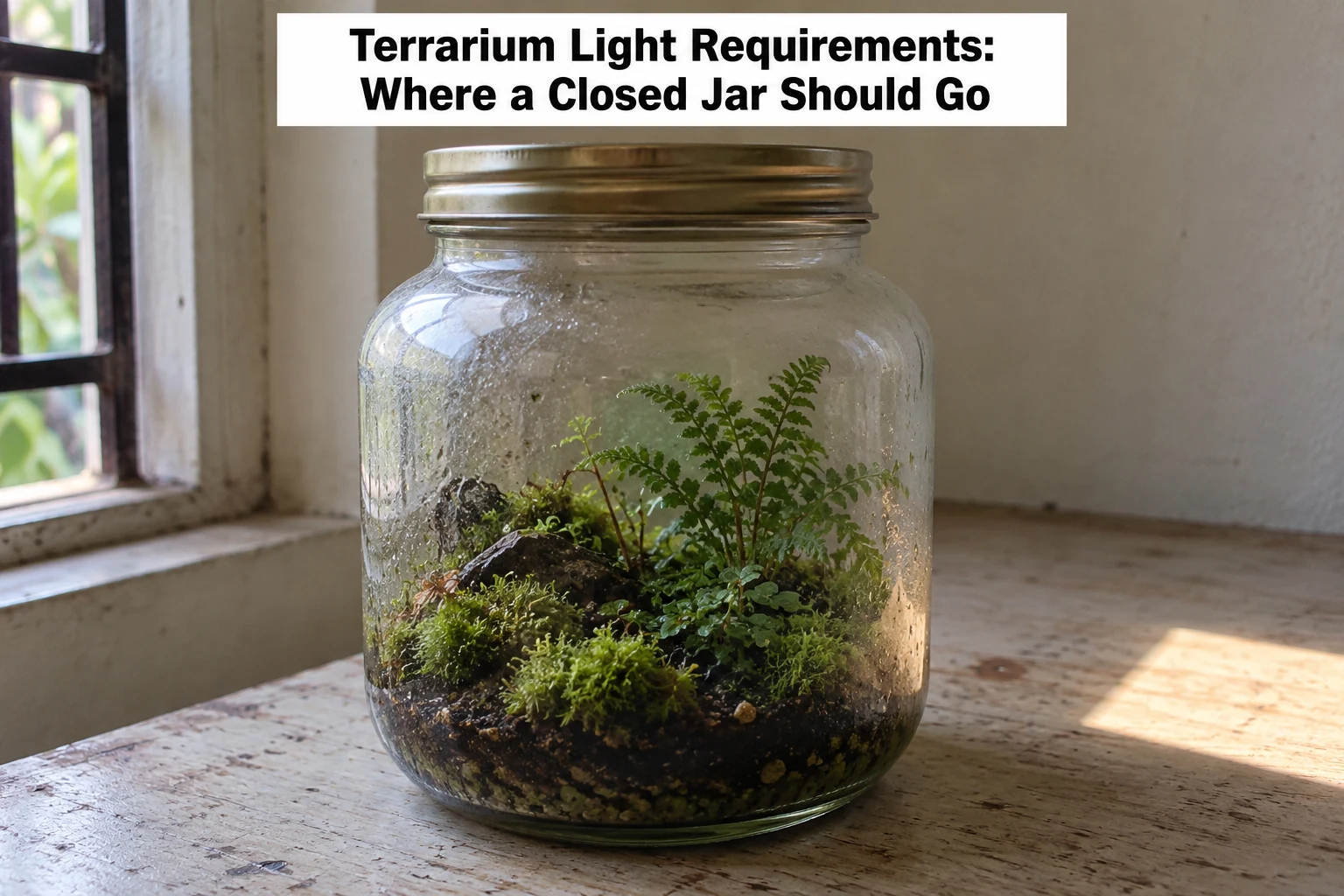
“I choose a terrarium spot by watching where sunlight actually lands, rather than trusting the window direction alone. A bright room can still put a sealed jar in a hot afternoon beam. I check the position at several times of day and look for steady growth afterward, because a comfortable-looking corner is not automatically a useful light source.”
What terrarium light requirements actually are
Plants in a terrarium need light for the same reason every plant does: to make food. A closed jar changes two things about that.
First, the glass sits between the plant and the light. Clear glass lets most daylight through. Tinted, frosted or dirty glass does not. Mississippi State University Extension’s guide How to Design a Closed-System Terrarium (Publication 3253, read September 25, 2026) says the container “should not be cloudy or tinted, as this would restrict light and limit plant growth.”
Second, a sealed container traps heat. The same publication warns: “Avoid placing a terrarium close to a window, as solar energy can build up heat inside the container, potentially burning the plants.”
So light for a closed terrarium is a balance. Too little and plants stretch and fade. Too much direct sun and the jar overheats. The goal is the brightest spot that never gets the sun directly on the glass.
Bright indirect light, defined
“Bright indirect light” is the phrase every guide uses and few explain. In practice it means:
- Bright: the spot is well lit by daylight for much of the day. You could comfortably read there without a lamp.
- Indirect: the sun’s rays do not land on the terrarium itself. The light reaches it after bouncing off walls, ceilings and the sky rather than as a direct beam.
Mississippi State adds a placement hint: “Find a location with bright, indirect light. Often, an eastern exposure with morning sun is ideal for terrariums.” Morning sun tends to be gentler than afternoon sun, which is why an east-facing room is often suggested. Notice that the same guide still says to keep the jar back from the window itself. The room faces east; the jar does not sit in the sunbeam.
Why direct sun is the main risk for a sealed jar
Open terrariums and potted houseplants can often take some direct sun. A closed terrarium is different, because it holds heat and moisture in.
When sunlight falls directly on a sealed jar, the air and substrate inside warm up, and there is nowhere for that heat to go. The plants inside are usually shade and forest-floor species, chosen because they like humidity, not heat. The typical damage looks like:
- Leaves that go limp or scorched within a day of sun exposure.
- Heavy fog that will not clear, because warm air inside holds more moisture.
- Brown, crispy patches on the side facing the window.
If you are already seeing that last symptom, brown, crispy leaves in a closed terrarium walks through heat and the other causes.
The sun also moves. A spot that is shaded in the morning can get a direct beam in the afternoon, and a spot that is fine in one season can get sun in another as the sun’s angle changes. The only reliable way to know is to watch the spot at different times of day.
Where standard advice needs a local check
Most care advice is written for a particular climate and a particular kind of window. “A bright window” in a mild, cloudy place and “a bright window” somewhere hot and sunny are not the same exposure. The sun’s strength and angle change with where you live, the time of year, and what is outside the window: a wall, a tree, a balcony overhang or open sky.
That is why it is safer to treat any direction-based advice (“east is best”, “avoid south”) as a starting point and then test the actual spot. The tests below take a few days and need nothing you do not already own.
How to find the right spot: four simple tests
1. The shadow test
Hold your hand a short distance above the spot at different times of day. A sharp, dark shadow means direct sun is landing there. A soft, blurry shadow means bright indirect light. Barely any shadow means the spot is dim. Check it in the morning, around midday and in the afternoon, because the answer can change.
2. The warm glass test
After the jar has been in the spot for a while on a bright day, touch the glass. It should feel close to room temperature. If the side facing the window is noticeably warm, the spot is getting too much sun for a sealed build.
3. The condensation pattern
A healthy closed jar usually fogs lightly at some point in the day and clears later. Fog that builds heavily on the side facing the light, and never clears, can point to heat from direct sun. What the fog is telling you is covered in more depth in too much condensation in a terrarium.
4. A light meter app
University of New Hampshire Extension’s Q&A Optimizing Plant Growth with Indoor Lighting (Jonathan Ebba, February 2, 2021, read September 25, 2026) notes that light meter apps “use the light sensor on your phone” to estimate light. A phone reading is not lab precise, but comparing readings between two spots in the same room shows you which is brighter, which is the decision you actually need to make.
How the plants tell you the light is wrong
Once the jar is placed, the plants give feedback over the following weeks.
Too little light:
- Stems stretch toward the window with longer gaps between leaves.
- New leaves come in smaller and paler.
- Colorful foliage fades toward plain green.
- Plants lean hard in one direction.
Too much light or heat:
- Leaves scorch, bleach or crisp on the window side.
- Plants wilt during the brightest part of the day.
- Algae spreads quickly on the glass facing the light. Terrarium algae on the glass explains why light and algae are linked.
Leaning toward the light is normal to a degree. Turning the jar a quarter turn every so often keeps growth even.
Why the “hours of light” numbers disagree
Terrarium guides give different numbers for how many hours of light a jar needs, often without explaining why. The reason is that hours alone are only half the picture.
UNH Extension’s Q&A makes the point directly: “Failure with growing plants under lamps is more often about light quantity (intensity and duration) than quality (spectrum).” What a plant uses is the total light it receives over a day, which is brightness multiplied by time. The same Q&A expresses that as a daily total (Daily Light Integral) and gives “4-6 moles per square meter per day for houseplants” and “6-8 for shade plants.”
In plain terms: a jar in a very bright spot needs fewer hours to get its daily total, and a jar in a dimmer spot needs more. That is why one guide’s number does not transfer cleanly to another room. It also means you cannot fix a dark corner by leaving a weak lamp on longer and longer. Brightness and duration have to work together.
When a grow light makes sense
If your only bright window gets direct sun all afternoon, or your room has no window at all, artificial light can do the job. A few principles apply regardless of which light you choose:
- Cooler is better. Any light that makes the glass warm is repeating the direct sun problem.
- Keep it consistent. Plants respond better to regular on and off times than to irregular ones. A simple plug-in timer handles this.
- Give the jar a dark period. Light around the clock is not the aim.
- Watch the plants, not the box. The signs of too much and too little light above apply to lamps as well as windows.
A lamp over a damp glass jar also raises safety questions. Use only plug-in fixtures as their manufacturer intends, keep cords and plugs away from water and condensation, and do not modify or rewire a fixture. Anything involving your home’s wiring is work for a qualified electrician.
Light and plant choice go together
Light is not only a placement decision. It also shapes what you should plant. Many common terrarium plants are forest-floor species that do well in moderate, filtered light, which is what makes them suited to jars in the first place. If your available spot is on the dimmer side, choose plants that tolerate it, and if it is bright, check that your plants can handle the extra warmth near the glass. Best plants for a closed terrarium covers which species cope with typical jar conditions.
A quick placement checklist
- The room is bright during the day.
- No direct sunbeam lands on the jar at any time of day (check with the shadow test).
- The glass stays near room temperature on bright days.
- The container is clear and clean, not tinted or cloudy.
- The jar is away from heaters, stoves and other heat sources.
- You turn the jar every so often for even growth.
Frequently asked questions
Can a closed terrarium sit in direct sunlight?
It is not recommended. Mississippi State University Extension warns that solar energy can build up heat inside the container and potentially burn the plants. Place a closed terrarium in bright, indirect light instead.
Which window is best for a terrarium?
Mississippi State University Extension suggests that an eastern exposure with morning sun is often ideal, with the jar kept back from the window itself. Local conditions vary, so confirm the spot with a shadow test at several times of day.
How many hours of light does a terrarium need?
It depends on how bright the light is. UNH Extension explains that plants respond to the total light over a day, which is intensity multiplied by duration, so a brighter spot needs fewer hours and a dimmer spot needs more. Always leave a dark period.
Can a terrarium survive without natural light?
It can, if a suitable artificial light supplies what daylight would. Keep the light cool enough that the glass does not warm up, run it on a consistent schedule, and watch the plants for signs of too much or too little light.
How do I know if my terrarium is getting too much light?
Scorched or crispy leaves on the window side, plants wilting during the brightest part of the day, glass that feels warm, and fast algae growth on the sunny side are all common signs. Move the jar further from the window.