
Terrarium Without Springtails: Does a Jar Need a Crew?

Yes, a terrarium without springtails can work. Sealed jars were growing plants long before adding a “cleanup crew” became common hobby advice, and many still do. What you give up is a population that eats mold and small bits of decay for you, so that job moves to you: pulling dead leaves, wiping early mold and keeping the jar from getting too wet. A jar without springtails is a jar with a more attentive owner, not a jar that is doomed.
This guide explains what springtails actually contribute, why a crew-free jar is less unusual than shop blogs suggest, which builds cope best without one, and the routine that replaces them.
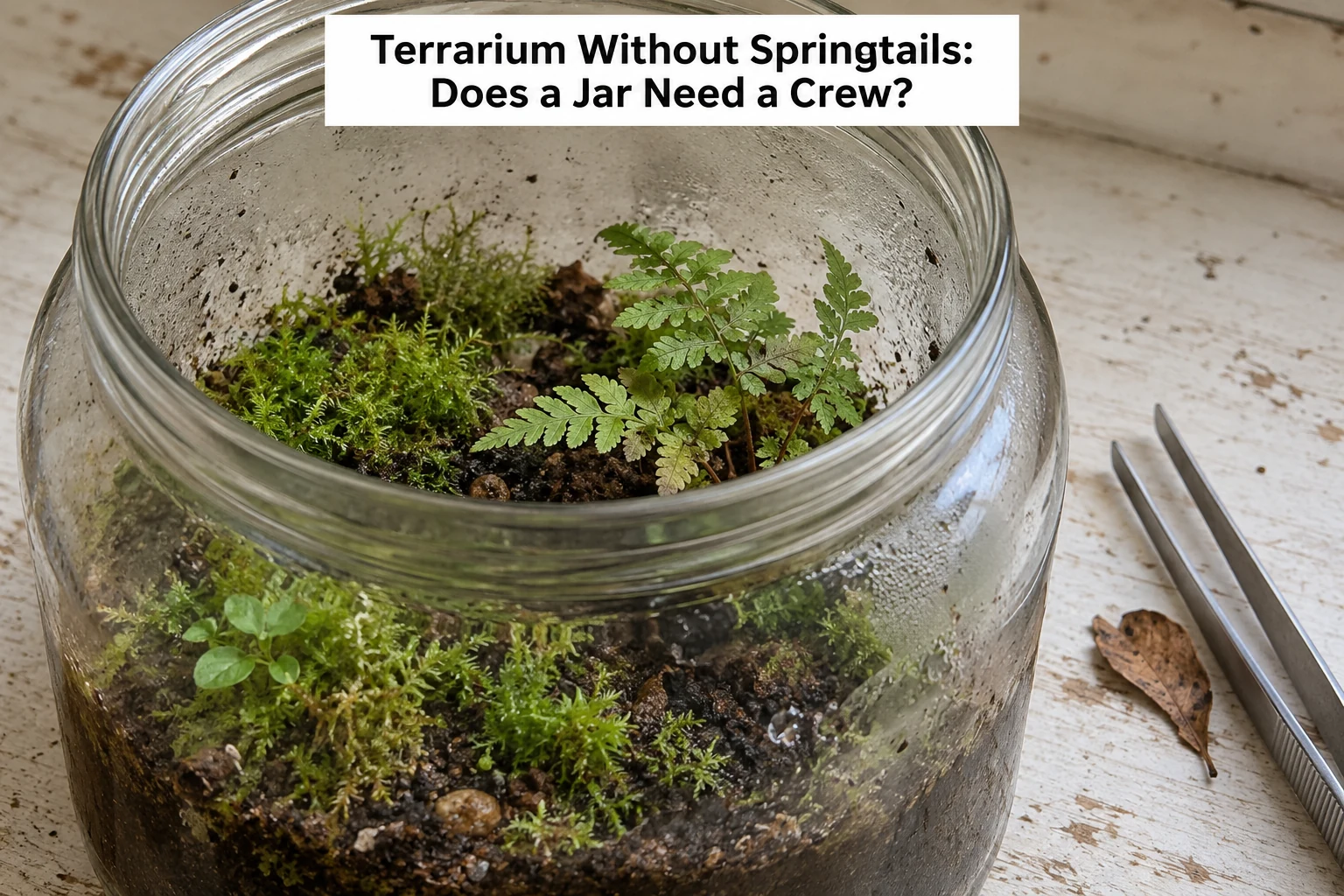
“I treat a jar without an added cleanup crew as a build that needs accessible maintenance, not as a failed ecosystem. A wide opening and modest amounts of decaying material make the work easier. Removing a fallen leaf while it is still intact is usually simpler than trying to lift the soft fragments after it has collapsed into the moss.”
What Springtails Actually Do for a Terrarium
Before deciding whether to skip them, it helps to be precise about their job.
Springtails are tiny soil animals. Ohio State University Extension’s Ohioline springtails fact sheet (David J. Shetlar and Jennifer E. Andon, April 20, 2015, read on 2026-09-27) says “Most feed on algae, fungi and decaying vegetable matter,” and that “They are abundant only in damp, moist or very humid locations.” A closed terrarium is exactly that kind of place, which is why they do well in one.
In a jar, that feeding habit translates into three useful things:
- Grazing mold early. They eat fungal growth on the soil surface and on wood before it builds into a visible patch.
- Breaking down small debris. Tiny pieces of dead leaf and root are their scale.
- A living moisture gauge. A population that booms or disappears tells you something about how wet the jar is.
What they do not do is hold the jar together. The water cycle, the light, the plant choice and the drainage are what keep a closed terrarium alive. Springtails are maintenance staff, not the foundation.
Sealed Jars Ran Without a Crew Long Before It Was Fashionable
The closed terrarium itself started with a jar nobody stocked with bugs. The New York Botanical Garden’s Plant Talk article on terrariums (Matt Newman, March 19, 2012, read on 2026-09-27) tells the story of Dr. Nathaniel Ward, a British physician who kept moth cocoons in jars. “A fern spore had made its way into the container and germinated in the small spread of soil that was kept at the bottom.” Ward “kept the jar sealed for four years as an experiment,” and the fern “ultimately died, but not due to neglect. The jar’s cap simply rusted through.”
NYBG describes the result as “a miniature biome, with its own self-regulating water cycle to sustain the plants inside.” Nobody added springtails. That does not prove Ward’s jar was free of soil animals, since he used ordinary soil, but it shows the core of a closed terrarium is the sealed water cycle, not a purchased culture.
Adding a crew on purpose, the “bioactive” approach, is a good idea in many builds. It is not a requirement for a plant-only jar.
You May Already Have Springtails Without Adding Any
Here is the point many “do I need springtails?” articles skip: a jar you never stocked may not be springtail-free.
Ohioline lists where springtails live: “in soil, leaf mold, under bark, in decaying logs, on the surface of pools, in organic mulches, in termite nests, in greenhouses, in mushroom cellars.” Several of those are exactly where terrarium materials come from. Moss lifted from outdoors, wood from a garden or woodland, leaf litter and some bagged mixes can all carry a few springtails in with them.
So “terrarium without springtails” can mean two different things:
- A jar you did not deliberately stock. It may still have a small hitchhiker population. If you see tiny white specks jumping at the soil line some weeks after building, that is probably what happened.
- A jar built from sterilized or bagged materials only. This is closer to truly crew-free. If you sterilize your substrate before building, our guide to sterilizing terrarium substrate and jars covers the method and its safety points.
Neither is wrong. It just means that if you are aiming for no springtails at all, wild-collected moss and wood are the most likely way they get in.
What You Give Up in a Terrarium Without Springtails
Being honest about the trade-off:
| Job | With springtails | Without springtails |
|---|---|---|
| Early mold on soil and wood | Often grazed before you notice | You spot it and remove it |
| Dead leaves and debris | Small pieces broken down over time | You pick it out by hand |
| Warning of a wet jar | A population boom | Condensation and soil color only |
| Mold flush in the weeks after building | Grazed as it appears in many jars | You manage it until the jar settles |
| Risk from the crew itself | Rare; population swings and escapees | None |
The biggest real loss is the early-grazing effect in the first weeks after a build, when new wood and substrate often grow a flush of mold. Without a crew, you need to watch the jar more closely in that period.
Jars That Cope Best Without a Cleanup Crew
Some builds suit a crew-free approach much better than others.
Easier without a crew:
- Jars you can reach into. A wide opening lets you pull out dead leaves and wipe mold with tweezers or a cotton swab.
- Builds with little organic debris. Sparse leaf litter, no soft wood and mostly moss or small, slow plants give mold less to feed on.
- Jars that are not too wet. Excess water is the main driver of mold. A jar watered conservatively has fewer outbreaks for anything to eat. Our guide to terrarium maintenance sets out the weekly and monthly checks.
- Plants that drop few leaves. Fast-growing plants that shed or melt create a steady stream of decay.
Harder without a crew:
- Narrow-necked bottles and carboys, where reaching a dead leaf means tools, patience and a steady hand.
- Builds heavy on wood, bark or leaf litter, which feed mold continuously.
- Jars that have already had repeat mold problems, where the underlying moisture issue has not been fixed.
The Routine That Replaces Springtails
If you skip the crew, the crew’s work becomes part of your maintenance. None of it is complicated, but it has to happen.
Look closely once a week
Check the soil surface, the base of the plants and any wood for fuzz, cobweb-like threads or slimy patches. Not everything that grows in a jar is harmful mold. Our guide to terrarium mold identification helps you tell fuzz, cobweb mold and slime mold apart before you act.
Remove dead material promptly
Yellowing and dead leaves should come out while they are still whole. A leaf that is left to collapse into the soil becomes food for the next mold patch. Long tweezers do most of this work. When a plant is growing into the glass and shedding leaves, trimming it back keeps debris down; our guide to pruning terrarium plants explains how.
Wipe mold early
Small patches can be lifted out with a cotton swab or a pair of tweezers. Take the affected moss or soil surface with it where you can. Early removal is the crew’s job done by hand.
Keep water on the low side
A springtail-free jar has no grazer to soften the effect of overwatering. Only add water when the jar clearly needs it, and let excess condensation clear before adding more.
Air the jar when it is too wet
A short period with the lid off lets excess moisture escape. NYBG describes the closed jar as self-regulating, but a jar that has been overwatered is not yet in balance, and airing is how you help it get there.
Should You Add Springtails Later?
A crew-free jar can take springtails at any point. Many keepers start without them and add a culture only if mold keeps coming back despite good moisture control. That is a sensible order: fix the water first, then add the crew if you still need help. Adding springtails to a waterlogged jar only gives you a population boom on top of a moisture problem.
If you do add them, remember they need damp soil and some decaying material to eat. A very clean, sparse jar may not support a population for long, which is fine. They were only ever there to help.
Frequently Asked Questions
Can a closed terrarium survive without springtails?
Yes. Sealed jars grew plants long before adding a cleanup crew became common. The New York Botanical Garden describes Nathaniel Ward’s original sealed jar, which he kept closed for four years. Without springtails, you take over their job of removing mold and dead material.
What happens if I do not add springtails to my terrarium?
Mold and dead leaves are not grazed for you, so you need to remove them by hand. The first weeks after building, when new substrate and wood often grow some mold, need the closest watching.
How do I stop mold in a terrarium without springtails?
Keep watering conservative, remove dead leaves while they are whole, lift out small mold patches early and air the jar briefly if it is too wet. Mold is driven mainly by excess moisture and decaying material.
Why do I have springtails when I never added any?
They likely came in with your materials. Ohio State University Extension lists soil, leaf mold, bark, decaying logs and organic mulches among the places springtails live, so wild moss, wood and leaf litter can carry them.
Are isopods a substitute for springtails?
Not usually in a small closed jar. Isopods are larger and depend on a steady supply of decaying material, so they tend to suit bigger enclosures with plenty of leaf litter better than a small, tidy jar.