
Does a Terrarium Need a Lid? What Changes Without One

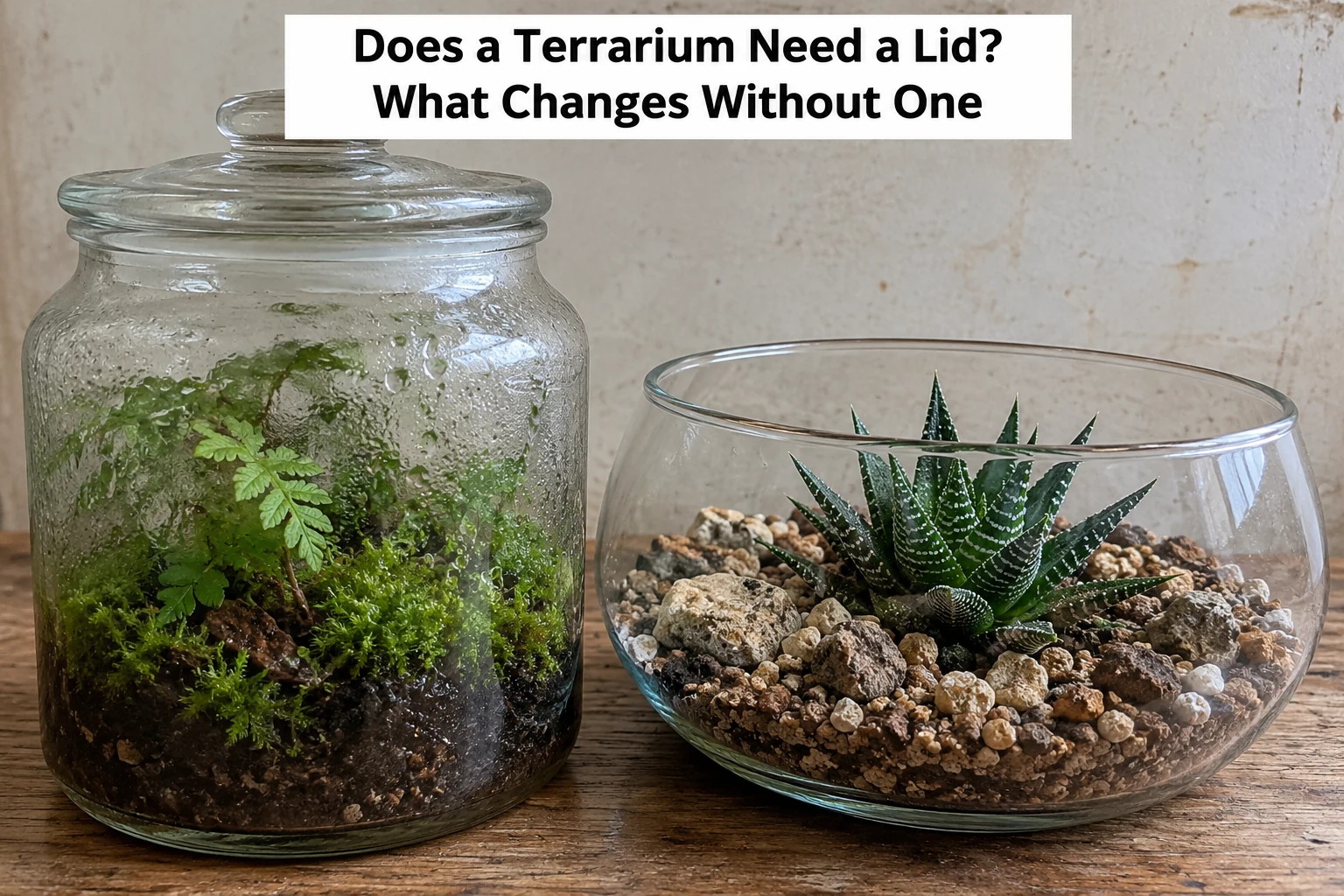
Does a terrarium need a lid? Only if you want a closed terrarium. A lid, or a very narrow opening, is what holds moisture inside the glass so the plants can recycle their own water. Without one, you have an open terrarium: drier air, more airflow, and regular watering by hand. That suits succulents, cacti and other plants that rot in damp air, and it does not suit ferns, mosses or fittonia. So a container that came without a lid is not a failed terrarium. It is a different kind, and the lid question is really a question about what you plant in it.
The rest of this guide works through what a lid actually does, what you can grow with and without one, and what to do if your container arrived lidless but you had your heart set on a jungle of moss.
“I match the lid to the plants rather than treating a cover as an automatic improvement. Moss and ferns benefit from retained humidity, while a succulent needs a very different environment. If a lid goes missing, I also reconsider the care routine immediately, because the same planting can start losing moisture much faster even though the container still looks familiar.”
What a Lid Actually Does
A lid does one job: it stops water vapor leaving the container.
Inside any planted jar, water evaporates from the soil and passes out through the leaves. In a closed container, that vapor has nowhere to go. It condenses on the cooler glass, runs down the sides and soaks back into the substrate. That loop is why a well-balanced closed terrarium can go a long time between waterings.
Mississippi State University Extension’s publication How to Design a Closed-System Terrarium (P3253, by James M. DelPrince and Gary Bachman, dated September 2024, read on 2026-09-28) draws the line clearly. It describes open-system terrariums as using “a container with a wide opening, such as a large glass bowl,” which “typically need to be watered more often than closed systems.” Closed-system terrariums use “a closed (or nearly closed) container” and “sustain the ecosystem necessary for moisture- and humidity-loving plants.”
Two details in that wording matter for anyone with a lidless container. First, “nearly closed” counts. Second, the difference is described in terms of the opening, not in terms of owning a lid.
Does a Terrarium Need a Lid? It Depends on the Plants
The simplest way to answer the question for your own jar is to start from what you want to grow.
| What you want to grow | Lid or cover? | Why |
|---|---|---|
| Succulents and cacti | No | They need dry air and airflow; the same MSU publication says they “would quickly rot and die” in closed conditions |
| Ferns, mosses, fittonia (nerve plant), other humidity lovers | Yes, or a very narrow opening | They depend on the high humidity a closed container holds |
| A mix of dry-air and humid-air plants | Pick one group | No single container suits both; one group will struggle |
The last row catches a lot of people. A lidded jar with a succulent tucked between ferns tends to end with a rotted succulent, and an open bowl of moss tends to end crisp and brown. The lid is not the variable to fix; the plant list is.
If you have not decided yet which way to go, our guide to open vs closed terrariums walks through the choice from the start.
My Container Came Without a Lid: What That Changes
This is the situation most “do terrariums need lids” pages skip. You own a container. It has no lid. What can you actually do with it?
Look at the opening, not the lid
Not all lidless containers behave the same way. The shape of the opening decides a great deal.
- Wide bowls and open-front globes. A large, wide opening lets moisture escape freely. These are open terrariums by nature. Plant them with succulents, cacti or other dry-air plants and water them by hand.
- Tall vases and cylinders with a moderate opening. Some moisture escapes, some stays trapped in the column of air. These sit in the middle and are the hardest to predict. Watch how the plants respond before committing to humidity lovers.
- Bottles and jars with a narrow neck. A small opening lets little vapor out. MSU Extension notes that for closed systems “a lidded jar or a jar with a narrow mouth works well.” A narrow-necked bottle without a stopper can behave much more like a closed terrarium than its lack of a lid suggests.
Find or improvise a cover
If you want a closed terrarium and your container has a wide mouth, you do not necessarily need a matching lid from the maker. Anything that sits securely over the opening and holds moisture in can work: a glass plate or saucer resting on the rim, a cork cut to fit, or a piece of clear, rigid material cut to size. The things to check are simple:
- It sits securely and does not slide off when the jar is moved or bumped.
- It is clear or translucent enough to let light through, if it covers a large part of the top.
- It is clean, so you are not introducing residue into a humid space.
How snugly it fits changes how the terrarium behaves. A tight seal holds almost all the moisture; a loose-fitting cover lets some escape and makes the jar dry slowly. Our guide to lidded, corked and clamp-top closures explains how each type of seal changes the water cycle inside.
Test before you plant for humidity
If you are unsure whether your container will hold enough moisture, watch it. MSU Extension describes a way to settle a newly planted closed terrarium: leave it open for about 24 hours, close it for 24 hours, then open it again. When condensation forms on the inside walls or lid, it advises opening the lid “for about an hour to allow excess moisture to evaporate,” and repeating the open and closed cycle until no moisture collects on the inside glass.
The same habit of watching the glass tells you whether a lidless or partly covered container is holding moisture at all. If the glass never fogs and the soil keeps drying out, it is behaving as an open terrarium. If you expected condensation and see none, our guide to a terrarium with no condensation goes through the usual causes.
Adding a Lid to an Open Terrarium
Putting a lid on an existing open terrarium is not a small change. You are turning a dry environment into a humid one, and the plants that suited the open jar may not survive it.
- If the jar holds succulents or cacti, do not close it. Move them to a new open container first, then replant the lidded one with humidity lovers.
- If the jar already holds humidity lovers that have been struggling, a cover may be exactly what they need. Close it and watch for heavy fogging, which is a sign there is more water inside than the jar can cycle comfortably; if that happens, open it for a while as described above.
- If the substrate was built for an open terrarium, it may be a gritty, fast-draining mix intended for dry plants. A closed terrarium usually needs a substrate that holds more moisture.
Taking the Lid Off a Closed Terrarium
The reverse happens too: a lid breaks, goes missing, or you decide you prefer the open look. In that case the humid plants inside lose the thing keeping their air moist, and watering becomes your job.
Expect the substrate and moss to dry noticeably faster, and expect to water by hand on a regular basis rather than occasionally, in line with MSU Extension’s note that open systems need watering more often. If the plants are fern, moss or fittonia, finding a replacement cover is usually kinder than trying to keep them going in open air.
What a Lid Will Not Fix
It is worth being honest about the limits, because a lid is often treated as the whole answer to a struggling terrarium.
- It will not fix the wrong plants. Closing a jar full of succulents makes them worse, not better.
- It will not replace light. A lid holds moisture; it does nothing for a jar in a dark corner.
- It does not protect against heat. A closed jar in direct sun can overheat, because the same glass that holds moisture also holds warmth.
- It will not correct overwatering. Too much water in a sealed jar has nowhere to go. That is why MSU Extension’s settling method involves opening the jar, not closing it.
- It does not make the jar safe from pets or children on its own. A lid keeps paws and hands out of the plants, but it does not stop the jar being knocked over.
A lid is a tool for one job: holding humidity for plants that need it. Match it to the plants and it works. Use it to fix something else and it usually makes the problem worse.
Frequently Asked Questions
Can a terrarium be open without a lid?
Yes. An open terrarium is a legitimate style, not a closed terrarium missing a part. It suits plants that prefer dry air and airflow, such as succulents and cacti, and it needs regular watering by hand because moisture escapes through the opening.
What happens if I put a lid on a succulent terrarium?
Humidity builds up inside the glass. Mississippi State University Extension notes that succulents and cacti in closed conditions “would quickly rot and die.” Keep succulent terrariums open.
Do moss terrariums need a lid?
Moss and other humidity-loving plants generally do best in a closed or nearly closed container, because the lid or narrow opening holds the moisture they depend on. In a wide open container, moss tends to dry out unless it is watered often.
Does a terrarium lid need to be airtight?
Not necessarily. A tight seal holds almost all the moisture, while a looser cover lets some escape and the jar dries slowly. Both can work for humidity lovers; a looser fit simply means occasional watering.
Can a bottle with a narrow neck work as a closed terrarium without a lid?
Often, yes. Mississippi State University Extension says that for closed systems “a lidded jar or a jar with a narrow mouth works well.” Watch for condensation on the inside of the glass to see how much moisture it is holding.