
Terrarium as a Gift: What the Recipient Needs to Know

A terrarium as a gift works when three things line up: the type of terrarium suits the person’s home, the build has settled before it leaves your hands, and the recipient is told how to look after it. A closed jar of ferns and moss suits someone who forgets plants exist. An open bowl suits someone who enjoys watering. Many gift terrariums fail because of something nobody mentioned at the handover, such as a sunny windowsill or a weekly watering habit carried over from ordinary houseplants.
This guide covers how to choose the right kind for the person, when to build it, how to get it there intact, and exactly what to write on the card that goes with it.
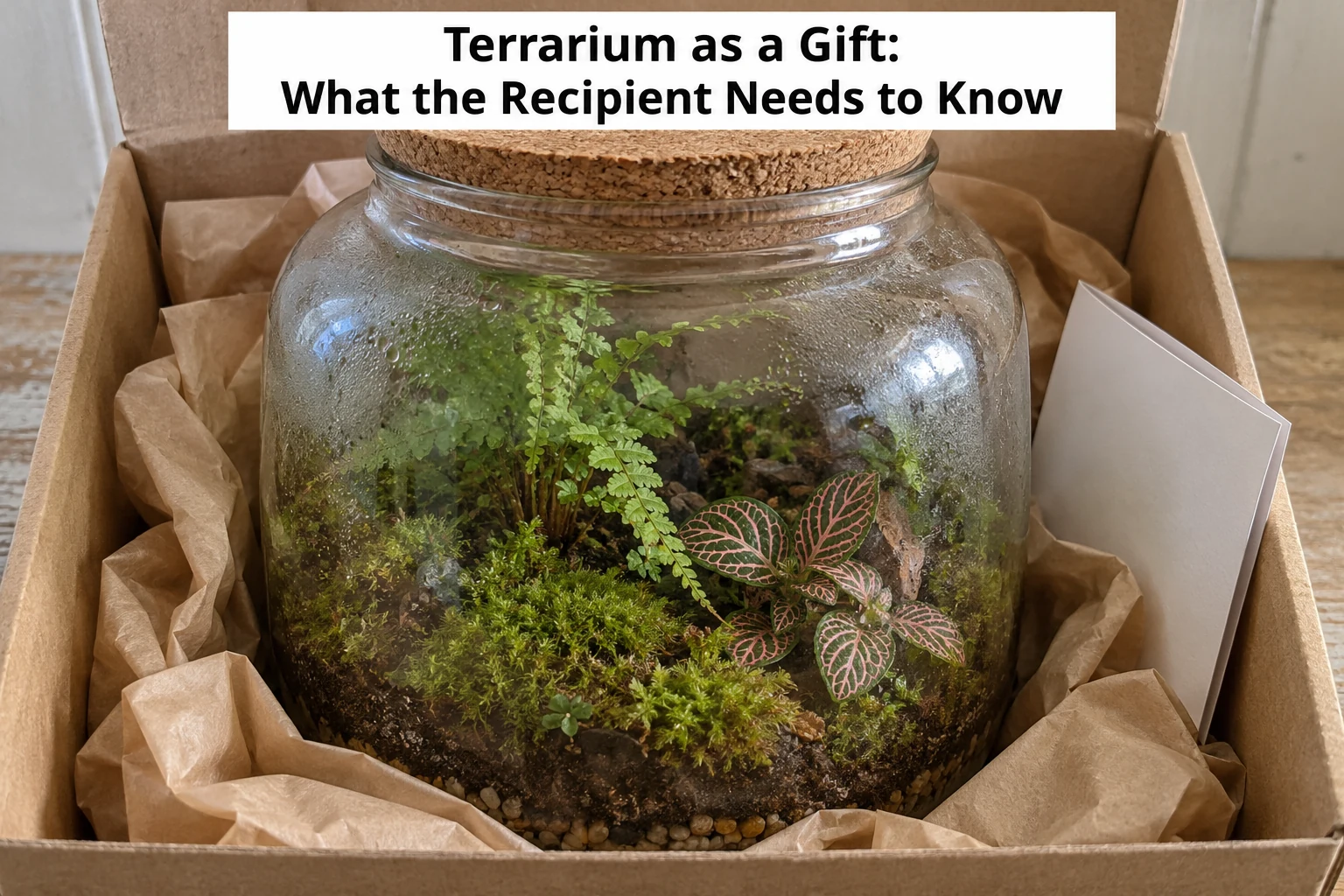
“I would give a settled terrarium with clear care notes rather than hand over a fresh build and hope the recipient guesses correctly. The useful gift is the jar plus an explanation of its light, lid and watering needs. Naming the plants and describing the jar’s normal condensation gives the recipient something specific to check before watering out of habit.”
Is a Terrarium as a Gift a Good Idea?
For the right person, yes. The University of Georgia College of Agricultural and Environmental Sciences ran a holiday gifting piece, “Tiny gardens make perfect gifts for the holidays” (Christina Conner, December 13, 2017, read on 2026-10-02), in which UGA Trial Gardens manager Brandon Coker said: “A terrarium is a great option for people who like the idea of plants, but don’t have the space or time to plant an outdoor garden.”
That describes a lot of people in apartments, shared rooms and offices. It does not describe everyone. A terrarium is a poor fit for:
- Someone who loves to water. A closed jar recycles its own moisture, and an enthusiastic waterer can drown it.
- Someone about to move house. Transit is hard on glass and on a settled build.
- A home whose only bright spot is a sunny sill. Glass in direct sun overheats.
- A household with a cat that chews plants, unless every plant has been checked first.
The honest test is simple: picture where the jar will sit and who will touch it. If either answer is shaky, choose a different gift or a different kind of terrarium.
Match the Terrarium to the Person, Not the Occasion
Most gift guides sort terrariums by occasion: birthdays, housewarmings, thank-yous. The occasion tells you nothing about whether the plants will live. The recipient’s habits and home do.
The first decision is open or closed, and our guide to choosing between an open and a closed terrarium covers the difference in depth. For gifting, it maps onto people like this:
| The recipient | Better choice | Why it suits them |
|---|---|---|
| Forgets plants exist | Closed jar with humidity-loving plants (ferns, mosses, fittonia) | It recycles its own water and asks for very little |
| Enjoys tending plants, has a bright room | Open container with succulents or cacti | It dries out and needs regular watering, which gives them something to do |
| Works at a desk with steady indoor light | Small closed jar | Low effort, compact, nothing to spill |
| Wants a project, not an object | The materials and a build session together | They learn how it works, so they can keep it working |
| Moving home in the next few months | Wait, or choose an open container | A settled closed build is the hardest kind to transport |
The last row matters more than it looks. A gift that has to survive a house move a month after it arrives is a gift with two chances to fail.
The Mismatches Common in Gift Terrariums
Many ready-made gift terrariums are designed to look good on the day, not to last. Four pairings come up again and again, and they are worth avoiding whether you buy or build.
Succulents sealed in a closed jar. They look tidy under a lid, but they want dry air. In the same UGA piece, Coker advised: “Avoid succulents, as they need excellent drainage to survive, which is very difficult to maintain in terrariums.” If the container has a lid, the plants inside should be ones that like humidity.
Air plants shut inside glass. Air plants (Tillandsia) need to dry out after watering. A sealed globe keeps them damp, which is the opposite of what they need.
Fast growers crammed in for instant fullness. University of Vermont Extension’s Creating a Garden in a Terrarium (Deborah J. Benoit, Extension Master Gardener, January 5, 2023, read on 2026-10-02) warns that “plants not suited to growing inside the limited space of a terrarium will soon outgrow the container and overcrowd their companion plants.”
Decorative extras that rot. Cut flowers, dried stems and untreated wood scraps can soften and grow mold in a humid jar.
Build It Weeks Ahead, Not the Night Before
A freshly built closed terrarium goes through a settling period. Condensation swings from heavy to light, a few leaves may yellow or drop as plants adjust to new conditions, and disturbed soil can show a little surface mold. All of that is normal for a new build. To a recipient who has never seen a terrarium settle, it looks like the gift is dying.
The fix is timing. If you are making the terrarium yourself, build it early enough to watch it through that adjustment, ideally a few weeks before the occasion. Our guide to how long a closed terrarium takes to stabilize covers how long that settling period tends to run.
Building early has a second benefit: you learn the jar. You will know whether it fogs heavily each morning, whether it needed opening to dry out, and which plant is growing fastest. That is exactly the information the recipient needs, and you can only pass it on if you have watched the terrarium for a while yourself.
If you are buying one, ask the seller how long ago it was planted. A jar that has already settled is a safer gift than one assembled that morning.
Getting It There in One Piece
The trip from your home to theirs is one of the riskiest moments in a gift terrarium’s life. Glass breaks, decorative stones shift and crush plants, and a car parked in the sun can heat a sealed jar fast. University of Vermont Extension advises against direct sunlight “as the glass will magnify the sun’s rays and overheat the environment,” and a parked car’s dashboard or passenger seat is direct sunlight with nowhere for the heat to go.
A few habits reduce the risk:
- Carry it upright in a box, padded on all sides so it cannot slide or tip.
- Secure loose hardscape before you go, or remove small stones and add them on arrival.
- Skip watering in the days before, so the substrate is not saturated when it gets jostled.
- Never leave it in a parked car, in either hot or cold weather.
- Wrap the box, not the glass. Wrapping paper around the box is fine. Plastic film tight around an open container traps humidity the plants were not chosen for.
For longer journeys, our guide to moving a terrarium without breaking it looks at what tends to break in transit and how to prevent it.
What to Tell the Recipient: The Care Card
This is the part nearly every gift guide skips, and it decides whether the terrarium lives. The recipient did not build it, does not know what is inside it, and will treat it like any other houseplant unless told otherwise. A short handwritten card fixes that.
A useful card answers six questions:
- What kind is it? Open or closed, and whether the lid stays on.
- Where should it go? University of Vermont Extension’s advice is a spot “with bright light but avoid placing in direct sunlight.”
- How much water? For a closed jar, the same source says to “water sparingly by misting or adding spoonfuls of water,” and notes that a well-sealed terrarium may not need water for months. Our guide on how often to water a closed terrarium goes into more detail.
- What does normal look like? Some condensation on the glass is normal. If excess moisture builds up on the inside of the glass, UVM’s advice is to “briefly open the lid.”
- What needs trimming? UVM notes plants “may need to be groomed periodically with pruning.”
- What are the plants called? Names let the recipient look things up, including toxicity.
A care card you can copy
This is a closed terrarium. Keep the lid on.
Put it somewhere bright, out of direct sun.
It rarely needs water. If the glass stays dry for weeks, add a few spoonfuls.
Some fog on the glass is normal. If it is heavy all day, take the lid off for an hour.
Trim anything that touches the glass.
Plants inside: (list them here by name).
Add a line inviting questions. A recipient who can ask “is this normal?” is far less likely to overwater in a panic.
Pets and Small Children in the Recipient’s Home
If a pet has already chewed a terrarium plant, contact your veterinarian or the ASPCA Animal Poison Control Center at (888) 426-4435. The ASPCA’s poison control page, read on 2026-10-02, states that the line is open around the clock and that a consultation fee may apply.
Before giving a terrarium to a home with cats or dogs, check every plant inside against the ASPCA’s Toxic and Non-Toxic Plants list (read on 2026-10-02). The ASPCA notes that the list covers the most frequently encountered plants and asks readers to “check the name of the plant to determine its toxicity,” which is another reason the care card should name every plant. A plant missing from the list is not confirmed safe, so ask a vet if you are unsure.
Small children raise a different issue: glass. A terrarium belongs on a stable, high surface where it cannot be pulled down, and a lid that lifts off easily invites curious hands.
What a Gift Terrarium Cannot Promise
Gift listings often describe terrariums as self-sustaining or able to last forever. It is better not to repeat that on your card.
A closed terrarium can go a long time with little help, but the plants inside are alive and keep growing. Sooner or later something will touch the glass, crowd its neighbor or outgrow the space, and the recipient will need to trim it or replace a plant. A leaf turning yellow is not automatically a failure; it can simply be a plant doing what plants do.
Open terrariums need more care, not less. They lose water like any potted plant and need watering on a rhythm that depends on the room.
Set the expectation honestly: this is a small garden that needs very little, not a decoration that needs nothing. A recipient who expects occasional trimming will enjoy doing it. A recipient told it runs forever will feel they broke it the first time a plant struggles.
Frequently Asked Questions
Is a terrarium a good gift for someone who kills houseplants?
Often, yes, if it is a closed terrarium with humidity-loving plants and the card says clearly that it rarely needs water. A closed jar removes most of the reasons to water at all. The risk is the recipient watering it anyway out of habit, which is why the care card matters.
How far ahead should I make a terrarium gift?
Long enough to see it through its settling period, ideally a few weeks. A brand-new closed build often swings between heavy and light condensation and may drop a few leaves. You want those swings to happen in your home, where you know they are normal, not in theirs.
Can I wrap a terrarium for a gift?
Wrap the box it travels in, not the glass itself. Paper around an open container is fine for a short time, but plastic film tight around it traps humidity. A closed jar can simply keep its lid on, with a ribbon and the care card tied around the neck.
Do gift terrariums need watering?
It depends on the type. A well-sealed closed terrarium may go months without added water, according to University of Vermont Extension. An open terrarium dries out like any potted plant and needs regular, light watering. Tell the recipient which kind they have, because the two need opposite habits.