
Open vs Closed Terrarium: Which Should You Build?

The difference between an open and a closed terrarium comes down to one thing: a lid. A closed terrarium is sealed, so it recycles its own water in a tiny climate cycle and needs almost no watering once it settles. An open terrarium has no lid, so air moves through it, moisture escapes, and you water it regularly. That single choice decides which plants will live for you. Closed suits humidity lovers like ferns and moss. Open suits dry plants like succulents, cacti, and air plants. If you tend to forget your plants, a balanced closed terrarium is more forgiving. If you tend to overwater and panic at condensation, open is the safer place to start.
A first sealed jar built straight from a Western tutorial will often mold over within a couple of weeks in a hot, humid room, because the tutorial never accounted for the climate it would be built in. So this is not a neat differences table that leaves you to guess which side you belong on. It is here to help you pick the setup that will not fail on you.
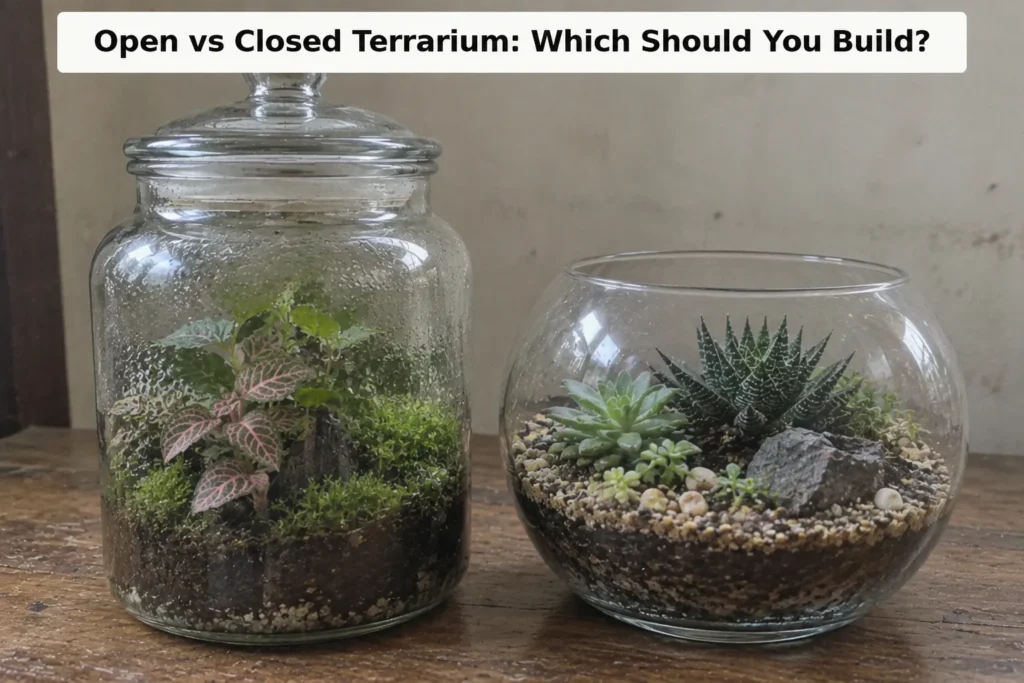
“In my own builds, open and closed terrariums have never felt like interchangeable styles, because they behave like two completely different kinds of care. Closed terrariums have always been the more forgiving option for me when I want a stable little system that can mostly look after itself, especially with moss, fittonia, and small ferns. Open terrariums, on the other hand, ask for much more attention than people think, because they dry faster, show stress sooner, and punish small watering mistakes in a different way. Over time, I have come to see closed builds as the better choice when I want consistency, and open ones as something I only build when the plants themselves clearly want more air, more drying, and a less sealed environment.”
The one-sentence difference: sealed water cycle vs open airflow
A closed terrarium is a sealed glass container. Water evaporates from the soil and leaves, condenses on the glass, and drips back down. That loop is why a well-balanced sealed jar can go weeks, sometimes months, without you opening it. It is a self-contained water cycle, not just a plant in a jar with a lid on top.
An open terrarium has no seal. Air circulates freely, moisture leaves the container, and you replace it by watering. Because the humidity stays lower and the air keeps moving, mold has a much harder time taking hold. The trade is that you become the water cycle. Skip watering for too long and an open setup dries out.
Everything else, which plants thrive, how often you fuss over it, what tends to kill it, flows from that one structural fact.
Closed terrarium: how it works, what thrives, what goes wrong
How it works. You seal a jar or bottle with plants, substrate, and a drainage layer, then let it find its balance. Once the water cycle settles, the glass shows a light fog in the morning that clears through the day. That gentle fog is the sign it is breathing correctly.
What thrives. High-humidity, low-light tropical plants love a sealed jar. Moss is the safest starting plant. Small ferns, fittonia (nerve plant), and peperomia all do well in that warm, moist air. For a fuller shortlist, see my notes on the best plants for a closed terrarium, because plant choice is where most sealed jars are won or lost.
What goes wrong. Mold and overwatering are the classic closed-terrarium failures, and they are usually the same mistake wearing two faces: too much water and not enough airflow. Add a plant that hates humidity, like a succulent, and it rots. Add too much water at the start and the glass fogs solid all day, which is your warning that the balance is off. This is exactly how my first build died, and I wrote the full autopsy in how I killed my first terrarium in two weeks. If mold or heavy fog is already showing up, my guide to terrarium mold and condensation walks through the fix.
The upside is real, though. Once a closed terrarium is genuinely balanced, it is the most hands-off living thing you can keep. Forgetting about it is a feature, not a risk.
Open terrarium: how it works, what thrives, what goes wrong
How it works. No lid, so the container relies on room air. Moisture evaporates and you top it up by watering, usually a light drink every week or so depending on the plants and how warm your room is.
What thrives. Dry-loving plants that would rot in a sealed jar are right at home here: succulents, cacti, and air plants (Tillandsia). These want airflow and dry-out cycles between waterings, which an open container gives them and a closed one never can.
What goes wrong. Two things kill open terrariums for beginners: drying out and dust. Miss your watering rhythm during a dry spell and the plants desiccate. Leave an open container on a shelf for months and dust settles on the leaves and inside the glass. Neither is dramatic, but both are on you to prevent, because there is no self-watering cycle catching your mistakes.
The upside is forgiveness of a different kind. Because the air moves and the humidity stays low, an open terrarium rarely molds. If overwatering and fuzzy panic are your weak spots, that lower mold risk matters more than it sounds.
The decision framework: three inputs, not a coin toss
Most guides list the differences and leave you to guess. Here is how I actually decide, using three inputs in order.
1. Start with the plants you want. This is the tiebreaker, because plants do not compromise. Want moss carpets, ferns, and that jewel-toned nerve plant? You need a closed, humid setup. Drawn to little succulents, a jade, or air plants? You need an open, airy one. Pick the look you love first, then let it dictate the container. Trying to force the wrong plant into the wrong box is the single most common beginner mistake I see.
2. Then factor in your room’s climate. A closed jar amplifies whatever humidity you already have. In a cool, dry Western room, sealing in moisture is helpful. In a hot, humid room like mine in Dhaka, a closed terrarium can tip into permanent heavy fog and mold far faster than the tutorials warn. More on that caveat below.
3. Then be honest about your neglect tolerance. How the setup handles you matters. If you travel, forget, and go weeks without checking on things, a balanced closed terrarium survives that better than anything. If your failure mode is the opposite, fussing, overwatering, and reacting to every drop of condensation, an open terrarium removes the exact temptations that would sink a sealed one.
Here is the same logic in a quick reference.
| Question | Closed terrarium | Open terrarium |
|---|---|---|
| Has a lid? | Yes, sealed | No |
| Water source | Recycles its own | You water regularly |
| Watering frequency | Rarely, once balanced | Weekly-ish |
| Best plants | Ferns, moss, fittonia, peperomia | Succulents, cacti, air plants |
| Humidity | High | Low |
| Main risk | Mold, overwatering | Drying out, dust |
| Survives neglect? | Yes, if balanced | Only if you keep watering |
| Beginner note | Forgiving once set up right | Simpler to understand day one |
Which is easier for a true beginner? The honest take
You will read everywhere that open terrariums are more beginner-friendly, and for the first few weeks that is true. Open setups are simpler to understand: air gets in, you water when the soil dries, mold rarely shows up. There is less that can go mysteriously wrong while you are learning to read a terrarium.
But here is the nuance those pages skip. Over the long run, a properly balanced closed terrarium is more forgiving of the most common beginner sin, which is forgetting to water. Open terrariums are easier to start and easier to neglect to death. Closed terrariums are harder to balance at the start and then almost impossible to kill through inattention. So “easier” depends on whether your struggle is the setup or the follow-through.
The tropical caveat. If you live somewhere hot and humid, the usual advice shifts. In my Dhaka apartment, sealed jars fog heavily and invite mold much more readily than any Western guide admits, because the ambient air is already saturated. If that is your climate, I would lean a beginner toward an open setup first, or toward a closed one built with a proper cleanup crew of springtails from day one and a more cautious first watering. Climate is not a footnote here. It changed how I build every jar.
Can you convert one to the other?
Yes, and it is easier than people assume. To turn an open terrarium into a closed one, add a lid and swap in humidity-loving plants, because your succulents will rot in the new sealed climate. Then let it find balance and watch the condensation. To go the other way, remove the lid, let the humidity fall, and replace the moss and ferns with dry-tolerant plants over time.
The catch is always the plants, not the glass. The container converts in a second. The living things inside it do not. So a conversion is really a replant, and it is worth planning as one.
My pick for most first-timers, and why
If you are nervous and want the highest odds of keeping something alive, I usually steer first-timers toward a closed terrarium built correctly, with moss and one or two forgiving plants and springtails in from the start. Once it balances, it asks almost nothing of you, and that hands-off quality is what turns a nervous beginner into someone who keeps going.
The honest exception is my own climate. In a hot, humid room, or if you already know you overwater, start open with a couple of hardy plants, learn to read a terrarium, and graduate to sealed later. Either way, match the plant to the container and you have won most of the battle. If you want the exact build, follow my step-by-step guide to building a closed terrarium, and if you just want the hardest plants to kill, start with low-maintenance terrarium plants ranked by neglect tolerance.
Frequently asked questions
Is an open or closed terrarium better for beginners?
Open terrariums are simpler to understand in the first weeks because they have airflow, rarely mold, and follow familiar water-when-dry logic. But a properly balanced closed terrarium is more forgiving long term, since it recycles its own water and survives you forgetting about it. In a hot, humid climate, lean open first or build closed carefully with springtails.
Can succulents go in a closed terrarium?
No. Succulents and cacti need dry air and dry-out cycles between waterings, so the trapped humidity of a sealed jar rots them. They belong in an open terrarium. For plants that actually thrive sealed, see my list of the best plants for a closed terrarium.
Should my terrarium have a lid?
Add a lid only if you are growing humidity-loving plants like ferns, moss, and fittonia and you want a low-watering, self-recycling setup. Skip the lid if you are growing succulents, cacti, or air plants, which need airflow and would rot when sealed.
Which one needs less watering?
A closed terrarium, by a wide margin. Once its water cycle is balanced, it can go weeks or longer without watering because moisture condenses and drips back down. An open terrarium needs regular watering, roughly weekly, since moisture escapes into the room.
Can I turn an open terrarium into a closed one?
Yes. Add a lid and replace the dry-loving plants with humidity lovers, because succulents will rot once the jar is sealed. Then let it balance and watch the condensation. The container converts instantly, but the plants have to be swapped, so treat it as a replant.