
Terrarium Mold ID: Fuzz vs Cobweb vs Slime Mold

Four different growths get lumped together as “terrarium mold”: powdery white fuzz, fast-spreading cobweb mold, bright-colored slime mold, and harmless mycelium threads. They are not the same thing, they do not behave the same way, and they do not call for the same response. The fastest way to tell them apart without a lab is growth pattern and speed, not color alone: mycelium stays structured and close to the substrate, cobweb mold spreads into a visible web within a day or two, slime mold appears suddenly as a soft colored mass rather than a fuzz, and ordinary white mold sits as a dense, cottony patch that grows steadily rather than explosively.
No appearance-only identification, including everything in this guide, tells you the exact species. What it can tell you is which broad category you are probably looking at and what that category typically means for a sealed jar. Treat the guide below as narrowing the question, not closing it.
Why a photo alone cannot give you a species
Fungal identification down to species level generally requires spore examination or lab culturing, not a photo of the growth on a substrate. University extension services and mycology references are consistent on this point: color and shape alone are unreliable for species-level identification, even for trained observers, because many unrelated organisms converge on similar appearances at a glance. What is reliable from observation is category-level pattern-matching: is this fuzzy and cottony, wispy and web-like, a soft colored blob, or fine threads running through the substrate. That is the level this guide works at, and it is also the level that is actually useful, since the response is driven by category and behavior rather than by species name.
The four growth patterns
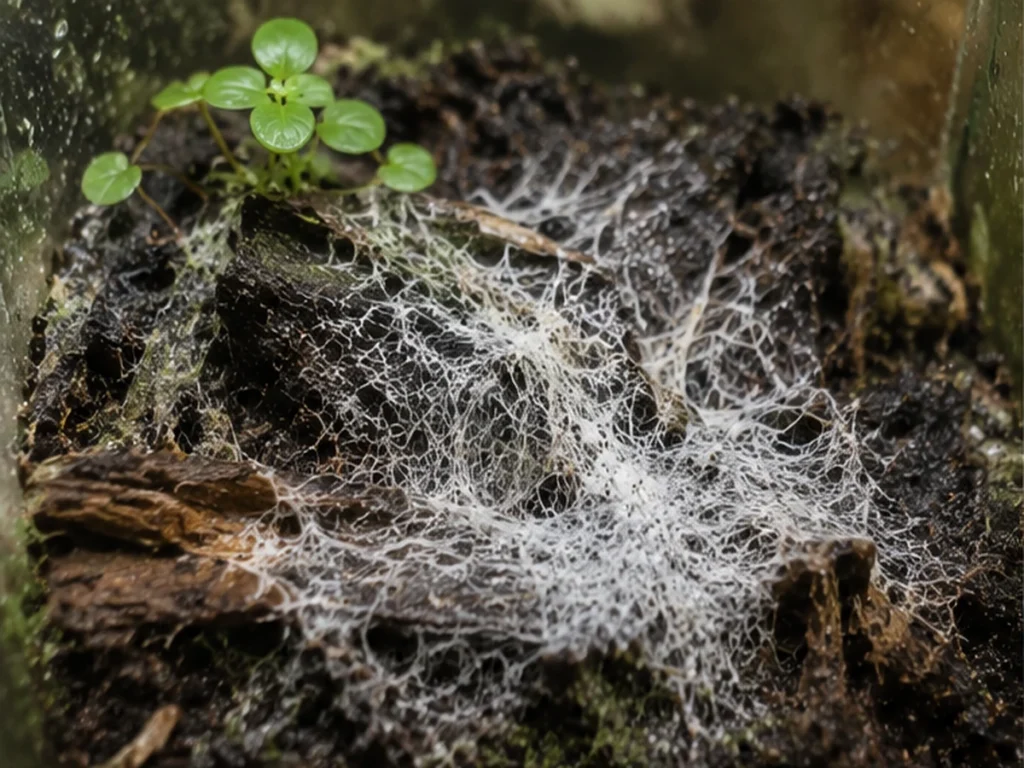
Mycelium: fine white threads, often harmless
Mycelium is the vegetative body of a fungus, fine, hair-like, usually bright white threads that run through the substrate, along wood, or across leaf litter. It is a normal and expected part of decomposition in a bioactive setup, particularly one with cork bark, driftwood, or other decomposing wood in it. Healthy mycelium tends to stay bright white, stays structured rather than exploding outward overnight, and is generally described by mycology sources as a sign of an active, balanced decomposition process rather than a problem to remove.
Mycelium is frequently mistaken for mold and torn out unnecessarily. If threads are running along or through wood, staying close to the substrate, and not spreading onto living leaf tissue, that pattern is consistent with ordinary mycelium rather than a problem growth.
Ordinary white or gray mold: dense, cottony, slower spreading
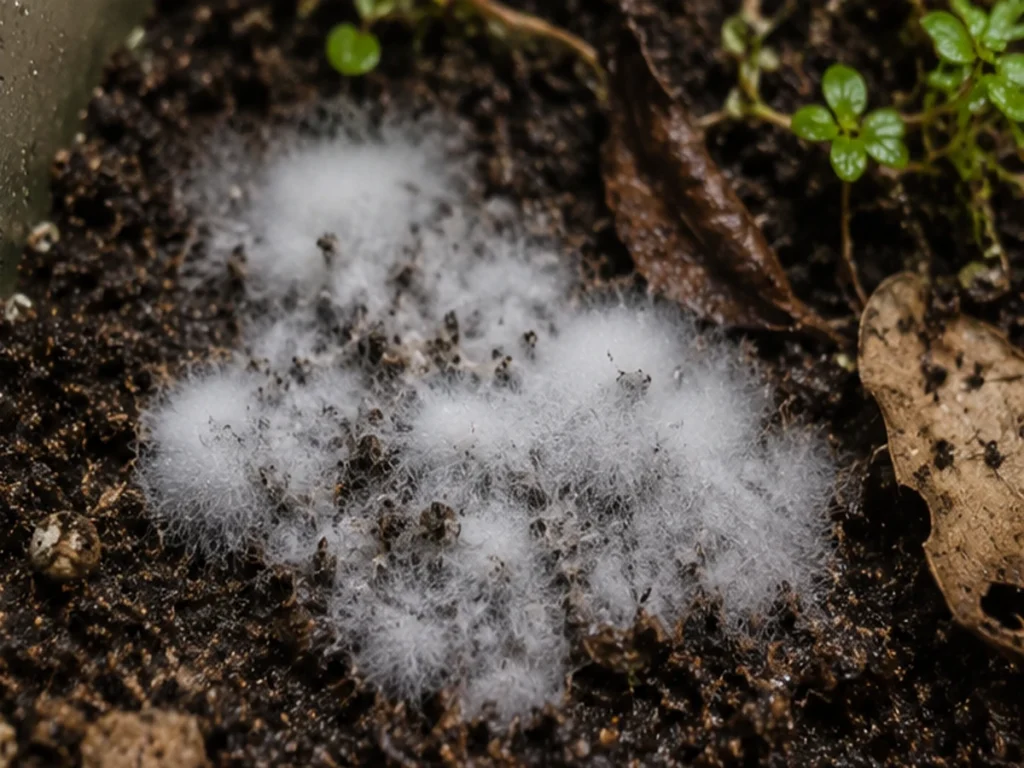
This is the common “there is fuzz on my substrate” growth most new builders encounter in the first weeks. It typically presents as a dense, cotton-like or powdery patch sitting on top of the substrate, on decaying leaf litter, or on a cut plant stem, sometimes taking on a gray or slightly greenish cast as it matures. It grows over days rather than appearing overnight, and it tends to stay put on the surface it started on rather than throwing out visible webbing.
This growth pattern is generally associated with excess surface moisture and available organic matter to feed on: a dropped leaf, a dying stem, overwatered substrate. It is the pattern the mold and condensation guide covers for removal and prevention.
Cobweb mold: fast, wispy, web-like
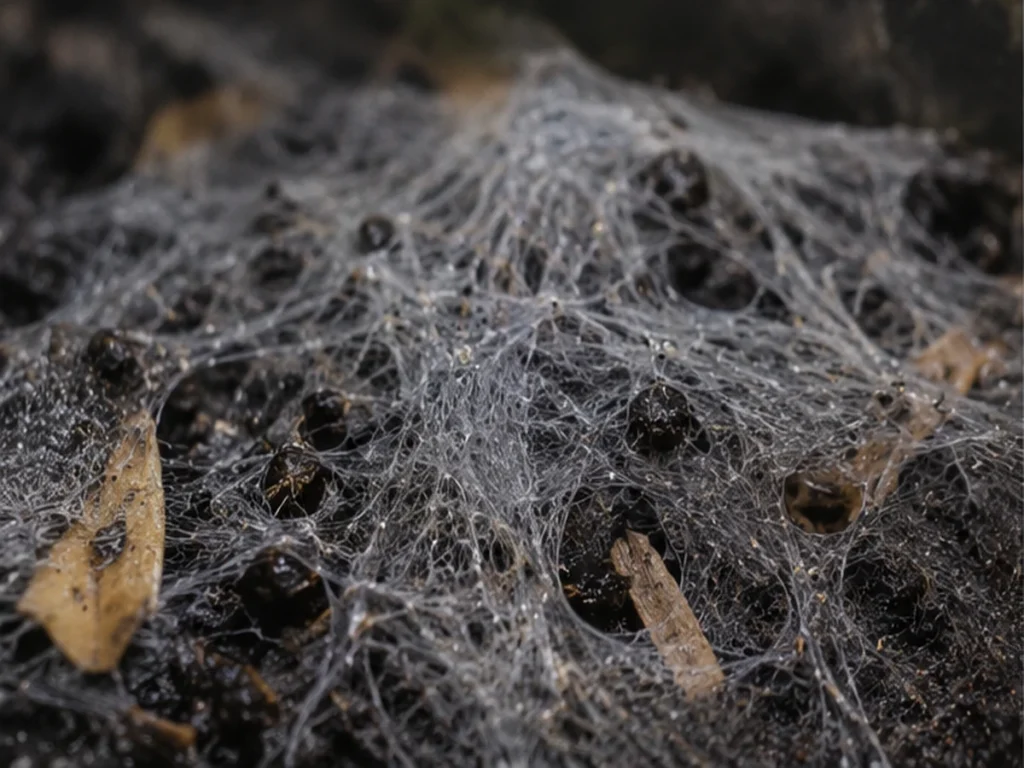
Cobweb mold gets its name honestly. It presents as a light gray, wispy growth that forms visible strands resembling a spiderweb across the surface it is growing on, and its defining feature is speed: it is commonly reported to cover a significant area within 24 to 48 hours, far faster than ordinary surface mold. It is also commonly associated with a musty, mildew-like smell where it grows in quantity.
The speed and the web-like structure, rather than color, are what separate it from ordinary fuzzy mold. If a patch of white fuzz doubled in size or genuinely webbed across the surface in a day or two, cobweb mold is a more likely category than the slower-growing ordinary kind.
Slime mold: sudden, soft, and often colored
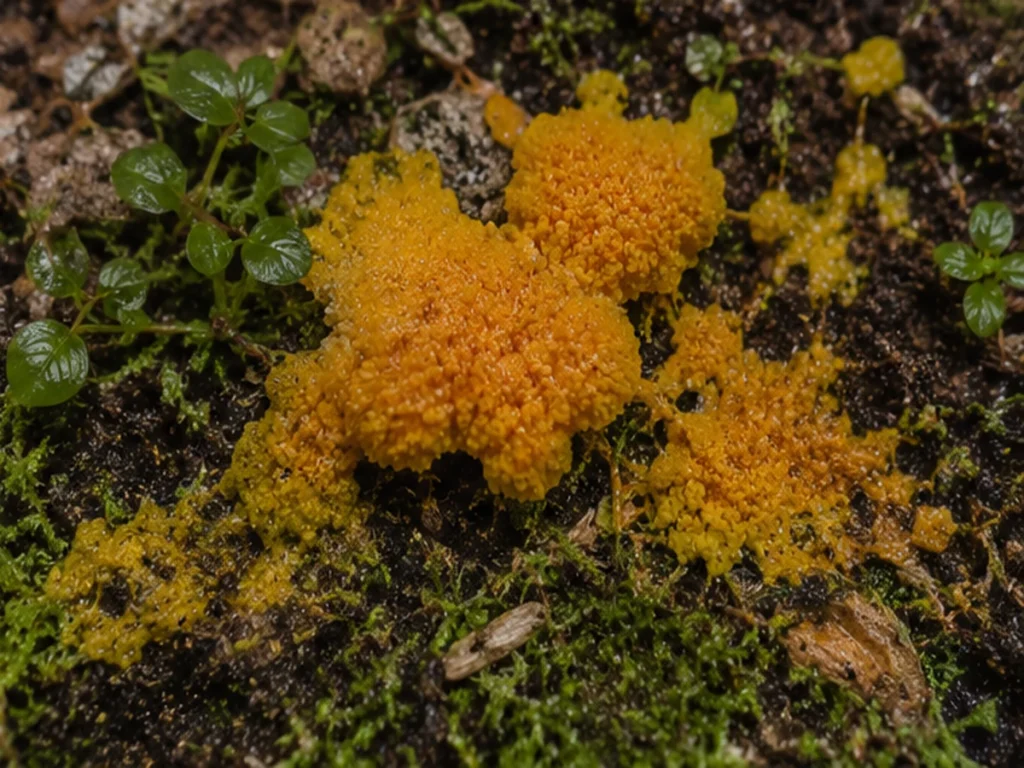
Slime mold is a different kind of organism altogether, and it is worth naming precisely rather than lumping it in with fungal mold. Despite the common name, it is not a fungus; it belongs to a group called myxomycetes, more closely related to amoebas than to mold or mushrooms. According to the Missouri Department of Conservation’s field guide to the species, the most commonly encountered example, dog vomit slime mold (Fuligo septica), appears as a soft, amorphous, sometimes foamy or scrambled-egg-textured mass that ranges from white to bright yellow or orange in its active stage, before drying into a flatter, crustier, darker form.
What makes slime mold recognizable is how suddenly it appears, often overnight, as a soft blob rather than a gradual fuzz, and how differently it looks from anything fungal: brighter color, a wetter or foamier texture, and no fine threading. The same Missouri Department of Conservation reference describes it as not toxic and notes that it typically disappears on its own in a matter of days, about as quickly as it appeared. That reference describes the organism generally, in outdoor settings such as mulch beds, rather than inside terrariums specifically, so treat it as background on what the organism is rather than terrarium-specific guidance.
A side-by-side summary
| Appearance | Speed | Typical location | What it usually indicates | |
|---|---|---|---|---|
| Mycelium | Fine white threads, structured | Gradual, stays put | Running through wood or substrate | Normal decomposition |
| Ordinary mold | Dense, cottony, may gray with age | Days | Substrate surface, dead leaves, cut stems | Excess surface moisture, organic matter to feed on |
| Cobweb mold | Wispy, web-like strands | 24 to 48 hours | Spreads across surfaces broadly | Very high humidity, still air, fast-feeding conditions |
| Slime mold | Soft, blob-like, often yellow or orange | Appears suddenly | On substrate or mulch-like material | A distinct organism, not a fungus; not linked to build failure the way mold is |
What none of this proves
None of the patterns above prove the growth is safe or unsafe to be near, and this guide does not make that call. What they indicate is category and likely cause; what they do not prove is species identity, and species identity is what would actually be needed to make a safety claim with any confidence.
Sensible precautions if you are disturbing or removing a growth
A sealed jar concentrates whatever is growing inside it, so if you are removing visible mold, cobweb growth, or slime mold, it is reasonable to open the lid and let the air exchange for a few minutes before working inside it, avoid putting your face close to the opening while disturbing the growth, and wash your hands afterward. Anyone with asthma, mold allergies, or a compromised immune system should be more cautious around any visible mold growth generally, and should speak with their own doctor about their specific situation rather than relying on general guidance like this. That is where this guide stops; it is not medical advice and does not attempt to be.
When the pattern points at a build problem
Mycelium and slime mold are generally not signs that something is wrong with the build itself. Ordinary mold and cobweb mold, by contrast, both point back at excess moisture, poor airflow, or organic matter breaking down faster than the system can process it, which usually traces to a specific build decision: too much water at the first watering, an undersized drainage layer, or unprepared hardscape. The troubleshooting pillar walks through how to trace a visible symptom back to the build step behind it.
FAQ
Can I identify the exact species of mold in my terrarium from a photo?
Not reliably. Category-level identification (mold vs mycelium vs slime mold) is possible from growth pattern and behavior; species-level identification generally requires spore examination or lab culturing, which is outside what any appearance-based guide, including this one, can offer.
Is the white fuzz in my terrarium dangerous?
This guide does not make that determination, because it depends on factors an appearance-only guide cannot verify. What is reasonably well established is that ordinary surface mold and cobweb mold both indicate excess moisture and organic matter, and both are addressed by improving airflow, cutting back watering, and removing decaying material. Anyone with respiratory sensitivities should be cautious around any visible mold and consult their own doctor.
How is slime mold different from regular terrarium mold?
Slime mold is not a fungus at all; it belongs to a different group of organisms (myxomycetes) more closely related to amoebas. It tends to appear suddenly as a soft, often brightly colored mass, rather than as a gradual fuzzy patch, and according to the Missouri Department of Conservation it generally disappears on its own within a matter of days.
I see white threads running through the wood in my terrarium. Should I remove them?
If the threads are fine, structured, staying close to the wood or substrate, and not spreading onto living leaves, that pattern is consistent with mycelium, which is a normal part of decomposition rather than a problem growth. If it is instead spreading rapidly, forming a visible web, or moving onto living plant tissue, treat it as the mold category instead.
Does removing mold or slime mold from a sealed terrarium fix the underlying cause?
Removing the visible growth addresses the symptom, not the cause. If the growth was ordinary mold or cobweb mold, the underlying cause is usually excess moisture or organic matter, which needs a separate fix at the source; see the mold and condensation guide for that step.