
Brown, Crispy Leaves in a Closed Terrarium: Why

Crispy, dried-out leaf edges inside a sealed, humid jar look like a contradiction, and that is exactly why the cause is usually not what it appears to be. In most closed terrariums, brown and crispy leaves mean heat, not dryness: direct or intense filtered sun hitting the glass creates a greenhouse effect strong enough to scorch leaf tissue in hours, even while the substrate underneath stays damp. A genuinely dry cause is possible too, but it almost always comes paired with a seal that has failed rather than with a properly closed jar. Checking the condensation on the glass at the same time as the leaves tells these two apart quickly.
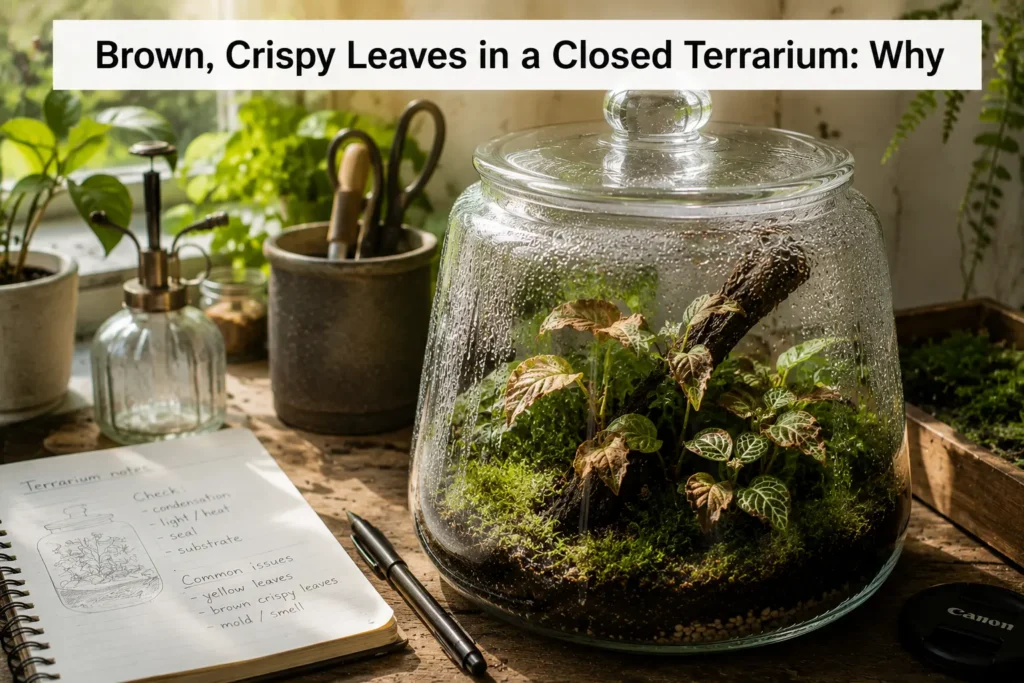
Why “crispy” reads as dry, but usually is not
Crispy, brown, curling leaf tissue is the classic visual signature of underwatering in nearly every houseplant guide, because in an open pot, that is almost always what it means. A closed terrarium is a different environment: it holds humidity by design, so a plant inside one drying out from a genuine lack of ambient moisture is comparatively rare. What is common instead is heat damage that produces the same crispy, browned appearance through a completely different mechanism, cooking the leaf tissue rather than dehydrating it slowly.
Both causes produce a visually similar result, which is why the leaf alone does not settle the question. The condensation on the glass at the time the browning appeared is the faster diagnostic.
Cross-check: what does the glass say?
Brown leaves plus normal or heavy condensation points strongly toward heat rather than dryness. If the jar is producing its usual amount of fog, or more, the system clearly has adequate water in it, which rules out simple dehydration as the cause. A sealed glass or plastic container in a sunny position behaves like a small greenhouse: light passes through the glass, warms the interior, and the heat has nowhere to escape, sometimes reaching damaging temperatures within a single afternoon even when the outside air feels moderate. If the jar was recently moved to a brighter spot, or the sun’s angle through a window has shifted with the season, that timing lines up with a heat cause more than anything watering-related.
Brown leaves plus no condensation at all is the pairing that supports a genuine dryness cause, and it should send you to a seal check rather than a watering fix. See the no condensation guide for how to test whether the lid is actually sealing; a container that has been leaking humidity steadily is the scenario where a terrarium plant genuinely dries out despite being inside a “closed” jar.
Why heat is easy to miss as the cause
Heat damage does not require the jar to feel obviously hot to the touch at the moment you check it, because the damage can happen during a window of peak sun exposure earlier in the day and the interior can have returned closer to normal temperature by the time you notice the browning. Checking whether the jar sits anywhere that receives even brief direct sun, including reflected or intensified light through a window at certain hours, is worth doing even if the current position looks like general “bright” light rather than obviously direct sun.
A jar that looked fine for weeks and then browned quickly after being repositioned, or after a seasonal light change, is a strong pattern match for a heat cause specifically.
Checking for direct sun without guessing
Rather than relying on a general impression of “bright” versus “not bright,” watch the actual jar at a few different points across a single day, especially late morning through mid-afternoon, when sun angles are typically highest. A patch of direct sunlight crossing the jar for even twenty to thirty minutes at its most intense point in the day is enough to raise interior temperatures significantly, and it is easy to miss if you only check the position once, at a time when the sun happens to be elsewhere. If a spot that seemed fine in the morning turns out to catch a shaft of direct light in the early afternoon, that window is very often enough to explain scorching that appears by evening.
What to do about it
If heat is the likely cause: move the jar out of any direct or intensified sun exposure immediately, even if the position previously looked acceptable. Bright, indirect light is the target, not a sunny windowsill. Trim off the damaged leaf tissue, since it will not recover its color or texture, and the plant will direct energy to new growth once the heat source is removed. The damage itself does not spread the way rot or mold does, so removing it is about tidiness and preventing the tissue from decaying in place, not about stopping a spreading problem.
If a seal leak is the likely cause: address the container itself before assuming the plant is at fault. Adding water without fixing a leaking seal produces only a temporary improvement, since the moisture continues to escape at the same rate. See the no condensation guide for how to test and correct the seal specifically.
What this is not
Brown leaves from heat or a seal leak are a different presentation from yellowing, which is covered separately in the yellow leaves guide and is more often linked to overwatering than to heat or dryness. Brown, crispy tissue is also different from soft, dark, mushy patches, which usually indicate rot rather than heat or dryness and are addressed in the troubleshooting pillar.
Prevention going forward
Positioning is the entire prevention strategy here, and it is worth setting correctly once rather than correcting after damage appears. Bright, indirect light, out of the path of direct sun at any point in the day, is the standing recommendation for a sealed glass or plastic terrarium. If a windowsill position cannot avoid some direct sun during part of the day, particularly in a lower-latitude, intensely sunlit climate, a position slightly back from the window, or behind a sheer curtain, reduces the greenhouse effect without moving the jar out of good light entirely.
It is also worth revisiting the jar’s position each season rather than assuming a spot that worked in one season still works in the next. The angle of the sun through a given window changes over the year, and a position that received only indirect light for months can start catching direct sun as the season shifts, without anything about the terrarium itself having changed.
FAQ
Does brown, crispy leaf tissue in a terrarium always mean it needs more water?
No, and this is the most common misdiagnosis in a sealed jar. Check the condensation on the glass first: normal or heavy fog rules out simple dryness and points toward heat instead, which is the more common cause inside a closed, humid container.
Can direct sun really damage plants through glass that quickly?
Yes. A sealed glass or plastic container concentrates light and heat in a way an open pot in the same spot does not, and temperatures inside can rise enough to scorch leaf tissue within hours of direct sun exposure, even on a day that does not feel especially hot outside the jar.
Will trimmed brown leaves grow back the same color?
No. Damaged leaf tissue does not recover; trimming it removes dead material and lets the plant direct energy toward new growth, which will be healthy if the underlying cause (usually heat) has been corrected.
My terrarium has good condensation but the leaves are still crispy. What else could it be?
With condensation present, a genuine moisture shortage is unlikely. Heat from direct or intensified light is the most probable remaining cause; check the jar’s position at a few different times of day for any direct sun exposure before considering other causes.
How is a heat-damaged leaf different from a rotted one?
Heat damage is dry, brittle, and crisp to the touch. Rot is soft, dark, and often slightly slimy. The two point in opposite directions (too hot and dry versus too wet) and call for opposite responses.