
When to Restart a Terrarium: Rebuild or Save It?

Tear a terrarium down when the failure sits in the base of the build rather than in the planting. Dead leaves, a fuzz bloom on a piece of wood, one collapsed fern: those are planting problems and they can be corrected in place. A substrate that has gone sour through its full depth, standing water that returns after you remove it, or a container that keeps producing the same failure after the cause was fixed: those are base problems, and trimming never reaches them. Base failure means restart. Everything above it means repair.
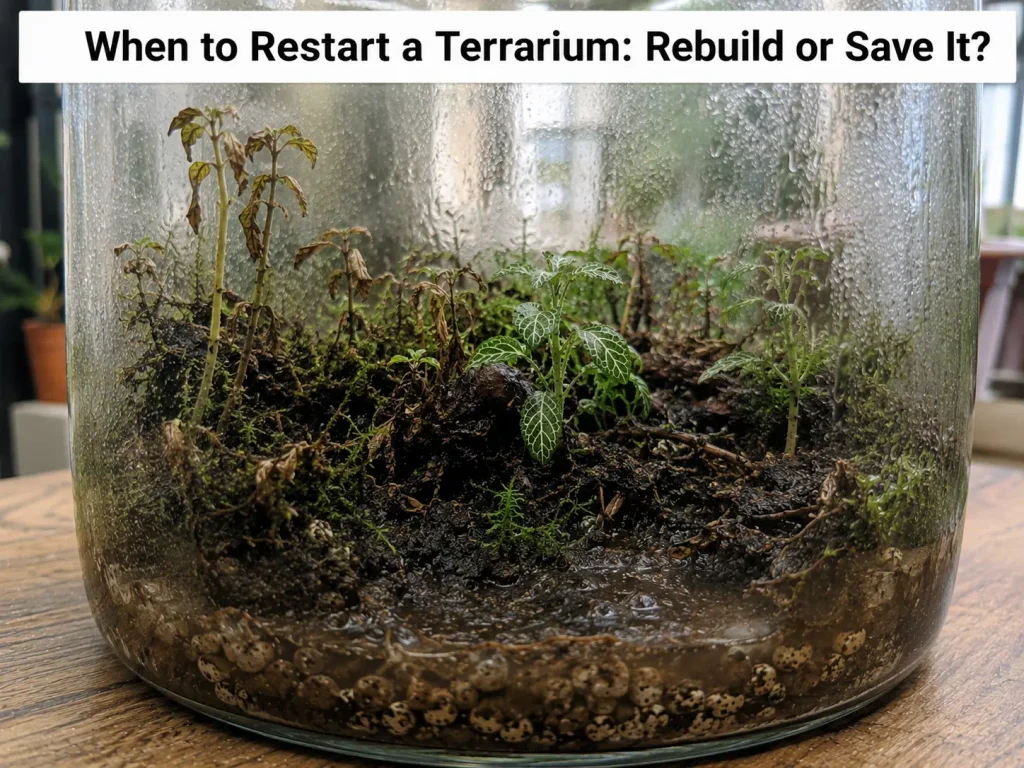
“I decide whether to save or restart a terrarium by looking at which layer actually failed, not by how bad the plants look at first glance. In my build here, some living tissue is still hanging on above a base that looks heavily compromised, so I would test the plants individually, check the smell and substrate condition, and let the deepest failed layer make the decision. If the problem is only in the planting, I repair it in place; if the substrate has gone sour, compacted, or repeatedly waterlogged, I rebuild the base rather than keep trimming symptoms.”
The three layers, and why the deepest one decides
A closed terrarium is three layers stacked, and each fails differently. The planting is the plants and moss you can see. The base is the substrate and the drainage layer under it. The shell is the container itself plus the hardscape wood and stone.
The rule that settles most of these arguments is simple. The deepest failed layer sets the decision. You can replace every plant in a jar without disturbing the base, so a total plant wipeout is not by itself a reason to restart a terrarium. You cannot replace the base without lifting the planting out, which is a teardown whether you call it one or not. And if the shell is the problem, nothing you do inside it holds.
Most people work in the wrong direction. They see dead plants, decide the whole thing is finished, and throw out a perfectly good substrate along with the container. Diagnose downward instead: planting, then base, then shell.
When to restart a terrarium: read the layer, then the verdict
Work through the build before deciding anything, using the terrarium troubleshooting guide to read the glass, the substrate and the smell in order. Once you know which layer failed, this is the call.
| Layer | Repair in place when | Restart when |
|---|---|---|
| Planting | Anything green passes a stem scratch or a firm crown check, or the species simply need replacing | Nothing living remains and the species were unsuited to a sealed jar from the start |
| Base | The sour patch is local, the drainage layer still takes water and releases it | Sour or blackened through the depth, or water pools again after you drain it |
| Shell | Glass cleans up, wood is still firm under a fingernail | Wood crumbles or slumps, the lid cannot seal, the container has no way to hold a drainage layer |
The awkward case is the middle row, because a base fault looks like a plant fault from the outside. That is what makes people nurse a corpse for weeks. Rotting roots in a waterlogged base produce yellowing, wilting and collapse in sequence, and every one of those symptoms invites you to treat the plant instead of the ground it is standing in.
The states that say it is recoverable
None of these are about how long the build has been sick. They are things you can look at today.
- Living tissue anywhere in the jar. Green under a scratched stem, a firm crown, a patch of moss still green in the middle rather than only at the tips.
- The smell is earth, not drain. An honest forest-floor smell is a working system. The line between the two, and what each one means, is the whole of why a terrarium smells bad.
- The substrate crumbles when you lift a little of it. Damp and dark is fine. Sticky, sealed and airless is not.
- Water moves. If you tilt the container and the drainage layer gives water back to a syringe or a length of tubing, the base still functions.
- The mold is on something, not in everything. Fuzz on a piece of wood or a fallen leaf sits on dead material. It is a housekeeping problem, and the flooded terrarium guide covers the water conditions that usually feed it.
- The failure has a single named cause you have not corrected yet. An uncorrected cause is not evidence the build is finished. It is evidence you have not run the experiment.
The states that say it is over
- Every plant fails every check. No green under any scratch, no firm crown, roots dark and falling apart when touched.
- The drain smell survives the cleanup. You have removed the dead material and drained the standing water, and opening the lid still smells sour or sulfurous. That smell is coming from the substrate, and the substrate is the thing you cannot clean in place.
- The substrate has gone to paste. It slumps rather than crumbles, holds a fingerprint, and has no visible air in it. Anaerobic decay does not reverse because you improved the light.
- The water comes back. You drained it, you did not add any, and the base is wet again. The drainage layer has either flooded above its capacity or was never able to separate from the substrate.
- The same failure returns after the cause was genuinely corrected. One repeat is information. It means the fault is in the build, not in the handling.
That last one is a judgment call and deserves honesty: it only counts if you actually corrected something and changed nothing else at the same time. If you moved the jar, opened the lid daily and watered it in the same week, you have no idea which change did what.
Why this page gives you no timeline
Nothing here says “give it two weeks” or “if it has not improved in ten days, start over,” and that is deliberate. No recovery timeline, mold progression rate or survival percentage was measured for this article, so none is quoted. Plenty of pages will hand you a number anyway. Ask where it came from before you plan around it.
The reason a number would be misleading even if someone had one: recovery speed depends on the species, the severity, the room temperature and how completely the original cause was removed, and those vary enormously between one shelf and another. A build in a warm Dhaka apartment and a build in a cool European room are not running the same clock. States are portable. Durations are not.
So judge on the states above and on the direction of travel. Is there more living tissue this week than last, or less? That comparison works without a stopwatch.
One boundary worth stating plainly: this site covers plants and container ecosystems. Questions about mold in your home beyond the jar, or about anyone’s health, sit outside what a plant blog should answer, and belong with a source qualified to answer them.
The option nobody names: swap the base, keep the build
The search results treat this as a binary, save it or bin it, and there is a third path that fits more failures than either. Lift the surviving plants and hardscape out, discard the substrate and drainage layer, rebuild the base, and put the survivors back. You keep the container, the wood, the stone and whatever passed the checks, and you replace only the layer that actually failed.
It is the right call when the base is finished but the planting is not, which is exactly what a slow overwatering failure produces. Clean the glass and the hardscape properly first, since anything you put back carries whatever was on it, and the method for that is in the guide to sterilizing a terrarium jar and substrate. Treat the fresh base as a fresh build with a head start, not as a continuation.
If the planting has also gone, then it is a full restart, and the closed terrarium build guide is where to begin again rather than reassembling from memory.
The salvage inventory
| Part | Keeps | Notes |
|---|---|---|
| Glass container | Yes | Wash and dry it fully. Damage to the lid seal is the one thing that retires a jar. |
| Stone | Yes | Rinse and scrub. Stone does not carry rot the way wood does. |
| Hardscape wood | Only if firm | If a fingernail sinks into it or it has gone spongy, it is now substrate. |
| Drainage gravel or LECA | Usually | Rinse thoroughly. If it sat inside the sour zone, replace it. It is the cheapest part of the build to renew. |
| Substrate | No | If the base failed, this is the failure. Reusing it reimports the problem. |
| Moss | Partly | Keep sections that are green through the middle. Tip-green, brown-based moss is not worth carrying across. |
| Plants | Test individually | A build can look almost entirely dead and still hold two viable pieces. Test each one rather than the jar as a whole. |
| Cleanup crew | Assume not | Springtails and isopods live in the substrate, so discarding it discards the colony unless you deliberately move a scoop across. |
What a restart does not fix
A rebuild replaces the build. It does not replace the conditions the build was living in. If the jar was sitting where afternoon sun hits it, if the room runs hot, if the lid never sealed, or if the plant list was wrong for a sealed container, then a brand new build in the same place fails the same way with better-looking materials. Work out what killed the first one before you spend on the second, which is what the post-mortem checklist exists for.
This is also the honest argument for restarting earlier than instinct suggests. A build you keep nursing is a build you keep learning nothing from. A rebuild with one variable deliberately changed, a different plant, a different position, a coarser substrate, tells you something the nursing never will.
FAQ
Is mold on its own a reason to start over? No. Fuzz on wood or on a fallen leaf sits on dead material and is a housekeeping problem, not a structural one. Mold matters for this decision only when it appears alongside a sour substrate and failing roots, which points at the base rather than at the surface.
Can I reuse the substrate from a failed terrarium? If the substrate was the failure, no. Sour, compacted or waterlogged substrate carries those conditions straight into the new build. If the failure was clearly elsewhere, for example the wrong plants or the wrong position, the substrate may be fine and worth keeping.
How long should I wait before deciding to tear it down? There is no number here, because none was measured for this article. Decide on states instead: living tissue, the smell, whether the substrate crumbles, and whether there is more or less green than last week.
Can I keep the same jar after a rot failure? Yes, in almost every case. Glass carries nothing once it is washed and dried. The exceptions are a lid that no longer seals and a container with no practical depth for a drainage layer.
Should I rebuild in the same spot? Only if you have ruled the spot out as the cause. Light, direct sun and room heat are the failures that follow you from one build to the next, and they are the ones a fresh set of materials hides for a few weeks before repeating.