
Recycled Jar Terrarium: Which Jars Seal Well Enough

The jam jar is washed and waiting, and the question is whether it can hold a real closed ecosystem or will only look like one.
Most recycled glass jars can hold a closed terrarium, because a closed build needs a lid that keeps water vapor in, not an airtight seal. The jars that work have clear, untinted glass, a mouth wide enough to work through, and a lid that sits evenly without a rusting metal face. The reliable check is a test run with a damp paper towel before any plant goes in.
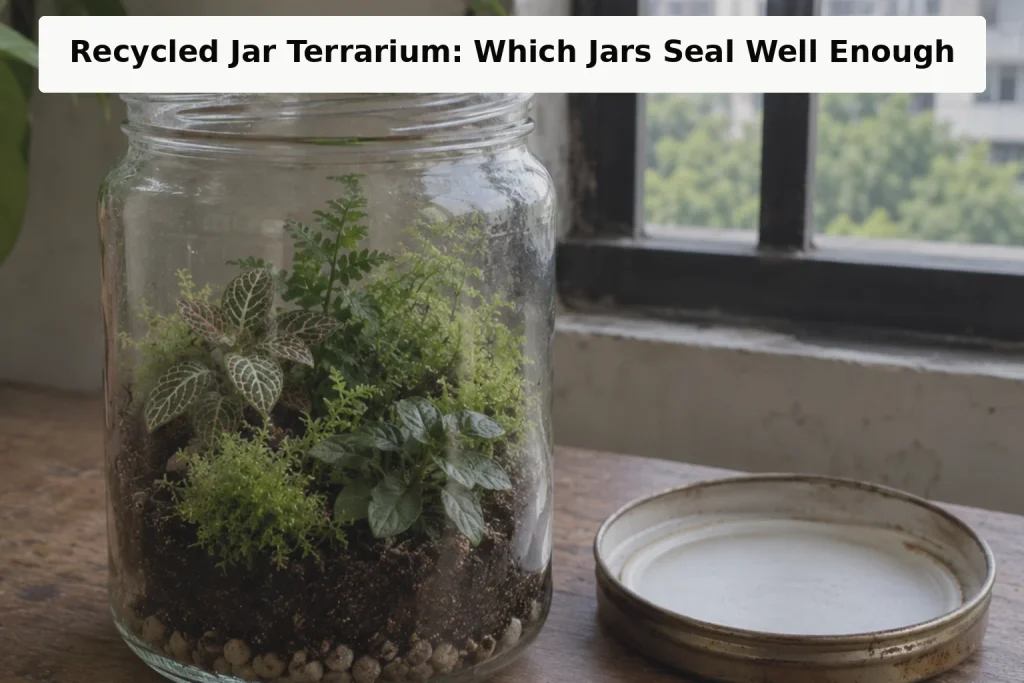
“In my own builds, recycled jars have taught me that the lid does not need to be perfect, it just needs to hold moisture well enough for the water cycle to stay stable. I pay more attention now to how evenly the lid sits, whether the glass is clear, whether the mouth is actually usable for maintenance, and especially whether the jar keeps condensation without slowly drying out. The simplest check I trust is a dry run before planting, because a damp towel and a few days of observation tell me more about the jar than the lid style ever could.”
What “seal well enough” actually means
A sealed terrarium runs on a water cycle. Vapor leaves the soil and the leaves, condenses on the glass, runs down and goes back in. The lid’s only job is to stop that vapor escaping into the room faster than the jar can afford.
That is a much lower bar than airtight. A lid that rests on the rim, a cork, or a sheet of glass laid on top can all run a closed build. How different closures change the way a jar behaves is covered in a separate guide on this site.
What “not well enough” looks like: a jar that never fogs, or one that gradually dries out and needs water by hand far more often than a closed jar should. That reading is on no condensation in a terrarium.
Start with the glass
Clear and untinted, always. Mississippi State University Extension’s How to Design a Closed-System Terrarium (P3253, DelPrince and Bachman, read September 11, 2026) says containers “should not be cloudy or tinted, as this would restrict light and limit plant growth.” Amber, green and frosted jars look good and fail on light.
Heavy embossing and labels. Raised lettering and printed patches block and distort light in exactly the band where your plants sit. Choose the smoothest face you can find.
Scratches and chips on the rim. A chipped rim is where a lid stops sitting evenly, and it is a cut hazard every time you reach in.
Glass over plastic, where you have the choice. Mississippi State accepts “any clear glass or plastic container,” but plastic scratches, and a scratched wall is a cloudy wall.
The lid, jar by jar
The Royal Horticultural Society’s terrarium advice (read September 11, 2026) says a closed terrarium “should have a sealable lid, ideally also made of glass,” and advises avoiding “opaque lids, as they reduce the light levels, and metal screw-tops, which can rust.” Most recycled jars come with exactly the lid it warns about, so here is how the common ones compare.
| Jar you probably have | Typical lid | Verdict for a closed build |
|---|---|---|
| Jam, pickle, sauce jar | Metal screw or twist lid with a liner | Works if the liner is intact and it passes the test run. Watch for rust |
| Home-canning jar | Two-piece metal: flat lid plus screw band | Works as a terrarium lid. Check the band for rust |
| Clamp-top storage jar | Glass lid, wire clamp, rubber gasket | Usually the tightest. Check the gasket |
| Coffee or spice jar | Plastic screw lid | Does not rust. Opaque, so it cuts light from above |
| Candle jar | Loose decorative lid, or none | Rests rather than seals. Test it, or add a glass cover |
| Wine or spirits bottle | Cork, screw cap, or none | Holds vapor with a cork, but the neck limits planting |
Two-piece canning lids. The National Center for Home Food Preservation’s canning FAQ (read September 11, 2026) says lids “should not be used a second time since the sealing compound becomes indented by the first use, preventing another airtight seal,” and that screw bands “may be reused unless they are badly rusted.” That rule is about food safety, where airtight is the whole point. A terrarium does not need airtight, so a used flat lid can still hold vapor well enough. Just do not assume it does: test it.
Twist lids from food jars work the same way. The liner was compressed when the jar was first sealed at the factory, so some will seat well on a second use and some will not. The test run tells you which you have.
Clamp-top gaskets perish. Rubber that is cracked or hard seals badly, and you cannot see that from outside.
Neck width and jar size
Can you get your hand, or at least a tool, through the mouth? Everything after the build (removing a dead leaf, pruning, cleaning the glass) goes through that opening. The RHS notes that narrow necks may need “improvised tools,” naming chopsticks, a spoon tied to a cane or barbecue tongs. That works, but it makes every job slower.
Is there enough depth for the layers? Small jars leave little room for drainage, substrate and plants. How the layers scale with the jar is on closed terrarium layers by jar size.
Cleaning a recycled jar, and a boiling-water warning
Wash it thoroughly. Mississippi State says to “be sure to wash the terrarium container before using it.” Food residue in the threads and under the lid liner is food for mold once the jar is humid and sealed. Scrub the threads and the underside of the lid, not just the inside of the glass.
Do not pour boiling water into a recycled food jar. The NCHFP lists “using commercial food jars rather than jars manufactured for home canning” among the causes of jar breakage in canning, along with sudden temperature changes such as putting jars of cold contents into boiling water. The failure mode is a jar that cracks or shatters while it is full of scalding water, in your hands or on your counter. If you want to sanitize a jar, the safer methods are on sterilizing the terrarium jar and substrate. Warm soapy water and a thorough rinse clean a recycled jar well enough for most builds.
Get rid of smells. A jar that still smells of vinegar or spice after washing has residue in the lid liner. Replace the liner, or use a different cover.
The humid-room problem with metal lids
In a temperate room, a metal lid over a closed jar faces damp air from the inside only. In a room that is humid most of the year, it faces damp air from both sides with no dry season in between. The RHS already warns that metal screw-tops “can rust.” In a humid climate, check the underside at every maintenance look, and watch for rust staining on the rim and running down the glass.
The practical workarounds, none of which need a purchase: a glass saucer or small plate laid over the mouth, a cork from another bottle if it fits, or a plastic lid from another jar of the same thread. Wider humid-climate build adjustments are on building a terrarium in a humid climate.
The test run: prove the seal before you plant
This is the step that answers the question for your jar, and it costs nothing.
- Wash and dry the jar and lid.
- Put a damp, wrung-out paper towel inside and close the lid.
- Leave it where the jar will live, in the light it will get.
- Watch it for several days. You are looking for fog that forms and clears as the room warms and cools, and a towel that is still damp at the end.
Fog that comes and goes, towel still damp: the lid holds vapor. Build in it.
No fog, towel drying out: vapor is escaping. Try a different lid, reseat it, or use a glass cover.
Rust spots or smells appear: the lid is not suitable over a humid jar.
Once a jar passes, the full build sequence is on how to build a closed terrarium.
What this page does not publish
No list of jar brands that “seal best.” We have tested none, and the test run above answers the question for your jar better than a list would.
No minimum jar size or neck width. The layers page covers how the build scales.
No prices.
FAQ
Can I use a pickle or jam jar as a closed terrarium? Yes, if the glass is clear and untinted and the lid holds vapor. Wash it thoroughly, including the threads and the lid liner, and do a test run with a damp paper towel before planting.
Does a recycled jar need to be airtight for a terrarium? No. It needs to keep water vapor in so the water cycle runs. The NCHFP’s rule against reusing canning lids is about airtight food seals, a different and stricter job than a terrarium lid does.
Is a metal lid a problem? It can be. The RHS advises avoiding metal screw-tops because they can rust, and in a humid room a lid gets damp from both sides. Check the underside regularly, or use a glass cover instead.
Can I sterilize a recycled jar with boiling water? Do not pour boiling water into it. The NCHFP lists commercial food jars and sudden temperature changes among the causes of jar breakage, and a jar that cracks while full of scalding water is a burn hazard. Wash it with warm soapy water, or use one of the safer methods on the sterilizing page.
The short version
Clear glass, a mouth you can work through, a lid that holds vapor without rusting, and a passed test run. If a jar clears those four, it can hold a real closed build.