
Dried Moss for Terrarium Use: How to Rehydrate It Right

Dried moss for a terrarium can be brought back to green growth by soaking or misting it with clean, non-chlorinated water over several days to a couple of weeks, then draining it and pressing it onto damp substrate. This only works on genuinely dried, still-living moss, not on glycerin-based “preserved moss” or dyed lichen sold under the same shelf label, since neither of those revives no matter how long they sit in water. Knowing which product is actually in the bag is the first step, and it matters more than the rehydration method itself.
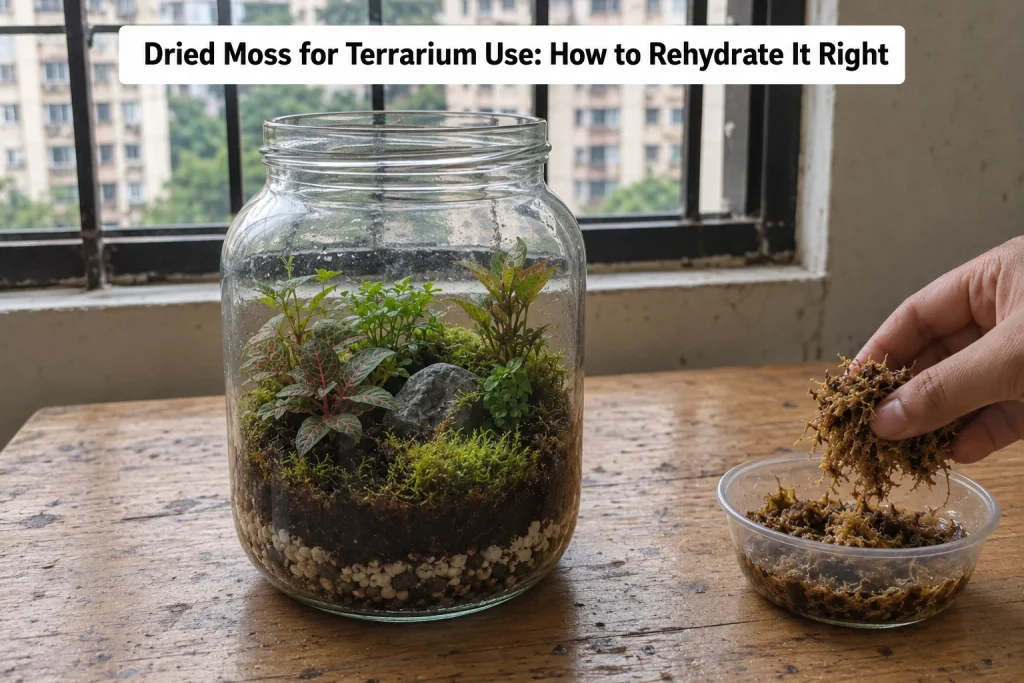
“In my own terrarium work, I’ve become much more careful about what “dried moss” actually means before I try to revive it. If the moss has been preserved with glycerin or sold as decorative reindeer moss, no amount of soaking is going to bring it back, so I check the material first rather than blaming the rehydration process later. With genuinely dried live moss, I rehydrate it gradually, let the excess water drain, and only move it into the jar once I can see fresh green growth returning. In my humid room, the bigger risk after that is usually not drying out but keeping it too wet, so I would rather place it slightly damp and let the closed terrarium maintain the moisture than keep misting on a fixed schedule.”
“Dried” moss, “preserved” moss, and lichen are not the same purchase
This is where most rehydration attempts fail before they start, and it is a labeling problem more than a technique problem. True dried moss, usually a species of sheet moss (Hypnum) or sphagnum, is simply moss that dried out naturally or was air-dried without chemical treatment. Its cells are alive but dormant, the same state wild moss enters during a dry spell. Preserved moss, by contrast, has had its water content replaced with glycerin and often a dye to keep the color stable indefinitely. It looks similar in the bag but is functionally dead craft material: it will never turn back into a living plant, and putting it in a closed, humid terrarium usually just gives it a surface for mold to grow on. A third product, often labeled “reindeer moss,” is not a moss at all. It is a lichen (commonly Cladonia), a fungus-algae partnership rather than a bryophyte, and it is almost always sold glycerin-preserved for the same reason: to lock its shape and color for decorative arrangements. Reading the packaging for words like “preserved,” “stabilized,” or “reindeer” before buying saves the trouble of soaking something that was never going to come back.
Why genuinely dried moss can come back to life
True mosses belong to a small group of land plants capable of surviving near-total water loss and recovering when moisture returns. A 2026 review in the International Journal of Molecular Sciences on desiccation tolerance in moss and liverwort (read 2026-09-18) explains that mosses can survive a reduction in cellular water content of more than 90% without permanent damage, and that dried tissue can remain viable as long-lived, dormant material for extended periods before rehydration triggers recovery. The review studies moss and liverwort side by side as separate lineages with related but distinct recovery mechanisms, which is also the clearest evidence that moss and liverwort are not interchangeable terms even though both tolerate drying out. This is not a universal plant trait: most houseplants die permanently once their tissue dries past a certain point. Moss survives it because of how it is built in the first place. According to the University of Maryland Extension’s guide to moss in the landscape (read 2026-09-18), moss has no leaf veins or true roots and instead absorbs and moves water directly from cell to cell, anchoring itself with root-like structures called rhizoids rather than a root system. That whole-surface absorption is exactly why soaking or misting the entire moss mat works, rather than watering it from one point the way a potted plant gets watered at the soil line.
How to rehydrate dried moss for terrarium use, step by step
- Confirm it is dried, not preserved. Squeeze a small piece. Genuinely dried moss feels brittle and crumbly. Preserved moss usually feels slightly rubbery or waxy, a sign of the glycerin treatment, and it will not be worth soaking.
- Rinse off dust and debris under plain running water before soaking, since packaged moss picks up dust in storage.
- Soak fully submerged in room-temperature distilled water, rainwater, or dechlorinated tap water for several hours to overnight for the first pass. Chlorine and chloramine in untreated tap water can damage moss tissue since it absorbs directly through its surface with no root system to filter anything out.
- Drain and rest it somewhere shaded and humid, not soaking wet, for the next few days. A loosely covered container or a plastic bag with a few air holes holds humidity without trapping standing water against the moss.
- Repeat misting or a brief re-soak daily for one to two weeks. Color return is gradual: expect faded, brownish-green moss to darken slowly rather than snap back to bright green overnight.
- Press it onto damp substrate once new green growth is visible, rather than burying the base, since rhizoids anchor at the surface.
Signs rehydration is working, or failing
New growth shows up as small, brighter green tips or a gradual deepening of color across the whole mat, usually starting within the first week if the moss was genuinely dried and not preserved. A moss that stays uniformly brown, brittle, and unchanged after two full weeks of consistent moisture was very likely preserved or already dead before it was packaged, and no amount of additional soaking will change that. A more concerning sign is white, gray, or black fuzz appearing on the moss during the rehydration period rather than green regrowth; that is mold taking advantage of constant moisture and still-dead tissue, and it is worth comparing against a proper mold identification guide before assuming the moss itself is simply slow to recover, since the two can look similar to an untrained eye at first glance.
Preparing rehydrated moss before it goes into the terrarium
Do not add rehydrated moss straight from a soaking dish into a closed jar. Squeeze out excess water first so it is damp rather than dripping, since moss that is still saturated when it goes in will overload the humidity balance of a sealed build almost immediately. The substrate underneath also matters more than most guides mention: a rich, compacted potting mix under moss tends to stay soggy and favor mold over new moss growth, while a lean, well-draining terrarium substrate gives the moss a surface it can actually root against without sitting in standing water. Press the moss firmly against the substrate rather than tucking the base under a layer of soil, since its rhizoids anchor at the surface and burying them does nothing useful.
Placing rehydrated moss in a closed vs. an open build
A closed terrarium holds humidity close to saturation almost permanently once it stabilizes, which suits rehydrated sheet or sphagnum moss well and usually needs little beyond the occasional light misting afterward. If the build is a smaller jar, working out the planting order in advance through a guide to layering a closed terrarium by jar size helps avoid disturbing newly placed moss later when adding plants or hardscape around it. Open terrariums lose moisture to the room constantly, so rehydrated moss placed in an open container needs more frequent misting to avoid drying out and going dormant again shortly after all the work of reviving it.
Common mistakes when rehydrating dried moss
The most common mistake is skipping the identification step and soaking preserved or lichen-based “moss” for weeks expecting it to green up, when it was never going to change. The second is using straight tap water on a sensitive first soak, which can leave chlorine damage that slows or prevents recovery even on genuinely dried moss. The third is over-misting once the moss is placed in the terrarium, saturating both the moss and the substrate underneath until the build starts fogging heavily or dripping condensation. If that happens, a guide to terrarium mold and condensation is worth reading before adding more water, since the fix at that point is usually airflow and a drier substrate, not another round of misting. In consistently humid climates such as Dhaka’s monsoon months, ambient room humidity alone can be enough to keep rehydrated moss from drying back out between waterings, so misting on the same fixed schedule used in a drier climate often ends up overwatering it instead.
FAQ
Can dried moss actually be brought back to life for a terrarium? Yes, but only if it is genuinely dried moss and not glycerin-preserved moss or dyed lichen. True dried moss enters a dormant state and can recover with consistent moisture over one to two weeks. Preserved moss and lichen were treated to stay a fixed color and shape permanently and will not revive.
How long does it take dried moss to turn green again? Expect a gradual change over one to two weeks of consistent soaking or misting, not an overnight result. Faded, brownish moss should slowly darken and show new growth tips first; a moss that shows no change after two weeks was likely already dead or preserved.
Can I use tap water to rehydrate terrarium moss? It is safer to use distilled water, rainwater, or dechlorinated tap water, especially for the first soak. Moss absorbs water directly through its surface with no root system to filter it, so chlorine and chloramine in untreated tap water can damage the tissue before it has a chance to recover.
Why is my rehydrated moss growing mold instead of turning green? Mold usually means the moss was already dead, whether from being preserved rather than dried, or from sitting too wet without enough airflow during rehydration. White, gray, or black fuzz is a mold sign, not a slow-recovery sign, and is worth checking against a dedicated identification guide before continuing the same routine.
Is reindeer moss the same as dried moss? No. Reindeer moss is a lichen, not a true moss, and it is almost always sold glycerin-preserved rather than simply dried. It will not rehydrate into a living plant, and using it in a closed, humid terrarium usually just gives mold a surface to grow on.