
Calathea Terrarium: Why Humidity Lovers Still Fail

A calathea terrarium can work, but humidity is not the part that goes wrong. Calatheas and their close relative maranta (the prayer plant) do want humid air, and a closed jar supplies plenty of it. They usually fail for other reasons: most species grow too big for the jar, their leaves move and end up pressed against wet glass, and constantly soggy substrate rots the roots in still air. A young or compact plant, a tall container, a well-drained mix, bright indirect light and regular venting give one a real chance. A small, crowded, fully sealed jar usually does not.
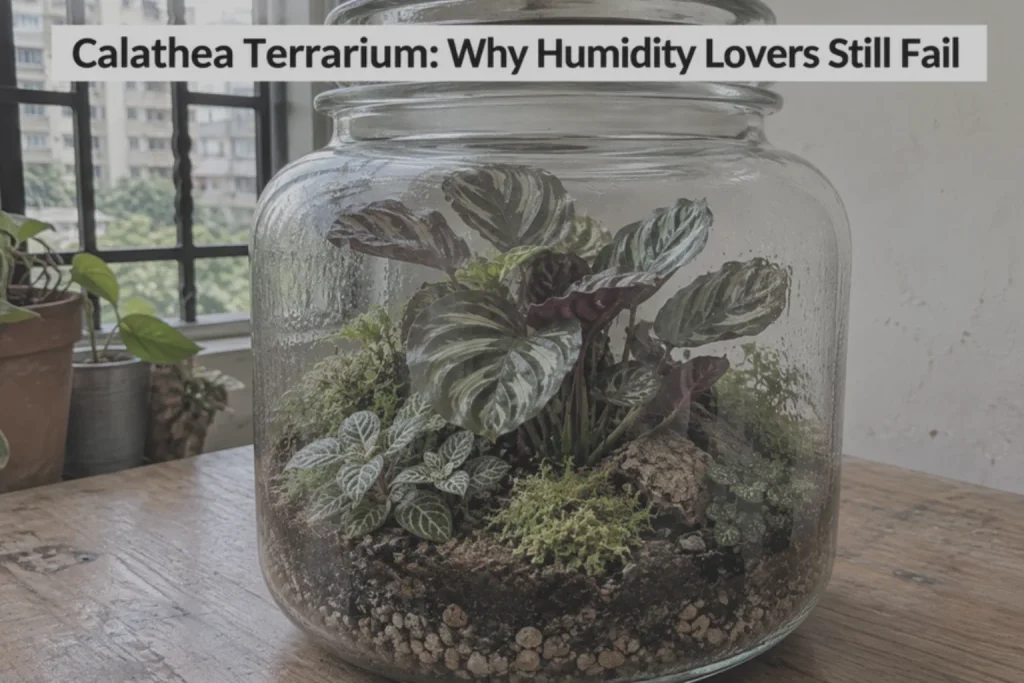
“I’ve found that calathea problems are a good reminder that loving humidity is not the same as loving a sealed jar. The air can be perfect while the roots are sitting too wet, the leaves are rubbing against condensation, and the plant is simply too large for the container. I now pay much more attention to headroom and leaf movement, especially because prayer-family plants change position through the day and night and can end up touching the glass even when they looked fine when I planted them. The biggest lesson for me is that when a calathea curls inside an already humid jar, I check the substrate and root zone before assuming it needs more water.”
Why a calathea terrarium fails even with perfect humidity
The logic behind putting a calathea behind glass is sound as far as it goes. Calathea care guides all repeat the same complaint: in ordinary room air, the leaf edges brown and crisp. The NC State Extension Gardener Plant Toolbox profile for Goeppertia makoyana (read on 2026-09-23), the peacock plant still sold as Calathea makoyana, says a humidity level of 60% needs to be maintained for the plant to thrive, and that low humidity causes leaves to roll or brown. A closed jar clears that bar without effort. When the glass fogs, the air against it is holding all the moisture it can.
So why do so many of them still die in jars? Because humidity was only one of the plant’s needs, and the jar meets it by taking away things the plant also relies on. The same profile says the soil needs to be moist but not wet or soggy, and that overwatering can cause root rot. A closed container has no drainage hole and very little air movement. Water that goes in stays in, and wet leaves stay wet. The toolbox’s genus-level Goeppertia entry also lists airborne fungal infections such as gray mold, the kind of problem that does well in still, saturated air.
Four failure routes account for most calathea and maranta losses in closed builds:
- Size. The plant is bigger than the container, or becomes bigger within months.
- Leaf contact. Leaves rest on the glass or on each other and stay wet around the clock.
- Root rot. Substrate that never dries, with little air in it, suffocates the roots.
- What is in the water. Minerals from tap water that have no way out of a closed system.
Low humidity is not on that list. The jar already fixed it.
The size problem: most calatheas outgrow the jar
This is where the numbers turn unfriendly. NC State’s makoyana profile gives the plant a mature size of 1 to 2 feet tall (roughly 30 to 60 cm) and 8 to 12 inches wide (about 20 to 30 cm). The NC State Extension profile for Maranta leuconeura (also read on 2026-09-23) lists the prayer plant at 6 inches to 1 foot tall and 6 inches to 2 feet wide, because it sprawls more than it stands. Neither is a plant for a mason jar or a small cloche.
That is why terrarium builders keep returning to the same short list. The compact types, such as the network plant (sold as Calathea musaica) and the fishbone prayer plant (Ctenanthe burle-marxii, a member of the same prayer plant family), are the ones usually suggested for enclosed builds. The big-leaved orbifolia and the pinstripe calathea (Calathea ornata) are usually steered toward open rooms instead. Treat that as a rule of thumb rather than a guarantee: size varies with light, age and cultivar, and a nursery tag rarely tells you which cultivar you are holding.
| Plant | Sold as | Size notes | Fit for a closed container |
|---|---|---|---|
| Peacock plant | Calathea makoyana (now Goeppertia makoyana) | 1 to 2 ft tall, 8 to 12 in wide, per NC State | Tall, large containers only |
| Prayer plant | Maranta leuconeura | 6 in to 1 ft tall, spreading 6 in to 2 ft, per NC State | Wide containers, with regular trimming |
| Network plant | Calathea musaica | Generally described as compact for the group | One of the better calathea choices for a large jar |
| Fishbone prayer plant | Ctenanthe burle-marxii | Generally described as low and bushy | Often suggested as the most forgiving of the family |
| Orbifolia, pinstripe | Calathea orbifolia, Calathea ornata | Large leaves, grow big | Better as potted plants in a humid room |
If you are weighing up containers, the guide to how small is too small for a closed terrarium walks through the trade-offs, and for this family the answer is to go larger than feels necessary. A young plant or a small division buys time, but it does not change where the plant is headed. Sooner or later you will be choosing between cutting back an overgrown jar and moving the plant out.
The praying leaves need headroom
This family has a habit most terrarium plants do not. The Maranta profile describes it plainly: by day the leaves are held parallel to the ground, and at night they move to a perpendicular “prayer” position. The Goeppertia genus entry calls the same behavior nyctinastic movement, meaning the leaves fold in response to darkness.
In a pot, nobody notices. In a jar, it matters. A calathea or maranta needs clearance for both positions: the flat daytime spread and the upright night fold. If the raised leaves meet the lid or the glass every evening, they spend each night pressed against a cool, wet surface. That contact point is where brown patches, soft spots and mold tend to start, and it is easy to miss because by morning the leaves have dropped back down.
Before you plant, stand the plant in the empty container and check two things. Can the leaves lie flat without touching the sides? Could they stand upright without touching the lid? If the answer to either is no, the container is too small for that plant, whatever the label says.
Reading the symptoms: a jar is not a pot
Most calathea troubleshooting online is written for potted plants, and in a pot the usual suspect is dry air or thirst. Inside a sealed terrarium, the same symptom often points the other way. This is the part most calathea terrarium guides skip, and it is the reason people keep adding water to a plant that is drowning.
| Symptom | Usual cause in a pot | More likely cause in a closed jar |
|---|---|---|
| Leaves curling or rolling | Low humidity or underwatering (NC State links low humidity to rolling) | Roots damaged by constant wet, so they cannot take up water; or heat building up behind sunlit glass |
| Brown, crispy edges | Dry air, or fluoride in tap water | Minerals building up from top-up water; a leaf touching the glass; sun scorch through the glass |
| Yellowing lower leaves | Old leaves aging out, or overwatering | Overwatering, especially if the substrate looks dark and wet all the way down |
| Soft, dark patches that spread | Uncommon | Leaf rot or gray mold where leaves stay wet |
| Plant collapsing at the base | Root rot in poorly drained soil | Root or stem-base rot in waterlogged substrate |
Curling with wet substrate is the combination to take seriously. A plant whose roots are rotting behaves as if it were thirsty, and the instinct is to water it, which makes things worse. The maranta profile notes that root rot may occur with poorly drained soils, and a closed jar is poorly drained by design. If the substrate is wet, the jar smells sour and the leaves curl anyway, read the guide to diagnosing terrarium root rot through the glass before you add a single drop.
Whatever goes in the water stays in the jar
Both NC State profiles warn about water quality. The makoyana profile recommends distilled water or rain water, because the fluoride in tap water can cause browning. The maranta profile says leaves will burn with high fluorides and with over-fertilization.
A closed terrarium makes this more important, not less. The water that condenses on the glass and runs back down is close to pure, because dissolved minerals do not evaporate with it. Whatever was dissolved in the water you added stays behind in the substrate. In a pot, you can flush the soil through the drainage hole now and then. In a jar, there is no flush. Each top-up with hard tap water adds a little more, and none of it ever leaves.
So for a calathea terrarium, use distilled water or clean rainwater for every top-up, and keep fertilizer out of the jar or use it far more sparingly than you would for the same plant in a pot. A balanced closed build needs very little water, so the extra cost of distilled water stays small.
How to set up a calathea terrarium that has a chance
None of this means you should not try. It means building around the plant’s real weak points instead of the one the jar already solves.
- Choose the container for the plant, not the shelf. Tall and wide beats small and pretty. Large jars, glass cabinets and carboys are more realistic than a lidded tumbler.
- Start with a young plant or a small division. A smaller root mass fits the space and gives you more months before the size problem arrives.
- Use an airy, well-drained substrate over a drainage layer. The makoyana profile’s “moist but not wet or soggy” is the target. Soggy substrate is where the rot starts.
- Set the base of the plant level with or slightly above the surrounding substrate, never in a dip where water collects.
- Give bright, indirect light. NC State says makoyana prefers bright, indirect sun or partial shade, and that too much sun will bleach the colors out of maranta leaves. Direct sun on glass also heats the whole container.
- Leave space around every leaf. Nothing should rest on the glass, by day or by night.
- Vent when the fog will not clear. A fully sealed lid suits some plants, but this family tends to do better with regular airing. The guide on when to open a closed terrarium covers when airing out helps and when it only dries the build.
- Check for pests before planting. NC State lists aphids, scale, mealybugs and spider mites for Goeppertia, and occasional spider mites and mealybugs for maranta. Look under the leaves and along the stems first, because a pest is far harder to remove once it is behind glass.
When a calathea is the wrong plant for your jar
It is worth being honest about the other option. Some calatheas are simply better as potted plants. If your container is small, if the plant on offer is already large, or if it is one of the big-leaved types, a sealed build is likely to be a slow fight that the plant loses.
For readers in a humid climate, including much of South and Southeast Asia, there is a second point. The whole case for the jar is dry indoor air. NC State’s own suggestions for raising humidity around Goeppertia are modest: a tray of wet pebbles, or a naturally humid spot such as a bathroom or kitchen. During a long humid season, a potted calathea kept away from air conditioning and fans may get enough humidity from the room without being sealed in. An open container, or a pot on a pebble tray, gives the plant moisture without the still air and trapped water behind most jar losses.
Signs it is time to take the plant out: it touches the lid in its night position even after trimming, rot keeps coming back at the base, or it is shading every other plant in the build. Moving it to a pot is not a failure. It is the right answer for a plant that grew into a size the tag never mentioned.
Calathea Terrarium FAQ
Can a calathea live in a closed terrarium?
Yes, if the container is large enough and the substrate stays moist rather than soggy. Humidity is not the problem inside a jar. Size, leaves resting on wet glass and root rot are. Compact types and young plants in tall containers have the best odds.
Why are my calathea leaves curling in a terrarium?
In a pot, curling usually points to dry air. In a humid closed jar, it more often means the roots are struggling in wet substrate, or the container is sitting in direct sun and heating up. Check the substrate and the light before you add any water.
Is maranta better than calathea for a terrarium?
Not automatically. NC State lists maranta at up to a foot tall but spreading up to two feet wide, so it needs a wide container and regular trimming. Both plants share the same weak points: moving leaves, rot in wet substrate and sensitivity to fluoride.
What water should I use for a calathea terrarium?
Distilled water or clean rainwater. NC State notes that fluoride in tap water can brown calathea leaves, and in a closed jar the minerals from tap water build up in the substrate because there is no drainage to flush them out.
Which calathea stays small enough for a terrarium?
None stays truly tiny. The network plant (Calathea musaica) and the fishbone prayer plant (Ctenanthe burle-marxii) are generally described as among the more compact choices, but even they need a large container and occasional trimming.