
Collecting Moss for Terrarium Builds: Legal, Clean, Alive

Collecting moss for a terrarium is only reasonable when three things are true: you have the landowner’s permission, the patch is large and common enough that a small piece will not be missed, and you clean and quarantine the moss before it goes into a jar. Take a small amount from the edge of a big patch, never from a nature reserve, then remove debris, rinse it, and hold it separately until you are confident nothing is living in it that should not be.
Most guides stop at “rinse it and plant it.” The problem is that a closed terrarium is warm, humid and sealed, which makes it an ideal place for anything you bring in with the moss to multiply. What follows covers the three questions in order: whether you should take it, how to take it, and how to make it safe for a sealed build.
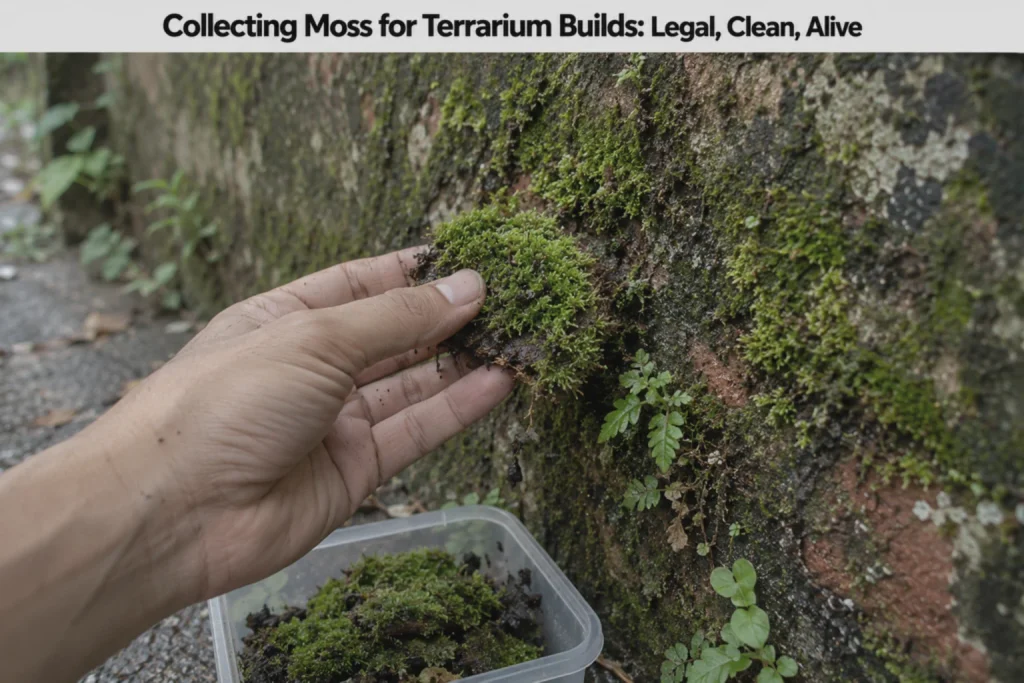
“In my own terrarium work, I treat wild moss as something that has to earn its way into the jar, not something I scrape off a wall and use immediately. I first ask whether I have permission to take it and whether the patch is common and large enough that a tiny edge piece will not matter, then I clean it, trim away the dirty dead underside, rinse it, and keep it separate long enough to see what crawls, hatches, molds, or simply fails to adapt. Pasted text Pasted text The biggest lesson for me is that quarantine is not just pest control: it is also a compatibility test, because moss that looks perfect outdoors may still dislike the permanently humid conditions inside a closed terrarium.”
Can you just scrape moss off a wall?
Physically, yes. Legally and ethically, it depends on where the wall is and who owns it.
Moss is a plant in the eyes of most wildlife law. The Botanical Society of Britain and Ireland’s Code of Conduct (read September 25, 2026) states that under the Wildlife and Countryside Act 1981, “it is illegal to uproot any wild plant without permission from the landowner or occupier,” and that the term plant “includes algae, lichens and fungi as well as bryophytes (mosses and liverworts), and vascular plants.” The same code notes that the British Bryological Society produces guidance specifically for mosses and liverworts.
That is British law, not a worldwide rule, and rules differ from country to country and site to site. But the principle travels well:
- Private land: ask the owner. A wall in your own building still belongs to someone.
- Public land: check whether collecting is allowed. Parks and public grounds often have rules.
- Protected areas: do not collect. The BSBI code says to “never take material from a nature reserve or protected site without permission and formal consent if necessary.”
If you cannot establish that collecting is allowed, the answer is a nursery or a moss you can propagate, not the wall.
How much moss is it reasonable to take?
Moss grows slowly, and a scraped-bare patch takes a long time to recover. The BSBI code gives a simple rule of thumb for wild plants in general: “If there are twenty, it is reasonable to take one. If you wish to take two, there should be forty, etc and do not uproot.”
Applied to moss, that translates into a few practical habits:
- Take from the edge of a large patch, not the middle, and never the whole cushion.
- Take only what one build needs. A jar terrarium needs very little moss.
- Leave rare-looking or unusual moss alone. If you do not recognize it and it is not everywhere, it is not the one to take.
- Photograph instead of collecting when you are not sure. The BSBI code’s advice to take a photo applies well to identifying moss later.
A small piece that establishes well in a jar can often be spread across a build over time, which is another reason to take less.
Where wild moss tends to come from, and what comes with it
In a city, the moss within reach usually grows on shaded brick and concrete, at the base of walls, beside drains, on old roofs and on tree bark. Each of those places brings its own passengers.
Walls and brickwork. Often the cleanest source. Moss here grows in a thin layer over grit and dust, so there is less substrate to carry life in.
Drain edges and damp ground. The least clean source. Water that runs into drains can carry waste and contamination. Wear gloves, avoid anything near sewage or runoff from roads, and wash your hands afterward. If you would not touch the water, do not bring the moss indoors.
Tree bark and soil. Thicker cushions with more material underneath, and more room for small creatures to live in them.
Around gardens, lawns and flower beds. These may have been treated with pesticides or fertilizers. You usually cannot tell by looking, which is a good reason to skip them.
Anywhere you would have to climb. Roofs, high walls and roadside ledges are not worth a fall. Collect only from where you can stand safely at ground level.
What pests ride along on wild moss
Hobbyist reports consistently name the same hitchhikers. Some are harmless, some are a nuisance, and a few can wreck a closed build:
| What you might find | Why it matters in a closed jar |
|---|---|
| Slugs and snails, or their eggs | They eat leaves and moss and can strip a small build |
| Fungus gnat larvae | Adults become a flying nuisance once the jar is opened |
| Mites | Many are harmless decomposers; some feed on plants |
| Springtails | Generally welcome, as they feed on mold and decaying matter |
| Ants, spiders, small beetles, millipedes | Mostly a nuisance; they are hard to remove once sealed in |
| Mold spores and fungal growth | Thrive in the humidity of a sealed build |
The point is not that every piece of wild moss is infested. It is that you cannot see most of these at the moment of collection, and a sealed jar gives them time to show up. If gnats do appear later, why the usual fungus gnat fix fails in a terrarium explains what to do in a closed container.
Cleaning wild moss before it goes near a jar
Cleaning is about removing the material where pests live, not about killing everything. Moss is alive, and most harsh treatments that would kill every pest also kill the moss.
A careful, low-risk cleaning routine looks like this:
- Shake and tap it out over a sheet of paper outdoors. Loose debris and some creatures fall out.
- Pick out visible debris with tweezers: leaves, twigs, grit and anything moving.
- Trim away the dead, brown underside and any soil clinging to the base. Rotting material is exactly what mold feeds on in a humid jar.
- Rinse it gently in a bowl of clean water, changing the water until it runs clear. Many hobbyists prefer rain, distilled or filtered water to avoid mineral spots.
- Split thick cushions carefully to check the inside, where slugs and larvae hide.
- Drain it on a paper towel before the next step.
The safety line: what not to do to moss
This is a safety-critical step, and the mistakes here are the ones that either kill the moss or hurt you.
- Do not use pesticides, insecticides or household sprays on moss for a terrarium. Anything that kills insects in a sealed jar is sealed in with the plants, and with you when you open it.
- Do not pour boiling water over moss in a glass jar. Boiling water will kill the moss, and pouring very hot water into cold or thin glass can crack it. If you want to sterilize the jar itself, do that separately, before the moss is involved. The method and its risks are covered in sterilizing terrarium substrate and jar.
- Do not bake or microwave live moss. Heat treatment belongs to substrate and hardscape, not to the living part of the build.
- Wear gloves when handling moss from drains or damp ground, and wash your hands afterward.
If a pest problem looks serious enough to need a chemical, the moss is not worth saving. Put it back outside where you found it, or discard it, and start with a cleaner source.
Quarantine: the step most people skip
Quarantine means holding the moss somewhere separate, under similar conditions to a terrarium, and watching it before it goes into your build.
- Use a spare clear container with a loose cover, kept in bright, indirect light.
- Keep it lightly damp, not wet.
- Check it regularly for movement, eggs, holes in the moss, fuzzy growth or a sour smell.
- Remove anything that appears, and keep watching.
How long to quarantine is a judgment call. Hobbyist keepers commonly hold wild moss for weeks or longer, and the longer the moss sits with nothing appearing, the more confident you can be. If fuzzy growth appears, terrarium mold identification will help you tell mold from harmless growth before you decide whether to keep going.
Quarantine has a second benefit: it shows you whether the moss can live in a humid container at all. Moss that thrived on a sunny wall may not like a sealed jar, and it is better to learn that in a spare container than in your finished build.
Will wild moss even survive in a terrarium?
Not always. Moss that grows in dry, exposed spots is adapted to drying out between rains, and a constantly humid jar is a different world. Moss from shaded, consistently damp spots has a better chance.
Signs that a collected moss is not adapting: it browns from the top down, goes limp and dark, or gets overrun by mold while the rest of the jar is fine. If that happens during quarantine, try a different source instead of forcing it into the build.
If you live somewhere hot and humid, conditions in and around the jar also matter. Building a terrarium in a humid climate covers how the surrounding climate changes what a closed build needs.
When buying or propagating is the better answer
Collecting is not the only way to get moss cheaply. Buying a small amount from a nursery, then letting it spread inside a build, avoids the legal question entirely and usually brings fewer pests. If a friend already keeps moss in a terrarium, a small piece from their established build has already proved it can live in a jar.
Wild collecting makes sense when the moss is abundant, the owner agrees, and you are willing to clean and quarantine it properly. When any of those is missing, one of the other routes is the better choice.
Frequently asked questions
Is it legal to collect moss from the wild?
It depends on where you are and who owns the land. In Great Britain, the BSBI Code of Conduct explains that under the Wildlife and Countryside Act 1981 it is illegal to uproot any wild plant, including mosses, without the landowner’s or occupier’s permission. Rules differ elsewhere, so check local rules and always ask the owner.
How do I get bugs out of wild moss?
Shake it out, pick out debris and visible creatures, trim the dead underside, rinse it gently in clean water, and split thick cushions to check inside. Then keep it in a separate container and watch it before it goes into a terrarium. Do not use pesticides.
Can I boil moss to sterilize it?
No. Boiling water kills moss, and pouring it into glass can crack the container. Sterilize the jar and substrate separately, and rely on cleaning and quarantine for the moss itself.
How much moss should I take?
Only what one build needs, taken from the edge of a large, common patch. The BSBI code’s rule of thumb for wild plants is to take one only where there are twenty.
Why did my collected moss turn brown in the terrarium?
Moss from dry or sunny spots often struggles in constant humidity. Moss from shaded, consistently damp places tends to adapt better. Testing it in a separate container first shows whether it will cope before it goes into your build.