
The Closed Terrarium Break-In Schedule

Right after planting, a closed terrarium has not yet found its balance, and the break-in period is the one to two weeks it takes to get there. The working schedule: leave it open for about 24 hours after building, seal it for 24 hours, then open it again whenever heavy condensation covers the glass, repeating until only a light morning fog remains that clears by midday. Estimates for full equilibrium range from about two weeks to as long as four to eight, and the spread comes down to a real variable, climate, container size, and how densely it is planted, not disagreement about the method.
What the break-in period is actually doing
A newly planted terrarium is not yet a closed water cycle, it is a jar with damp substrate and no established rhythm between evaporation and condensation. The break-in period is the process of letting that rhythm find its own level: moisture evaporates from the substrate and leaves, condenses on the cooler glass, and runs back down, and over repeated open-close cycles the system settles into a stable pattern rather than swinging between too wet and too dry. Rushing this by sealing immediately and leaving it, or by opening and closing too often out of anxiety, both interfere with the system settling into its own natural balance.
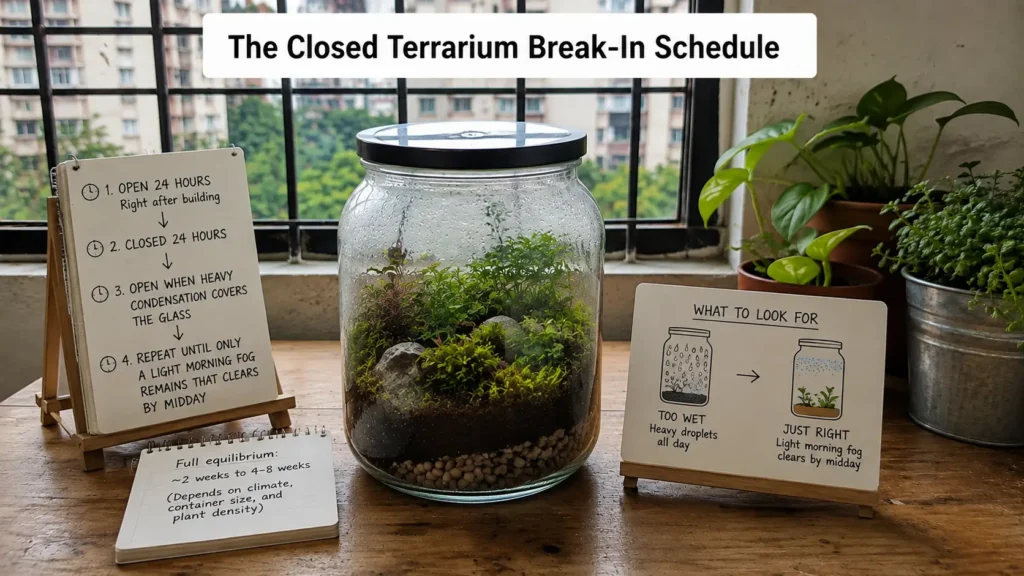
A day-by-day starting schedule for the first two weeks
A structured starting point, to be adjusted based on what the glass actually shows rather than followed rigidly:
- Day 1: leave the lid off or cracked for roughly 24 hours after planting, letting the initial watering settle and any excess surface moisture begin evaporating.
- Day 2: seal the lid fully for 24 hours.
- Day 3: check the glass. If condensation is heavy, covering more than roughly a third of the glass, open for several hours to vent, then reseal.
- Days 4-7: repeat the check-and-vent pattern daily. Expect condensation to gradually lighten as the system finds its balance.
- Week 2: checks can move from daily to every other day as the pattern stabilizes toward light morning fog that clears by midday.
This schedule is a starting structure, not a fixed countdown. A build that reaches light, clearing fog by day 5 does not need to keep following the full two-week calendar; one still showing heavy fog at day 10 is not necessarily failing, it may simply need more time or a longer vent session.
Reading condensation as your guide
| What you see | What it means | What to do |
|---|---|---|
| Light fog in the morning that clears by midday | Balanced, healthy cycle | Nothing. Continue as is. |
| Patchy fog that partly clears through the day | Slightly wet, still within range | Watch it. Vent a few hours if it lingers for several days straight. |
| Heavy fog all day, running droplets | Too much moisture in the system | Vent 6 to 12 hours, skip watering, wipe the glass. |
| No condensation at all | Too dry, or a seal issue | Add a small amount of water and check the lid seals fully. |
The gauge is the glass, not a fixed schedule. Adjust venting based on what is actually visible rather than sticking to a calendar once the pattern starts to diverge from it.
Why timelines vary so much between guides
Estimates for full equilibrium range widely, and the disagreement is explained by real variables rather than inconsistent advice. A larger container holds a larger volume of air and substrate, so it naturally takes longer to reach a stable state than a small jar. A densely planted terrarium has more leaf surface releasing moisture through transpiration, which extends the balancing period. Climate matters most of all: a build in a room with already-high ambient humidity, common in tropical and monsoon climates, takes longer to settle because venting removes less excess moisture per session when the air being exchanged is itself already humid.
The humid-climate adjustment
In a room where ambient relative humidity already runs high, the standard schedule above often needs to stretch: vent sessions may need to run longer, or happen more frequently, to reach the same light-fog balance point that a drier room reaches faster. This is not a sign the build is failing, it is the expected shape of a break-in period in that climate. See building a terrarium in a humid climate for the fuller set of adjustments, including drainage and substrate changes that reduce how much venting the break-in period needs to do in the first place.
What density of planting does to the timeline
A jar planted densely, with several plants close together and moss covering most of the visible substrate, releases more moisture into the air through transpiration than a sparsely planted one of the same size. That extra moisture load extends the break-in period, since there is simply more water entering the system’s air at any given point for the same drainage and substrate to manage. It is not a reason to plant more sparsely than otherwise wanted; it is a reason not to compare one build’s break-in timeline directly against a differently planted build and assume something is wrong when they diverge.
Signs you are done and can stop checking daily
A terrarium has reached its stable point when condensation settles into a consistent, light pattern, morning fog that clears by midday, without needing active venting to get there, and the substrate stays evenly damp without pooling. Once that pattern holds for several consecutive days, checks can drop from daily to occasional, and watering needs typically become rare, sometimes not required again for weeks.
What to do if it never seems to stabilize
If heavy condensation persists well past the expected range for the container’s size and climate, with no improvement despite regular venting, the cause is usually one of the build fundamentals rather than something the break-in schedule itself can fix: an undersized drainage layer, too much water added at the first watering, or substrate that is holding more moisture than it should. Address the underlying layer rather than continuing to vent indefinitely. If mold has developed alongside the persistent fog, the mold and condensation troubleshooting guide covers diagnosis and recovery.
FAQ
What if it has been a month and it still fogs heavily every day?
Persistent heavy fog well past the expected range usually points to an underlying build issue rather than an unusually slow break-in. Check drainage sizing and how much water went in at planting before assuming more time alone will fix it.
Can I speed up the break-in period?
Not meaningfully by opening and closing more often than the condensation pattern calls for. Over-venting can disrupt the balance the system is trying to find just as much as under-venting can. The schedule above, adjusted to what the glass shows, is close to the practical limit.
Do I need to check it every single day during break-in?
Daily checks are useful in the first week, when the system is changing quickly and heavy condensation needs prompt venting. By the second week, once the pattern is trending toward light fog, checks every other day are usually enough.
Does a bigger jar take longer to stabilize than a small one?
Generally, yes. A larger volume of air and substrate takes longer to reach a stable moisture balance than a small jar does, simply because there is more of the system that needs to settle.