
How to Clean the Inside of Terrarium Glass Without Wrecking the Build

The problem is not really cleaning. It is reach. The opening is small, the planting is close to the glass, and every tool you own is either too short, too rigid or too wide to get down the side of a jar without knocking a plant over.
Before you solve the reach problem, work out what the film actually is, because three completely different things get called dirty glass and only one of them is dirt.
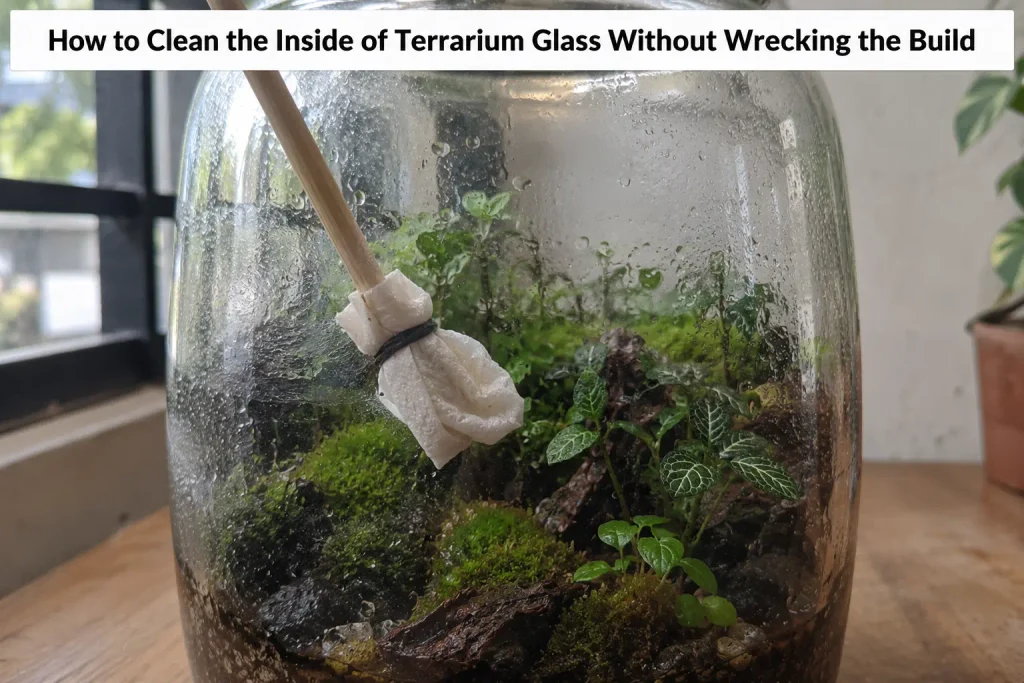
“I keep the inside of a terrarium clean with the least invasive method possible. In my build here, I use plain water and a soft cloth on a long stick to reach the glass without shifting plants or disturbing the substrate. I first make sure I am actually cleaning dirt, algae, or mineral film rather than normal condensation, and I avoid soaps, vinegar, glass cleaner, or anything else that would remain trapped inside the sealed system.“
Which of the three do you have?
Condensation. Water on the inside, clear, moving, changing through the day. This is not dirt and it is not a fault. It is the water cycle working, and how much of it is normal is the subject of too much condensation on the glass. You do not clean it off; if there is genuinely too much, you deal with the cause.
Mineral or hard-water film. A pale, hazy deposit that does not move and does not wipe with water alone. This is dissolved solids left behind where droplets evaporated, and it is the one that genuinely needs cleaning. The full read is on cloudy terrarium glass.
Algae. Green, in patches, usually where the light is strongest. Living, and cleaning it off is treating a symptom rather than the cause, which is on algae on terrarium glass.
Splashed substrate. Soil marks from the build or from watering. Ordinary dirt, and the easiest thing here.
The rule that governs everything
Nothing goes into a sealed terrarium that you would not want in it permanently.
This is the sealed-container inversion again and it is the most important sentence on the page. In a pot, a mistake drains away. In a closed jar there is no bottom exit, so anything you introduce stays until you rebuild.
That means, without exception:
- No glass cleaner. No ammonia, no alcohol, no commercial spray, not even a little.
- No soap or detergent.
- No vinegar inside a planted jar. It is a common suggestion for mineral film on empty glass and it is a different situation entirely once there are living roots below.
- No bleach, ever.
Water and a physical wipe. That is the whole toolkit for the inside of a planted jar.
If a mineral deposit will not come off with water and patience, the honest answer is that it stays, and this page will not offer you a chemical shortcut that damages the system. A hazy panel on the shady side of a jar is a cosmetic problem. A chemical burn through the root zone is a rebuild.
Reaching the inside
Improvised tools work as well as bought ones here, which is fortunate because the bought ones are expensive for one jar.
A long stick with something soft on the end. A chopstick, a bamboo skewer or a length of dowel, with a piece of clean cloth, a cotton pad or a folded paper towel held on the end. This does most of the work.
A cloth on a bent wire. A length of stiff wire with a small hook bent into it, the cloth threaded on. Gets down the narrow side of a jar where a rigid stick will not turn.
A long-handled soft brush, for corners and for the join between glass and substrate.
A cotton bud or two for a narrow neck, on a stick if the neck is very long.
And a spray of plain water, applied to the cloth rather than into the jar, so you are not adding volume to a system that has no way of losing it.
Do not use anything abrasive. A scouring pad, a metal edge or a rough sponge will scratch glass, and a scratch is permanent, catches more film, and looks worse than what you were removing.
Doing it without knocking the build over
Work from the top down. Anything you dislodge falls onto glass you have not cleaned yet rather than onto glass you have.
Support the plant, do not move it. A second stick used to hold a frond aside is better than trying to reposition anything.
Accept that you cannot reach all of it. The back of a narrow-necked jar behind a large plant is not reachable and never will be. A jar is not a window and the standard for a planted container is different.
Do it in the same session as any pruning. If the planting is pressed to the glass, cleaning the glass first is fighting the plant. Cut back, then clean, then let it settle. That order saves a repeat job in a week.
How often
There is no interval and we are not going to invent one. No source publishes a cleaning schedule for a sealed container, for the good reason that it depends on your water, your light and your build.
The practical trigger is visibility: clean when you can no longer see into the build well enough to check it. Being able to see is not vanity here, it is how you spot mold, pests, rot and die-back early, and every one of those is easier to fix caught early. That diagnostic point is the argument for keeping at least one panel clear.
The part people get wrong
Cleaning the outside is where a surprising share of “cloudy glass” complaints actually resolve. Household dust, cooking film and fingerprints sit on the outside, and the outside can be cleaned with anything you like, including glass cleaner, as long as you spray it onto the cloth and not at the opening of an open container.
Check the outside first. It takes ten seconds and it saves you reaching into a build you did not need to disturb.
FAQ
My glass is misty. Is that dirt? Probably not. Water on the inside that is clear, moving and changing through the day is condensation, which is the water cycle working rather than a fault. You do not clean it off. A pale haze that does not move and does not wipe away with water alone is a different thing, mineral film, and that is the one that genuinely needs cleaning.
Can I use glass cleaner or vinegar inside a planted jar? No. Nothing goes into a sealed terrarium that you would not want in it permanently, because a closed jar has no bottom exit and anything you introduce stays until you rebuild. That rules out glass cleaner, ammonia, alcohol, soap, detergent, vinegar and bleach. Water and a physical wipe are the whole toolkit for the inside.
What if the mineral deposit will not come off with water? Then it stays. This page will not offer a chemical shortcut that damages the system. A hazy panel on the shady side of a jar is a cosmetic problem, and a chemical burn through the root zone is a rebuild.
How often should I clean the inside of the glass? There is no interval here and we are not going to invent one, because it depends on your water, your light and your build. Use visibility as the trigger: clean when you can no longer see into the build well enough to check it. Being able to see in is how you spot mold, pests, rot and die-back early.
Do I need a special terrarium cleaning tool? No. A chopstick, a bamboo skewer or a length of dowel with a clean cloth or cotton pad on the end does most of the work, and a cloth threaded onto a bent wire reaches down the narrow side of a jar. Avoid anything abrasive, because a scratch in glass is permanent and catches more film than it removes.
What this page does not publish
No cleaning product recommendation for the inside, because water is the answer and anything else is a risk to a system with no drainage.
No cleaning interval, because none is published and inventing one would make this page the same as every page that already ranks.
No tool product names. A chopstick and a cloth do this.