
Do Terrariums Need Grow Lights? When a Window Is Enough

Most do not. Do terrariums need grow lights? Only when the spot they sit in cannot supply enough daylight. A closed terrarium near a bright window that never puts direct sun on the glass usually gets all the light its forest-floor plants use. A grow light earns its place in three situations: a room with no usable window, a shelf too far from the window, or a window so sunny that the jar has to be moved out of it. In every other case it is optional.
That is the short answer. The rest of this guide covers the decision in detail: how to tell whether a jar is actually short of light, what a lamp fixes and what it does not, and why the word “grow” on the box matters less than the marketing suggests.
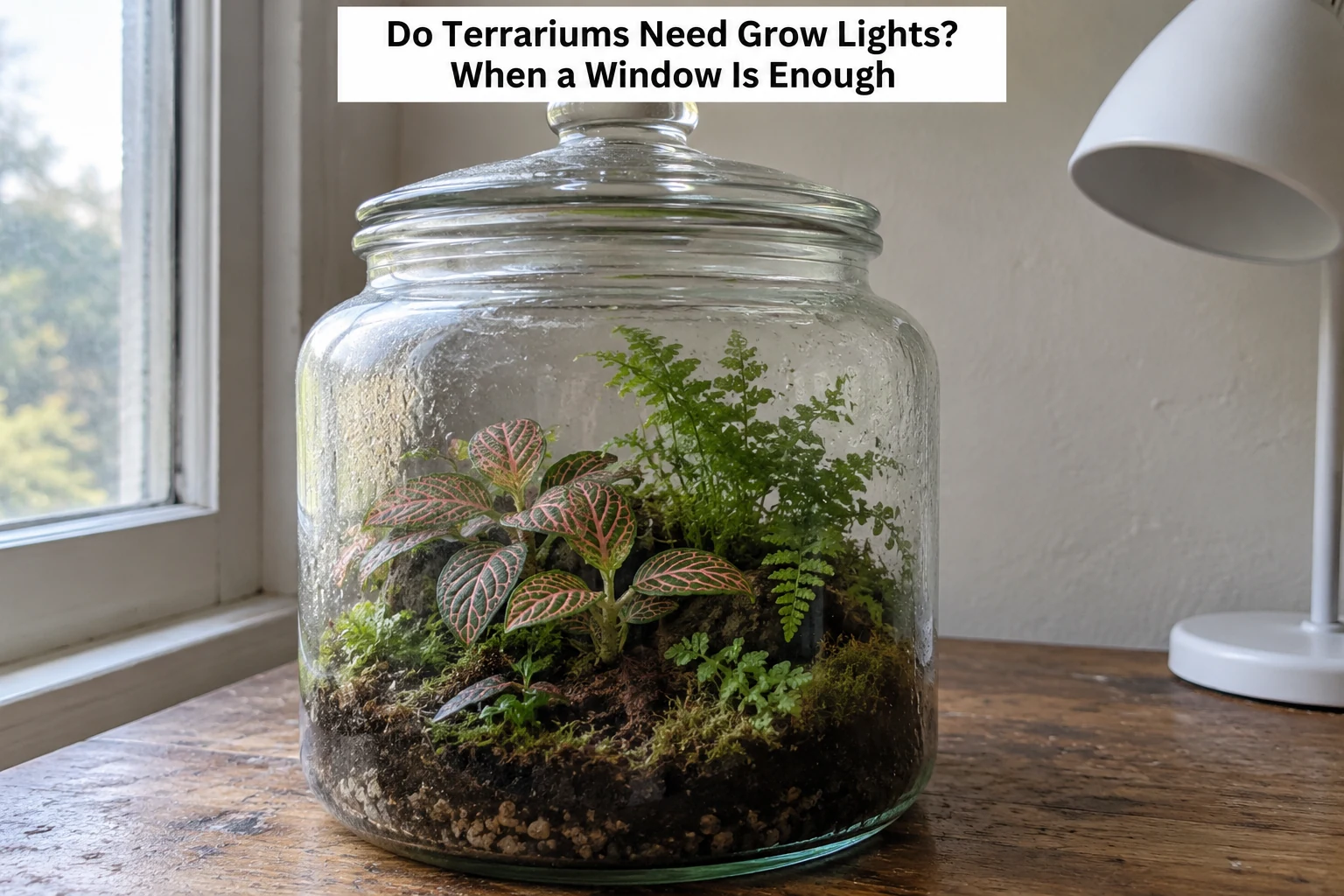
“I look at new growth before deciding a jar needs a lamp. Compact leaves and steady color matter more to me than speed, since slow growth keeps a closed build manageable. If the only bright window overheats the glass, I would move the jar to a cooler position and use a lamp to replace that exposure, rather than adding more light to an already hot spot.”
Why most terrariums do fine without a grow light
The plants that go into closed terrariums are chosen because they cope with modest, filtered light. Mosses, small ferns, fittonia and similar forest-floor species evolved under a canopy, not in open sun. That is exactly why they suit a jar on a shelf. If you are still choosing plants, the plants that survive a closed terrarium are the ones that make a grow light least likely to be necessary.
Placement advice from horticulture extension services is built around daylight. Mississippi State University Extension’s publication How to Design a Closed-System Terrarium (P3253, by James M. DelPrince and Gary Bachman, read September 27, 2026) says to “Find a location with bright, indirect light” and adds that “an eastern exposure with morning sun is ideal for terrariums.”
The same publication makes a point that changes how to think about lamps: “One goal of terrarium culture is to encourage slow growth, which reduces the need for pruning.” A terrarium is not a greenhouse trying to push maximum growth. More light than the plants need is not a bonus. It often means faster, leggier growth and more trimming.
Do terrariums need grow lights? The three cases where the answer is yes
1. The room has no usable window
A windowless room, an interior office or a corridor gives the plants almost nothing to work with. Overhead room lighting is designed for people, not plants, and it usually sits far above the jar. In this situation a lamp is not an upgrade. It is the light source.
2. The only free shelf is far from the window
Light falls away quickly as you move back from a window. Illinois Extension’s houseplant lighting guide (read September 27, 2026) shows how fast. It rates the spot directly in front of an east or west window as high light (300 foot-candles), a few feet away as medium (150 foot-candles), and 3 to 10 feet away as low light (75 foot-candles). A jar on a bookcase across the room may be getting a small fraction of what the windowsill gets, even though the room looks bright to you.
If the bright spot near the window is taken and the only free space is well back from it, a small lamp can make up the difference.
3. The window is too sunny for a sealed jar
This is the case most guides miss. Mississippi State’s publication warns: “Avoid placing a terrarium close to a window, as solar energy can build up heat inside the container, potentially burning the plants.” In a home with a strong, sunny window, the brightest spot may also be the one that cooks the jar.
A grow light solves this from the other direction. You move the terrarium back into the shade of the room, where it stays cool, and let a lamp supply the brightness the window would have. Here the lamp is not added to the sun. It replaces it.
How to tell a terrarium is short of light
Before deciding on a lamp, check whether the plants are actually asking for one. Typical signs of too little light include:
- Stretching. Stems grow long with wide gaps between leaves, reaching toward the brightest side.
- Smaller, paler new leaves. Each new leaf comes in a little weaker than the last.
- Fading color. Patterned or colorful foliage drifts toward plain green.
- Hard leaning. Plants tilt strongly toward the window.
One thing is not a sign on its own: slow growth. As the Mississippi State guide notes, slow growth is a goal of terrarium culture. A jar that barely changes month to month may simply be healthy.
Also rule out look-alikes before blaming light. Yellowing, for example, often comes from water rather than light, and yellow leaves in a terrarium walks through the difference.
What a grow light will not fix
A lamp is sold as a cure, so it is worth being clear about what it cannot do.
- It will not fix heat. If the jar is already overheating in the sun, adding a lamp without moving the jar makes things worse. Any lamp that warms the glass repeats the problem.
- It will not fix water problems. Rot, mold and a waterlogged substrate come from moisture, not light. More light does not dry out a sealed jar in a useful way.
- It will not rescue the wrong plant. Sun-loving plants such as most succulents do poorly in the humidity of a sealed jar however bright the lamp is. Plants that should never go in a closed terrarium explains why.
- It can make algae worse. Strong light on damp glass is one of the conditions algae likes. Terrarium algae on the glass covers how light and algae are linked.
“Grow light” or ordinary lamp: what the label changes
The word “grow” on a box can make a plain household lamp look inadequate. The extension guidance is more relaxed than that.
University of New Hampshire Extension specialist Jonathan Ebba, in a Q&A on indoor lighting published February 2, 2021, notes that “LED shop lamps will work fine.” A lamp sold as a grow light, he explains, provides a spectrum with a larger share of its light available for photosynthesis. His more important point is this: “failure with growing plants under lamps is more often about light quantity (intensity and duration) than quality (spectrum).”
Illinois Extension says the same thing in simpler terms: “For foliage plants, using cool white fluorescent bulbs works well.” Almost everything in a closed terrarium is grown for its foliage, not its flowers.
What this means in practice:
| Question | What matters more |
|---|---|
| Grow light or ordinary white lamp? | How bright it is at the plants, and for how many hours |
| Purple or white light? | White is easier to live with and suits foliage plants |
| Incandescent bulb? | Avoid. Older incandescent bulbs run hot, which is the last thing a sealed jar needs |
| Bigger is better? | No. The goal is enough light for slow, healthy growth, not maximum growth |
This article does not recommend specific products. The point is that you do not need anything specialized to test whether more light helps. A cool-running white lamp that the manufacturer rates for the way you plan to use it is a reasonable starting point.
If you do add a light: the principles that matter
Keep the schedule steady
Plants respond better to a predictable day than to a light that is switched on whenever someone remembers. A plug-in timer handles this. Illinois Extension says that “Duration of 14 – 16 hours is sufficient” for plants given extra hours of light and warns: “Do not expose plants to more than 16 hours of light since they need a rest period too.” A lamp that stays on around the clock is not helping.
Keep the glass cool
After the lamp has been on for a while, touch the glass nearest to it. It should feel close to room temperature. If it is warm, move the lamp farther away or choose a cooler one.
Pick the spot once
Mississippi State’s guide advises: “Avoid moving it frequently, as changes in light intensity and duration may harm plant health.” Decide where the jar and lamp will live, then leave them there and watch the plants for a few weeks before changing anything.
Treat the electrics seriously
A lamp over a damp glass jar puts electricity near water and condensation. Use only plug-in fixtures, and use them the way their manufacturer intends. Keep plugs, cords and the fixture itself away from water, and never let condensation drip onto them. Do not open, modify or rewire a fixture. Anything involving your home’s wiring, such as adding a socket near a shelf, is work for a licensed electrician.
A quick decision table
| Your situation | Grow light? | Why |
|---|---|---|
| Bright room, jar near a window, no direct sun on the glass | Not needed | Daylight covers what forest-floor plants use |
| Jar several feet back from the window | Maybe | Light drops quickly with distance; check the plants for stretching |
| No window at all | Yes | The lamp is the only light source |
| Only bright window gets strong direct sun | Useful | Move the jar back and let a lamp replace the harsh window light |
| Plants rotting, moldy or waterlogged | No | The problem is water, not light |
| Plants slow but healthy and colorful | No | Slow growth is normal and desirable in a sealed jar |
Frequently asked questions
Do terrariums need grow lights to survive?
No, not if they sit in bright, indirect daylight. A grow light is needed when there is no usable window, when the jar has to sit far from the window, or when the only bright window is too sunny for a sealed container.
Can I use a normal LED bulb instead of a grow light?
Often, yes. University of New Hampshire Extension notes that LED shop lamps work fine and that success under lamps depends more on light quantity than on spectrum. Choose a cool-running white lamp and keep it on a steady schedule.
How many hours should a terrarium grow light be on?
Illinois Extension says 14 to 16 hours is sufficient for plants given extra light and warns against more than 16, because plants need a rest period. Use a timer so the schedule stays the same every day.
Is a grow light better than a sunny window for a closed terrarium?
It can be. Direct sun can build up heat inside a sealed container and burn the plants, as Mississippi State University Extension warns. A lamp lets you keep the jar in a cooler part of the room while still giving it enough light.
What are signs my terrarium needs more light?
Stretched stems with long gaps between leaves, smaller and paler new leaves, fading color and plants leaning hard toward the window. Slow growth alone is not a sign, because slow growth is normal in a closed terrarium.