
Is a Terrarium Pet Safe? Cats, Dogs and Toddlers

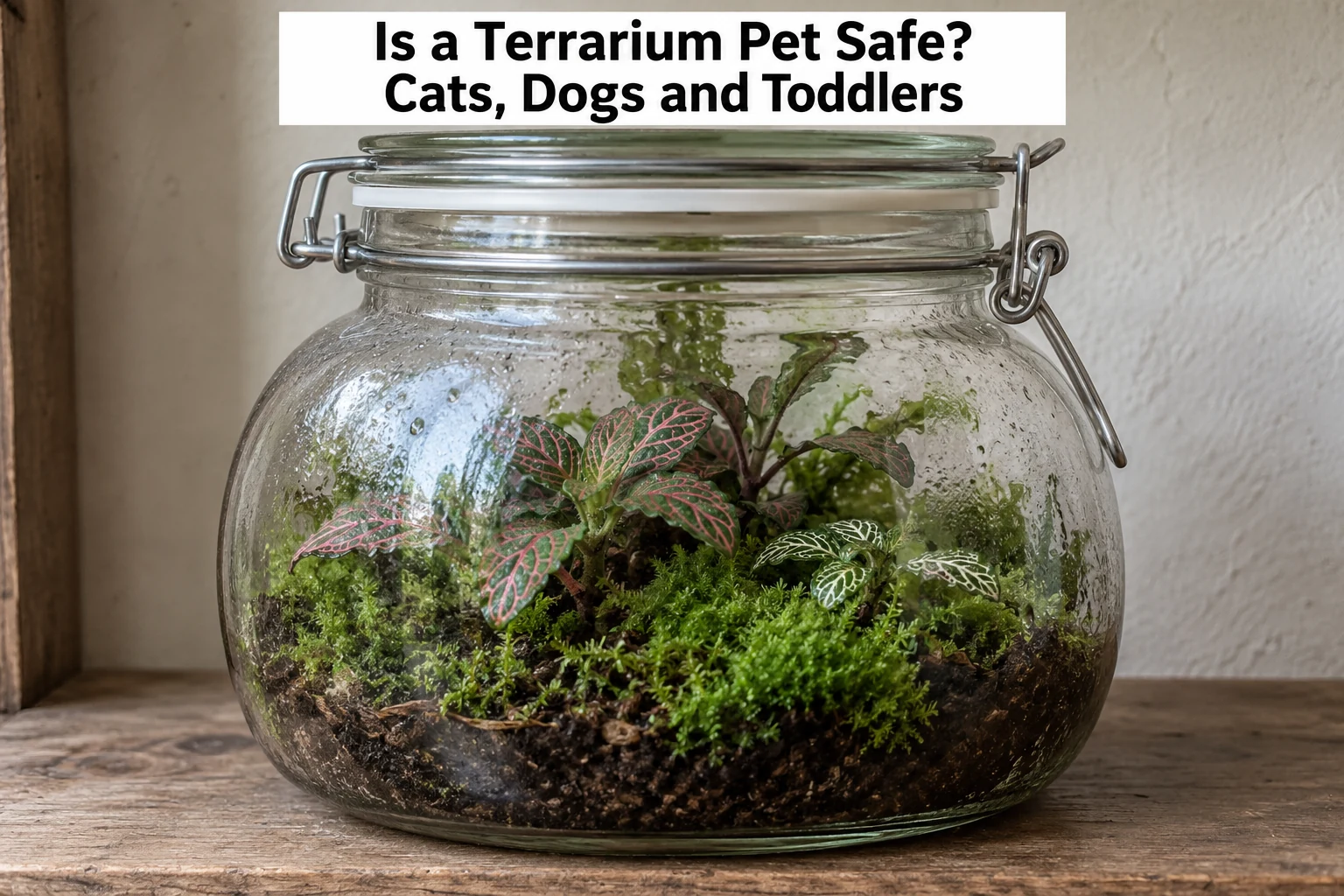
Is a terrarium pet safe? It can be, but no jar is safe by default. Whether it is depends on four things: which plants are inside, whether the container is closed, what small loose parts it holds, and where it sits. Choose plants listed as non-toxic on the ASPCA Toxic and Non-Toxic Plants list, keep the lid on, skip loose pebbles and small ornaments, and put it where paws and small hands cannot reach or tip it. Even then, treat “pet safe” as “lower risk,” because the ASPCA itself says eating any plant material can upset a pet’s stomach.
The rest of this guide takes each of those points in turn, so you can decide whether a terrarium fits a home with a cat, a dog, a toddler or all three.
“I look beyond the plant list when judging whether a terrarium belongs in a home with pets or young children. A secure lid, stable position and lack of loose decorations matter alongside plant identification. I treat non-toxic as a lower-risk choice, not permission to chew, and I would choose an inaccessible room if no reliable placement is available.”
If Something Has Already Been Eaten, Start Here
This page is about planning a terrarium, not about what to do after an animal or child has eaten something. If that has already happened, stop reading and contact help now:
- For a pet: your own veterinarian or the nearest emergency vet clinic. In the US, the ASPCA Animal Poison Control Center lists (888) 426-4435 on its plant list page, and the Pet Poison Helpline lists (855) 764-7661 and operates 24/7. Pet Poison Helpline states on its site that an incident fee applies; check the ASPCA’s own page for its current terms.
- For a child: in the US, America’s Poison Centers runs Poison Help at 1-800-222-1222, which it describes as available 24/7 at no cost. Outside the US, contact your national poison center or your local emergency number.
Have the plant’s name, or a photo of it, ready when you call. The people on the other end make the medical judgment; this page does not.
What Makes a Terrarium Pet Safe: The Whole Jar, Not Just the Plants
Most lists of “pet safe terrarium plants” stop at the plant. That is the obvious starting point, but in a home with a curious cat, a dog at nose height or a toddler who puts everything in their mouth, the plant is only one of several hazards:
| Part of the terrarium | Why it matters with pets or toddlers |
|---|---|
| The plants | Some common terrarium plants are on the ASPCA’s toxic list |
| The container | Glass can be knocked over and break; an open top invites paws and fingers |
| Small loose parts | Pebbles, glass beads, drainage gravel and figurines are small enough to swallow |
| Substrate and additives | Soil, moss and charcoal are not food, and some mixes contain added fertilizer |
| Its position | A shelf edge or low table puts the whole jar within reach |
A terrarium that passes on plants but fails on the other four is not pet safe. The good news is that the fixes for all five mostly point the same way: a closed jar, no loose small parts, and a high, stable spot.
1. Choosing Plants: Use the ASPCA List, Plant by Plant
The standard reference for plant toxicity to pets is the ASPCA Toxic and Non-Toxic Plants list (read on 2026-09-27). It has separate lists for dogs, cats and horses. Two notes on that page are worth reading before you use it:
- The list covers “the most frequently encountered plants,” so a plant missing from it has not been cleared, it has simply not been listed.
- The ASPCA adds that “the consumption of any plant material may cause vomiting and gastrointestinal upset for dogs and cats.” A non-toxic label is not an invitation to let a pet graze.
Popular terrarium plants fall on both sides of the list. As listed by the ASPCA on 2026-09-27:
| Plant | Scientific name | ASPCA listing |
|---|---|---|
| Nerve plant (fittonia) | Fittonia verschaffeltii | Non-toxic to dogs, cats and horses |
| Baby rubber plant | Peperomia obtusifolia | Non-toxic to dogs and cats |
| Golden pothos | Epipremnum aureum | Toxic to dogs and cats |
The lesson is not “fittonia good, pothos bad” as a rule to memorize. It is that plants can differ species by species, and common names are unreliable. Look up the scientific name on the plant’s label, check it on the ASPCA list, and if a plant has no label, leave it out of a jar that a pet can reach.
The ASPCA list is built for dogs, cats and horses. It is not a list for children. If your worry is a toddler, the poison center line in the section above is the right place to ask about a specific plant before you buy it.
2. The Container: Closed Beats Open in a Busy Home
In a house with animals or small children, the single most useful choice you can make is a closed terrarium with a lid that stays on. A closed jar keeps paws, noses and fingers out of the plants, keeps the soil and small parts in, and removes the temptation of an open bowl of greenery at cat height.
Our guide to open vs closed terrariums covers the plant side of that choice. For a household with a cat or a toddler, the safety case adds weight to the closed option.
The kind of closure matters too. A cork that pops out easily is less secure than a screw lid or a clamp-top. Our guide to lidded, corked and clamp-top seals explains how each type behaves. For a jar within any chance of reach, a closure that needs two hands and some grip to open is the safer choice.
Then there is the container material. Glass is traditional and shows plants best, but it breaks when knocked off a shelf, and broken glass plus spilled soil is a hazard to paws and bare feet. Our comparison of glass vs plastic terrarium containers sets out the trade-offs. In a home where a jar is genuinely at risk of being knocked down, that trade-off tilts further toward sturdier, heavier or lower-risk options.
3. Small Loose Parts: The Toddler Question
For young children, the loose bits of a terrarium can matter as much as the plants. The American Academy of Pediatrics, on its HealthyChildren.org choking prevention page (last updated 2/27/2026, read on 2026-09-27), says “Balloons, balls, marbles, pieces of toys and foods (small round objects) cause the most choking deaths.” It explains that “Babies and toddlers are at the highest risk” because “they love to explore the world by putting things in their mouths.”
A typical terrarium can contain several items in that “small round object” family:
- Decorative pebbles and glass beads on the surface.
- Drainage gravel or LECA balls at the base. Our guide to the terrarium drainage layer explains what that layer is for.
- Small figurines and ornaments added for decoration.
In a home with a toddler, the simplest approach is to leave loose decorative stones and figurines out of any jar that could be reached, opened or broken, and to treat the whole jar as something that lives out of reach rather than something the child is taught not to touch. HealthyChildren.org’s guidance on keeping small objects away from young children applies to a terrarium’s contents just as it does to toys. Your pediatrician is the right person to ask about your own child.
4. Where It Sits: Out of Reach and Hard to Tip
Placement is the part that makes everything else work. Even a jar with non-toxic plants and a tight lid can be knocked off a shelf, and a falling glass jar is a hazard in itself.
A few general principles:
- Height alone is not enough for a cat. Cats reach most surfaces in a room. For a cat, the question is not “is it high?” but “is there a clear landing spot next to it?” A jar on a crowded, narrow shelf edge is easier to nudge off than one pushed well back on a deep, stable surface.
- Dogs and toddlers are about height and edges. A coffee table or low shelf is within reach of both. A wagging tail or a small hand at table height can sweep a jar off.
- Stable surfaces only. A heavy jar on a light, wobbly side table can come down with the table.
- Away from climbing routes. A shelf a cat uses to reach a window, or furniture a toddler climbs, is not a place for glass.
- Think about light too. A sunny windowsill is a common cat perch, and direct sun can also overheat a closed jar. Placement for safety and placement for the plants often agree on a spot back from the window.
If no spot in the home meets these tests, a room the pet or child does not use is better than a compromise shelf.
5. Substrate, Additives and the Cleanup Crew
The rest of what is inside the jar deserves a quick check:
- Soil and moss are not food. A pet or child who digs in an open jar may eat some. A closed jar prevents this.
- Fertilizers and plant treatments do not belong in any jar a pet or child can reach. Most closed terrariums need little or no feeding anyway.
- Springtails, if you use a cleanup crew, are tiny soil animals that the University of Maryland Extension describes as not biting or causing damage. They live in the soil of a closed jar and are rarely seen.
If anything from the jar is chewed or swallowed, go back to the section at the top of this page. That is a question for a vet or a poison center, not for this guide.
A Terrarium Pet Safe Checklist Before You Build
Before a terrarium goes into a house with a cat, dog or toddler, run through this:
- Every plant identified by scientific name and checked against the ASPCA list.
- No unlabeled plants in a jar that can be reached.
- A closed container with a lid that needs some effort to open.
- No loose decorative stones, beads or small figurines in a toddler’s reach.
- A deep, stable surface away from edges, climbing routes and busy walkways.
- Your vet’s number and your poison line saved in your phone.
If you cannot tick all six, consider waiting on the build, or choosing a spot in a room the pet or child does not use.
Frequently Asked Questions
Are terrariums safe for cats?
A terrarium can be lower risk for cats if every plant is listed as non-toxic to cats on the ASPCA list, the jar is closed with a secure lid, and it sits somewhere a cat cannot easily knock it down. The ASPCA notes that eating any plant material may upset a cat’s stomach, so non-toxic does not mean edible.
What terrarium plants are toxic to pets?
Check each plant by scientific name on the ASPCA Toxic and Non-Toxic Plants list. As listed there on 2026-09-27, golden pothos (Epipremnum aureum) is toxic to dogs and cats, while nerve plant (Fittonia verschaffeltii) and baby rubber plant (Peperomia obtusifolia) are listed as non-toxic to dogs and cats.
Is a terrarium safe with a toddler in the house?
It can be lower risk if it is closed, out of reach and free of loose small parts. The American Academy of Pediatrics lists small round objects such as marbles among the leading choking hazards for young children, so decorative pebbles and beads are the part to leave out.
Is a closed terrarium safer than an open one around pets?
Generally yes. A lid keeps paws, noses and fingers away from the plants, soil and small parts. The seal type matters: a lid that needs some grip to open is more secure than a loose cork.
What should I do if my pet or child eats something from a terrarium?
Contact help straight away. For a pet, that is your veterinarian or an animal poison line such as the ASPCA Animal Poison Control Center or Pet Poison Helpline. For a child in the US, Poison Help is 1-800-222-1222; elsewhere, your national poison center or emergency number.