
Pet Ate Terrarium Plant? Who to Call First and What to Say

If your pet ate a terrarium plant, or anything else from the jar, contact your veterinarian or an animal poison line now, before searching further. In the US, the ASPCA Animal Poison Control Center is at (888) 426-4435 and Pet Poison Helpline is at (855) 764-7661; both run around the clock and both charge a fee. If a child swallowed something, call Poison Control at 1-800-222-1222, and call 911 if they collapse, have a seizure, have trouble breathing or cannot be woken. Do not wait to see whether symptoms appear.
This page does not try to tell you whether the plant was harmful. That is not something a website can judge about your animal or your child. It tells you who to call, what not to do while you wait, and what to have in your hand so the call is quick.
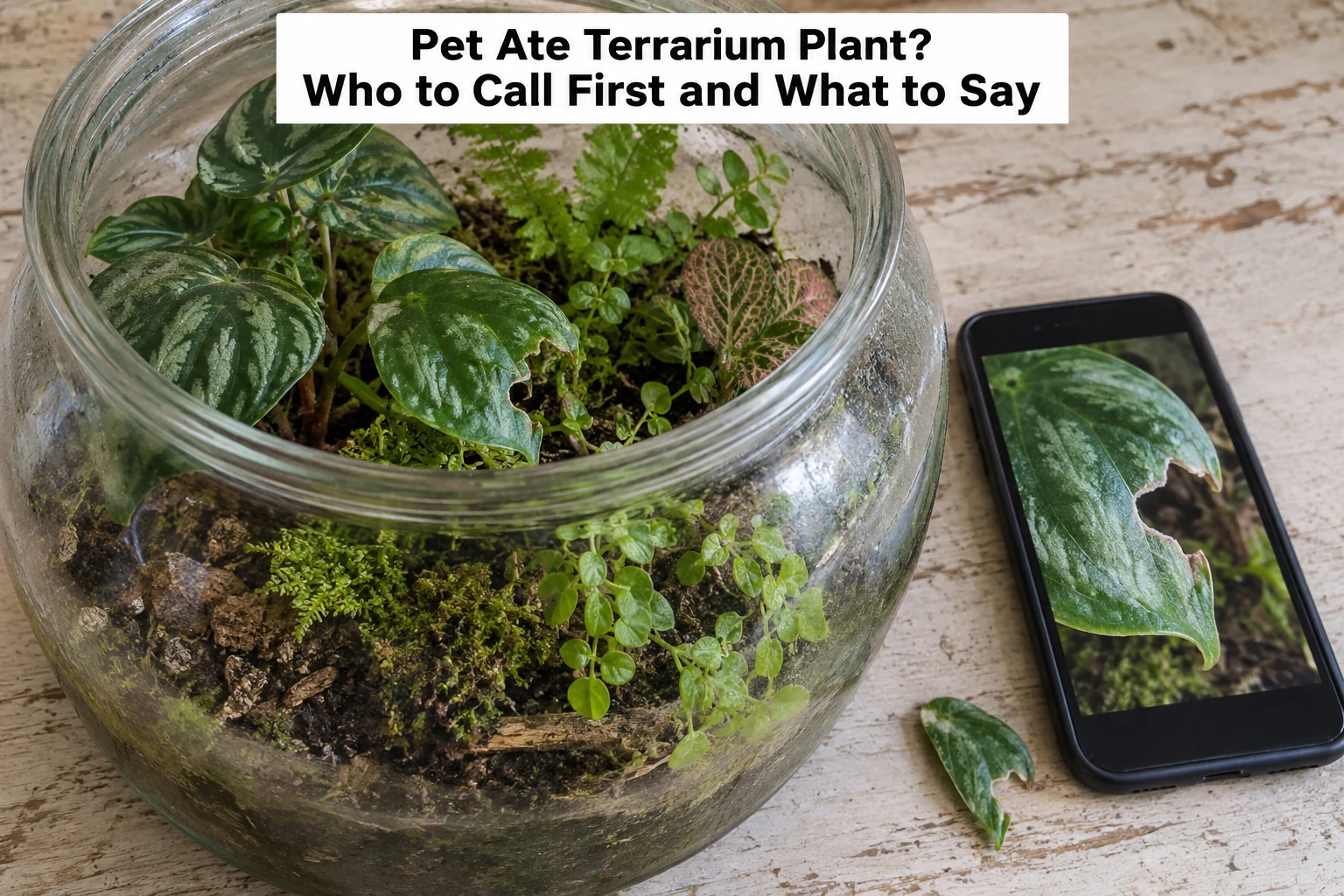
“If a pet may have swallowed something from a terrarium, I would contact a veterinarian first rather than trying to judge the risk from a plant list. I would have the plant photo, any product packaging and the likely time of exposure ready, while also mentioning soil, charcoal, stones or broken glass that might have been accessible. A record of the jar’s contents makes that conversation clearer.”
Call First: The Numbers, in One Place
| Who swallowed it | Call | Notes |
|---|---|---|
| Dog or cat | Your own vet, or the nearest emergency vet clinic | Your vet knows your animal’s history |
| Dog or cat (US) | ASPCA Animal Poison Control Center, (888) 426-4435 | 24/7, 365 days a year; the ASPCA says a consultation fee may apply |
| Dog or cat (US) | Pet Poison Helpline, (855) 764-7661 | 24/7; Pet Poison Helpline says an incident fee applies |
| Child or adult (US) | Poison Control, 1-800-222-1222 | Free and confidential, per the National Capital Poison Center |
| Anyone who has collapsed, is having a seizure, has trouble breathing or cannot be woken | 911 | The National Capital Poison Center’s instruction is “Call 911 now!” |
Outside the US, call your own veterinarian, your nearest emergency animal hospital, or your country’s poison information center for a child. The US lines above are listed because they are the ones the sources on this page name, not because they are the only option.
If you are unsure whether it is serious enough to call, call. Deciding that is exactly what these services exist to do.
What Not to Do While You Wait
Pet Poison Helpline’s instructions for a poisoned pet (read on 2026-09-28) are short and worth following exactly:
- “Remove your pet from the area.”
- “Check to make sure your pet is safe: breathing and acting normally.”
- “Do NOT give any home antidotes.”
- “Do NOT induce vomiting without consulting a vet or Pet Poison Helpline.”
In its list of things to remember in a poisoning, the helpline also says not to give milk unless a veterinary professional tells you to, and not to administer any sort of treatment before calling it or getting veterinary guidance. It also says “Don’t leave your pet alone after a potential intoxication.”
The same logic applies to a child: do not give anything by mouth or try to make them sick unless Poison Control or a doctor tells you to. Follow what the person on the phone says.
Why Terrariums Make This Harder
Most “my pet ate a plant” searches assume a single houseplant in a pot. A terrarium is different, and the differences matter to whoever takes your call.
There is more than one plant. A mixed jar can hold a fern, a fittonia, a creeping fig, several mosses and a cutting you forgot about. Your pet may have mouthed more than one of them.
It is not only plants. A closed terrarium usually holds several layers and extras that a pet or toddler can reach once the jar is open or broken:
- the substrate or potting mix
- activated charcoal, if the build uses it
- a drainage layer of gravel, clay balls or stones
- moss, bark or wood hardscape
- decorative stones, glass beads or figurines
- anything that has grown by itself, such as mold or mushrooms that appeared in the jar
- any fertilizer or pest product you have used in or around it
Labels get lost. Terrarium plants are often bought as small unlabeled cuttings or from mixed trays, so you may not know the exact species.
None of this means the situation is worse. It means the person on the phone needs a fuller picture than “my cat chewed a plant,” and you can give it to them.
What to Have Ready When You Call
Pet Poison Helpline advises: “Before you call make sure you have all product packaging information for the poison in front of you and bring it along to the vet.” For a terrarium, that translates into a short checklist:
- Which plant, as precisely as you can. The nursery label if you kept it, the name on the receipt, or a clear photo of the plant and of the damaged leaves.
- What else was in reach. Was the jar open, knocked over or broken? Could your pet or child have eaten soil, charcoal, stones or decor as well as leaves?
- Any product packaging. If you have ever added fertilizer or used a pest treatment in or near the jar, have the bottle or box in front of you. Our note on whether a sealed terrarium needs fertilizer explains why many closed jars get none, but if yours did, the vet will want to know which product.
- Roughly when and how much. A time window and a best guess are fine. If you do not know, say so.
- Your animal’s details. Species, rough age and weight, and any medical conditions or medicines.
For a child, Poison Control will ask similar questions: what it was, when, roughly how much, and the child’s age and weight.
If you are taking your pet to a clinic, bring the plant label or photo and any packaging with you.
About Plant Lists You Find Online
While you wait, it is tempting to search the plant name and read whether it is “toxic” or “safe.” The most-used reference is the ASPCA’s Toxic and Non-Toxic Plants list, which lets you filter by dogs, cats and horses. It is a useful reference when choosing plants. It is not a way to decide whether your animal needs help today.
The ASPCA Toxic and Non-Toxic Plants list (read on 2026-09-28) says itself that it “is not meant to be all-inclusive, but rather a compilation of the most frequently encountered plants,” and that if you believe your animal is ill or may have ingested a poisonous substance, you should contact your local veterinarian or the ASPCA’s 24-hour poison hotline. A plant being absent from the list, or listed as non-toxic, does not rule out a problem with the other things in a terrarium, or with how much was eaten. That judgment belongs to the vet or the poison line, which is why this page sends you to them rather than answering.
After the Call: Stopping It Happening Again
Once your pet or child has been seen to, the terrarium question comes back, and this part is ours to answer.
Close the jar. An open terrarium is reachable in a way a closed one is not. A secure closure matters more than it looks: a loose cork can be batted out and a resting lid can be pushed off. Our guide to lidded, corked and clamp-top seals explains how each closure behaves.
Move it out of reach. A closed glass-front cabinet, a room the pet does not use, or the back of a deep shelf all make the jar harder to get to. A lid keeps paws and hands out of the plants; it does not stop the jar being knocked over.
Rethink what goes in it. If you are replanting, look plants up on the ASPCA list before you buy them, not after. Some plants are a poor fit for sealed jars for reasons unrelated to pets, and our list of plants that should never go in a closed terrarium covers those.
Keep a label record. A note on your phone with each plant’s name, and the packaging of anything you have added to the jar, turns the next emergency call from a guessing game into a one-minute answer.
Frequently Asked Questions
My cat chewed a leaf from my terrarium but seems fine. Do I still need to call?
Yes. Contact your vet or an animal poison line such as the ASPCA Animal Poison Control Center or Pet Poison Helpline. Looking fine at first does not rule anything out, and deciding whether it is urgent is their job. Pet Poison Helpline also advises not leaving your pet alone after a possible poisoning.
My dog ate soil or charcoal from the terrarium, not a plant. Who do I call?
The same people: your veterinarian, the ASPCA Animal Poison Control Center or Pet Poison Helpline. Tell them exactly what was in the terrarium, including substrate, charcoal, stones and any fertilizer or pest product you have used.
My toddler put terrarium soil or a leaf in their mouth. What should I do?
In the US, call Poison Control at 1-800-222-1222, which the National Capital Poison Center describes as free and confidential. If your child collapses, has a seizure, has trouble breathing or cannot be woken, call 911 immediately.
Should I make my pet vomit after eating a terrarium plant?
Not on your own. Pet Poison Helpline says not to induce vomiting without consulting a vet or the helpline, and not to give home antidotes. Call first and follow their instructions.
Can I check the ASPCA plant list instead of calling?
Use the list for choosing plants, not for deciding whether your pet needs help. The ASPCA says its list is not all-inclusive and directs anyone who thinks their animal may have eaten something poisonous to a veterinarian or its 24-hour hotline.