
Topping Up Tired Terrarium Substrate: What You Can and Cannot Fix

The substrate has sunk. It sat level at the build and now there is a gap at the glass, the surface has compacted, and roots are visible where they were not before.
Two of the things you might do about this work, one does not, and one of them is the sealed jar’s permanent problem.
First, why it sank
Substrate settles for reasons that are mostly not faults.
Air spaces close. A freshly built jar has voids that water and time close. This is the main cause and it happens to every build.
Organic material breaks down. Bark, coir and leaf litter are being consumed by the same microbial life that makes a terrarium a system rather than a display. A shrinking organic layer is a working one, which is worth saying because the first instinct is to read it as decay in the bad sense.
Water has moved fines downward. Small particles wash down through the profile with every cycle, which is also how a substrate compacts from the top.
A plant has died and its roots have gone. Localized sinking around one spot is usually this.
Sinking is not, on its own, a problem. Compaction is, and they are not the same thing.
The difference that matters
Sunken means there is less of it. Compacted means what is there has lost its air spaces.
A compacted substrate holds water and holds it badly: saturated at the bottom, no air at the roots, and the conditions that produce root rot. It is also the state in which a build stops draining down to its drainage layer properly, which undoes the point of the drainage layer.
Adding material to the top corrects the sinking and does nothing at all about the compaction underneath. That is the single most useful sentence on this page, because topping up is what almost everyone does and it is only half a fix.
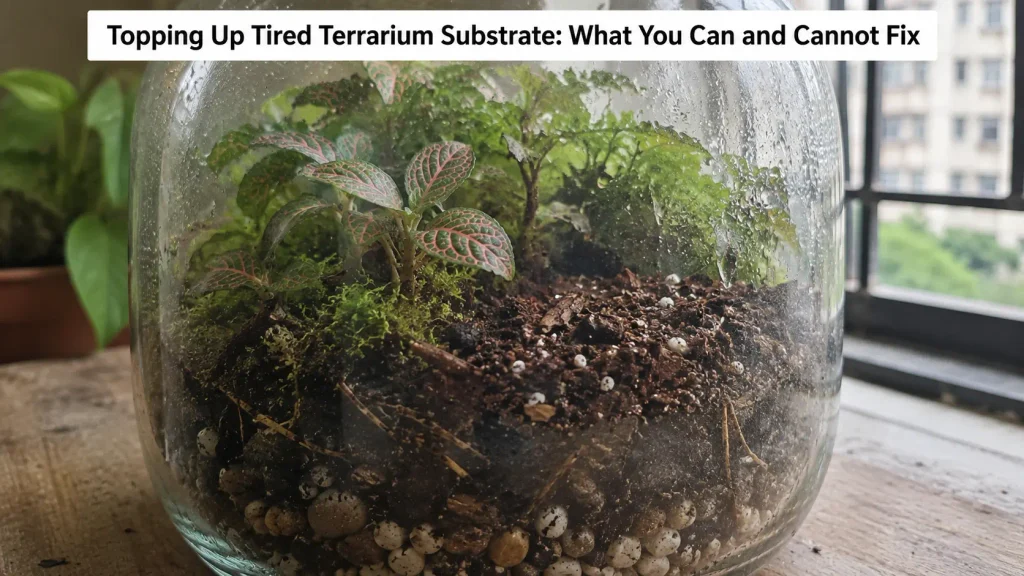
“I would top up only enough to cover exposed roots and restore the settled substrate line, using the same mix rather than burying a compacted lower layer under something fresh. I judge the decision from the bottom of the jar: if the lower substrate still drains, smells earthy, and holds some structure, a top-up is reasonable; if it has turned dense, sour, or permanently saturated, I rebuild instead. I also keep fresh mix away from plant crowns and stem bases, because raising the substrate too high around them can create another constantly wet contact point and invite rot.”
What topping up genuinely does
Worth doing, in its place.
Covers exposed roots, which matters, because a root sitting in jar air rather than in substrate is a root drying out.
Restores the visual line at the glass.
Adds a little fresh organic matter to a layer that has been consumed.
Use the same mix you built with, or close to it. A different mix layered on top creates a boundary that water moves across unevenly, which is the same problem as putting garden soil on top of a container mix. What that mix should be is on terrarium substrate mix.
Add it in thin layers and work it gently around stems rather than dumping it in. Nothing on this page requires a depth figure, and we publish none, because it depends on how much sank.
What topping up cannot do, and the sealed-jar reason
Here is the inversion that this site keeps running into.
In a pot, an exhausted or salted substrate is fixed by leaching: you flush water through and it carries the problem out of the bottom. That is the standard remedy in every extension publication about container plants.
A sealed terrarium has no bottom exit. Water goes in, cycles, and stays. So there is no leach, which means:
- Accumulated mineral salts stay. This is why a feeding mistake in a closed jar is permanent until a rebuild, and it is the whole argument on terrarium fertilizer.
- Breakdown products stay.
- A saturated bottom layer stays saturated unless you physically remove water or open the lid.
Adding fresh substrate on top of a compacted, saturated, salt-loaded layer buries the problem. It looks better and the system is unchanged.
When it is a rebuild
Be honest about this, because a half-measure on a failing build costs you the effort twice.
Rebuild rather than top up when: the lower substrate is waterlogged and stays that way, when there is a persistent smell that is not coming from a single dead leaf, when roots are rotting, when the substrate has become a dense mass rather than a structure, or when a feeding accident has put fertilizer into a sealed system.
Top up rather than rebuild when: the substrate has simply settled, the plants are healthy, roots are exposed at the surface, and nothing smells.
The test is what the lower layer is doing, not what the top looks like, and the only way to know is to look at the glass at the bottom of the build and, if you can, to probe gently.
A partial refresh, which is the middle option
You can sometimes lift a plant, remove the substrate immediately around it, replace that with fresh mix, and put the plant back. It is fiddly and it is real.
What it does: gives one plant a fresh root environment.
What it does not do: change the bulk of the jar, and the bulk is where the water and the salts are.
It is worth doing when one plant is struggling in an otherwise sound build. It is not a way of avoiding a rebuild the jar has earned.
The prevention, since it is cheap
Build with a structural mix in the first place. A substrate with bark, charcoal or another coarse component holds its air spaces far longer than a fine peat-heavy mix, and compaction is the failure a coarse component exists to prevent.
Do not fertilize a sealed jar. No exit, no forgiveness.
Do not over-water at the build. Most compaction begins as an over-wet start.
FAQ
My substrate has sunk. Is something wrong? Usually not. Air spaces close, organic material is consumed by the microbial life in the jar, fines wash downward, and a plant that has died takes its roots with it. Sinking on its own is not a problem. Compaction is, and the two are not the same thing: sunken means there is less of it, compacted means what is there has lost its air spaces.
Can I just add fresh substrate on top? You can, and it covers exposed roots, restores the line at the glass and returns a little organic matter. What it does not do is decompact anything underneath. Adding fresh material over a compacted, saturated, salt-loaded layer buries the problem and leaves the system unchanged.
Should I use a different mix for the top-up? Use the same mix you built with, or close to it. A different mix layered on top creates a boundary that water moves across unevenly, the same problem as putting garden soil over a container mix. Add it in thin layers and work it gently around the stems.
Can I flush a terrarium to clear built-up salts? No. Leaching works in a pot because water carries the problem out of the bottom, and a sealed terrarium has no bottom exit. Salts stay, breakdown products stay, and a saturated bottom layer stays saturated unless you physically remove water or open the lid.
How do I know whether to top up or rebuild? Judge the lower layer, not the surface. Top up when the substrate has simply settled, the plants are healthy and nothing smells. Rebuild when the lower substrate stays waterlogged, roots are rotting, there is a persistent smell that is not one dead leaf, the substrate has become a dense mass, or fertilizer has gone into the sealed system.
What this page does not publish
No depth figure for topping up, and no substrate volume. Both depend on the jar.
No refresh interval, because no source publishes one for a sealed container and the state of the lower layer is the trigger, not the calendar.
No fertilizer recommendation. The answer in a sealed system is none, for the reasons on the fertilizer page.