
Terrarium Ground Cover Plants: Selaginella & Pilea

The best terrarium ground cover plants are not always moss. Selaginella (spikemoss), Pilea depressa, Pilea glauca, and Soleirolia soleirolii (the plant most nurseries also sell as “baby’s tears”) all form a low, dense carpet over bare substrate without the misting schedule true moss demands. Each one wants steady moisture and no direct sun, but they differ enough in growth habit and humidity tolerance that picking the wrong one is the fastest way to bald patches or a carpet that eats the whole jar.
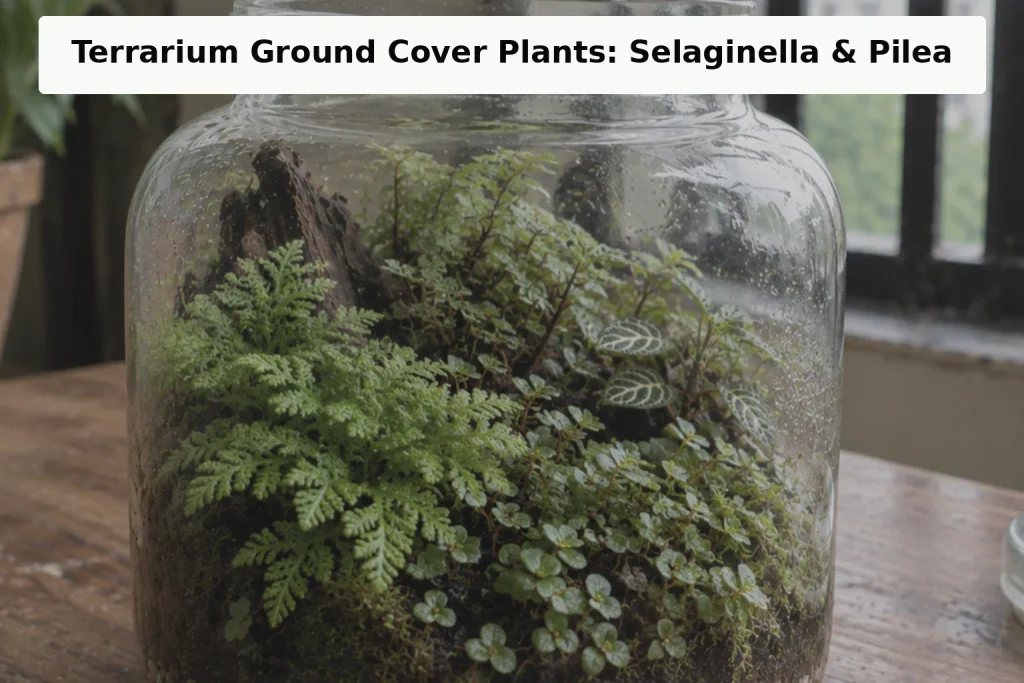
“In my own builds, I’ve found that ground cover works much better when I treat it as a rooted plant choice rather than a decorative moss substitute. Selaginella gives me that soft, moss-like look but anchors into the substrate and handles trimming well, while Pilea spreads by rooting along its stems and can fill the front of a jar quickly if I give it steady moisture and bright indirect light. The practical thing I watch most is how fast the carpet is moving into neighboring plants or hardscape, because once a fast spreader gets established, keeping a clean edge is much easier than trying to reclaim space later.”
What “Ground Cover” Actually Means Inside a Terrarium
Ground cover in a terrarium does one job: it hides bare substrate, holds surface moisture in, and gives small hardscape pieces something to root against visually. That job gets filled by plants from very different branches of the plant world, and mixing them up costs you a care mistake later. True mosses are bryophytes, non-vascular plants with no root system, which is why they can’t be “planted” so much as pressed onto damp material. Selaginella looks and behaves like a moss but is a vascular lycophyte with a real, if shallow, root structure. Pilea species and Soleirolia soleirolii are flowering plants, further still from moss, and they root and feed the way any houseplant does. None of that changes how they look once they’ve filled in, but it changes how you plant, feed, and trim them, so it’s worth keeping straight before you buy anything labeled “moss” at a nursery.
Selaginella (Spikemoss): The Look-Alike That Isn’t a Moss
Selaginella earns its “spikemoss” name from its appearance, not its biology. According to North Carolina State Extension’s plant database (read 2026-09-18), Selaginella kraussiana is a mat-forming, spreading plant that tolerates shade to partial shade and needs consistently moist, humid conditions to stay dense. The University of Cambridge Botanic Garden (read 2026-09-18) is blunter about the classification: despite the common name, Selaginella “is not a moss, but a lycophyte,” a group of vascular plants that predates flowering plants by hundreds of millions of years.
Practically, that vascular structure is good news for terrarium builders. Selaginella tolerates being planted into substrate rather than just laid on top, roots more securely than true moss, and recovers faster after light pruning if it spreads past its bed. It still wants the enclosed humidity a closed terrarium provides, so it is a poor fit for anything left open to room air for long stretches. Trim it back before it climbs hardscape you’d rather keep visible; left alone it will happily cover stone and wood as readily as substrate.
Pilea depressa and Pilea glauca: Small-Leaf Carpets
Pilea depressa, often sold simply as “baby tears,” is a Caribbean understory plant with round, thick, glossy leaves on trailing stems that root wherever they touch damp substrate. It spreads by rooting along its stems rather than by rhizome, which makes it easy to propagate from a cutting pressed into the terrarium substrate mix rather than left floating on top of loose soil that won’t hold moisture where the roots need it. Pilea glauca is a related, finer-leaved species with a silvery cast to its small leaves; it stays lower and denser, which makes it a common choice for filling the front edge of a terrarium where you want detail rather than volume.
Both species prefer bright, indirect light rather than the deep shade some other ground covers tolerate, and both dislike standing water at the root. In a closed terrarium with good drainage layers underneath, that’s rarely a problem; in a bowl or open dish garden, watch the substrate surface and back off watering once it stays visibly damp.
Soleirolia soleirolii: The Other Plant Sold as “Baby’s Tears”
Here is the naming trap worth knowing before you order online: two unrelated plants are both commonly called “baby tears” or “baby’s tears.” Pilea depressa is one. Soleirolia soleirolii is the other, and it is a member of the nettle family rather than the Pilea genus. The same North Carolina State Extension database also lists Soleirolia soleirolii as a ground cover and houseplant that grows best in dappled sunlight to deep shade, needs high humidity and consistently moist, well-drained soil, and spreads by a dense, creeping, horizontal growth habit that the extension page describes as capable of covering ground quickly.
That speed is the plant’s main terrarium liability. Soleirolia soleirolii will crowd out slower neighbors, including moss and Selaginella, if it isn’t kept in check, so it works best either as the sole ground cover in a build or as a plant you’re prepared to trim on a schedule. Direct sun scorches its leaves quickly, so it belongs in the same shaded, humid conditions as the rest of this list, never on a windowsill in full sun.
Terrarium Ground Cover Plants Compared
For a quick read on which terrarium ground cover plants fit which build:
- Selaginella: vascular, not a true moss; best in closed, consistently humid builds; moderate spread, tolerates trimming well.
- Pilea depressa: rounder leaves, trailing stems that root as they spread; wants brighter indirect light than the others here.
- Pilea glauca: finer, silvery foliage; stays lower and denser; good for detail work along the front glass.
- Soleirolia soleirolii: fastest spreader of the group; needs the most frequent trimming; best as a single-species carpet rather than mixed in.
None of these plants are true mosses in the botanical sense, which is worth remembering if a build also includes actual moss: the two groups have different root structures and different tolerance for being disturbed, so treat “moss” and “moss-like ground cover” as separate planning decisions rather than interchangeable labels.
Matching Ground Cover to Your Terrarium and Your Climate
A sealed or mostly closed terrarium holds humidity well enough for any plant on this list, which is why closed builds are the forgiving option for ground cover generally; the wider list of plants that hold up in a sealed jar leans heavily on the same humidity-loving group. An open terrarium or a dish garden is a harder environment for all four plants, since room humidity drops faster than these species tolerate, particularly in dry, air-conditioned interiors.
Builders working in naturally humid climates, including much of South and Southeast Asia, have an advantage even outside a sealed jar: ambient room humidity in a non-air-conditioned apartment often sits well above what a similar room in a dry, temperate climate would offer, which buys some margin if the terrarium lid comes off for maintenance more often than the plant would strictly prefer. That margin disappears the moment air conditioning runs constantly, so builds kept in a cooled room need the closed-lid discipline more, not less.
If low maintenance matters more than variety, it’s worth checking terrarium plants ranked by how much neglect they tolerate before committing to a ground cover that needs frequent trimming, since Soleirolia soleirolii and, to a lesser extent, Pilea depressa will outgrow a lid gap faster than Selaginella does.
Planting and Care Basics
Press cuttings or small divisions directly into damp substrate rather than laying them on the surface; all four plants root better with soil contact, even Selaginella despite its shallow root system. Water lightly and consistently rather than heavily and infrequently, since these plants tolerate steady moisture far better than a wet-then-dry cycle. Indirect light suits every species here; direct sun through glass will scorch leaves on Pilea and Soleirolia quickly and will slow Selaginella’s growth even if it doesn’t visibly burn.
Trim before a ground cover reaches hardscape you want to keep visible. Cut stems just past a leaf node on Pilea and Soleirolia, and shear Selaginella back to the height you want it to hold; all three recover from pruning within a couple of weeks in stable humidity. If leaves start looking translucent, mushy, or develop a sudden soft rot, check for standing water at the roots before assuming it’s a light problem.
Common Mistakes With Terrarium Ground Cover
The most common mistake is planting a fast spreader like Soleirolia soleirolii alongside slower plants and assuming they’ll balance out; they won’t, and the slower plant loses. The second is confusing the two “baby tears” plants when ordering, which matters because Pilea depressa tolerates brighter light than Soleirolia soleirolii wants. The third is treating any of these four as moss substitutes that need moss-level neglect: all of them are rooted plants that need actual feeding and occasional light fertilizer at low strength, not just misting.
Persistent surface fuzz or a sudden film on the ground cover itself is usually a humidity or airflow issue rather than a plant problem, and it’s worth reading what the fog and condensation on the glass are actually telling you before treating the ground cover as diseased. Pulling the lid for a few hours of extra airflow solves more early cases than removing the plant does.
FAQ
Is Selaginella actually a moss? No. Selaginella is a vascular lycophyte, a plant group with true (if shallow) roots and internal water-conducting tissue, unlike true mosses, which are non-vascular bryophytes. It looks moss-like and is often sold under moss-adjacent names like “spikemoss,” but it is planted and cared for more like a small rooted plant.
What’s the difference between Pilea depressa and Soleirolia soleirolii if both are called baby tears? They’re unrelated plants that share a common name. Pilea depressa has rounder, thicker, glossier leaves and prefers brighter indirect light. Soleirolia soleirolii is finer-textured, spreads faster, needs shadier conditions, and belongs to the nettle family rather than the Pilea genus.
Can terrarium ground cover plants grow in an open terrarium? They can, but all four species here prefer the steadier humidity a closed or mostly closed terrarium holds. In an open dish garden, expect slower growth and more frequent watering, and expect Soleirolia soleirolii in particular to struggle if room air runs dry.
How often should I trim terrarium ground cover? There’s no fixed schedule; trim whenever growth reaches hardscape or glass you want to keep clear. Fast spreaders like Soleirolia soleirolii may need trimming every few weeks in ideal conditions, while Selaginella and Pilea glauca usually need it far less often.
Will ground cover plants smother moss in the same terrarium? They can, especially Soleirolia soleirolii, which spreads quickly by creeping stems. If you want both moss and a rooted ground cover in one build, plant the faster spreader in a separate zone or be prepared to trim it back from the moss regularly.