
Terrarium Plants That Stay Small (and Why Some Don’t)

Short answer: the terrarium plants that stay small are the ones with three traits at once: slow growth, small leaves even when mature, and a low habit (a clump, a rosette or a creeper rather than a climber). Dependable picks include cushion-forming mosses, miniature ferns such as button fern, earth star (Cryptanthus), miniature African violets, Peperomia prostrata, Pilea glauca and mini fittonia. Even these need an occasional trim, because no plant stays put in a jar forever.
Most lists of small terrarium plants show each plant at the size it is sold. That is the trap. Almost everything is small in a nursery pot. The real question is what the plant will look like after six months of warm, humid, stress-free growing behind glass, and that depends on how it stays small, not on how small it is today.
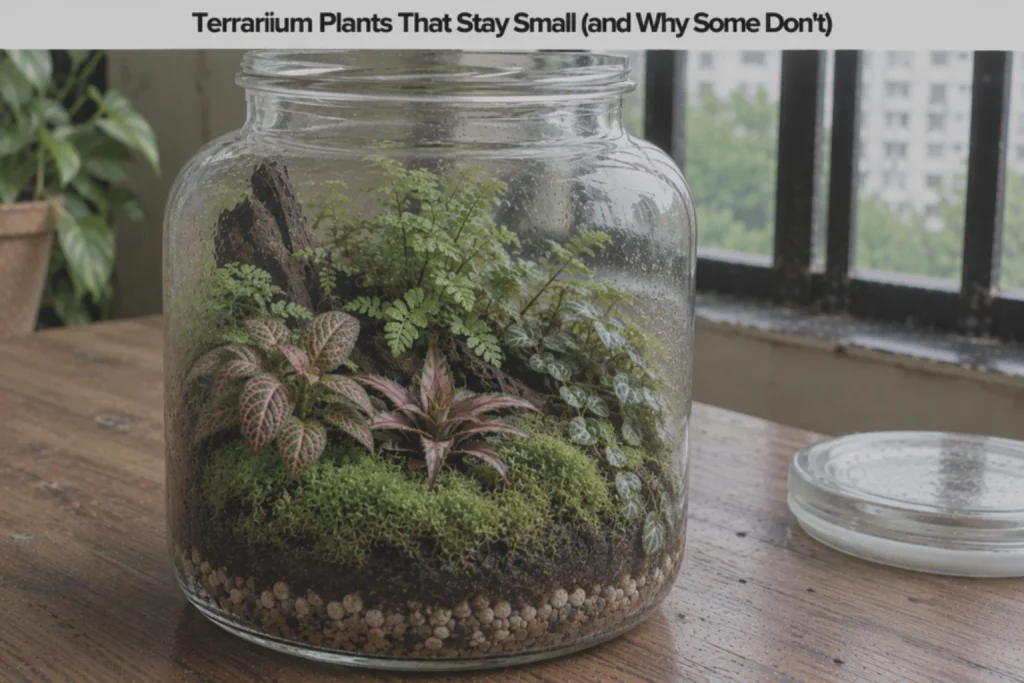
“In my own terrariums, I’ve found that “small” is much less useful than slow, compact, and easy to control. A plant can look tiny in a nursery pot and still turn into a problem once it gets steady warmth, humidity, and moisture behind glass. I now trust naturally compact growers like cushion mosses, miniature ferns, small peperomias, Pilea glauca, and mini fittonia far more than anything that only stays small because I keep cutting it back. The practical check I use is growth habit: if I see runners, long gaps between leaves, or a plant already reaching outward aggressively, I assume I’ll be pruning it often. The biggest lesson for me is that leaving a little empty space in the jar is not wasted space; it is what gives the plants room to stay manageable instead of forcing me into constant maintenance later.”
What “Stays Small” Actually Means
University extension guides describe the ideal terrarium plant in nearly the same words. The Iowa State University Extension guide to creating and caring for a terrarium, which we read on September 23, 2026, says: “Plants with slow growth rates, tolerance to high humidity, and small leaves make good candidates for terrariums.”
The University of Vermont Extension article on creating a garden in a terrarium, read the same day, splits the idea in two. It advises choosing plants “that either are naturally small and slow growing or that can be pruned to remain small.”
That split matters more than any single plant name. A plant in the first group stays small on its own. A plant in the second group stays small only because you keep cutting it. Both can work, but they are different commitments. If you want a jar you can mostly leave alone, fill it with the first group and use the second group sparingly, in spots your tweezers and scissors can reach.
Why a Closed Jar Can Make Plants Grow Bigger
A sealed terrarium removes most of the things that slow a houseplant down. The air stays humid, the substrate rarely dries out, and there is no drafty windowsill to stress the leaves. In a warm apartment, the kind common across South and Southeast Asia, there is also no cold season to pause growth. A plant that crawls along on a shelf can speed up once it is sealed in.
Light pushes growth in the other direction. A plant kept too dim does not stay compact. It stretches toward the light, putting longer gaps between its leaves, and the result looks like the plant is outgrowing the jar when it is really starving for light. The University of Vermont guide recommends a spot with bright light but no direct sun, because the glass magnifies the sun’s rays and overheats the inside.
Feeding is the third lever. Iowa State’s guide states that “fertilizer should be avoided because it will encourage growth and earlier crowding of the plants.” A jar that is fed is a jar that fills up faster.
Terrarium Plants That Stay Small, Sorted by Habit
Growth habit tells you more about future size than the plant’s current height does. Here is how the common small picks sort out.
Clumpers and rosettes: the safest group
These grow in a tight cluster or a flat circle and expand slowly outward.
- Cushion and mood mosses. These are acrocarpous mosses: they grow upright in tufts and mounds rather than spreading as a sheet. They are among the slowest things you can put in a jar. Keep in mind that liverworts and algae can show up in the same jar and look moss-like at a glance; they are different organisms and usually spread much faster.
- Earth star (Cryptanthus). A ground-dwelling bromeliad that grows as a low, flat rosette. It stays short, so the dimension to check is width.
- Miniature African violets. The University of Vermont guide lists them for terrariums. Look for plants sold specifically as miniatures, since standard African violets grow much larger.
- Button fern and small maidenhair. The same guide names button fern (Pellaea rotundifolia) and maidenhair fern (Adiantum microphyllum) as miniature ferns to consider.
Creepers: tiny leaves, wide ambitions
These stay low but travel sideways. They suit a jar only if you are happy to trim the edges.
- Pilea glauca. Very small gray-green leaves on trailing stems. It covers ground well and will cover neighbors too if nobody cuts it back.
- Peperomia prostrata (string of turtles). Small patterned leaves on slow, trailing stems. It dislikes sitting in wet substrate, so it suits a jar that is not waterlogged.
- Selaginella (spikemoss). Often sold alongside mosses, but it is not a true moss; it belongs to an older plant group, the lycophytes. Creeping kinds carpet quickly in humid jars.
- Sheet mosses. Pleurocarpous mosses grow as spreading, branching mats. They stay flat but will run across the whole floor of the jar over time.
Upright plants that only stay small as the right cultivar
With these, the label is everything. The species is too big; a named compact form is not.
- Fittonia. Standard nerve plants can grow large for a small jar. Look for plants sold as mini or dwarf types, and keep the full-size ones for bigger containers.
- Syngonium ‘Pixie’. A compact arrowhead plant. It is still a Syngonium, so give it a mid-size jar and expect to trim it.
- Lemon button fern. A compact relative of the Boston fern. Standard Boston ferns are far too big for most jars.
Small leaves, big futures: the ones that fool people
Creeping fig (Ficus pumila) has tiny leaves and a strong urge to climb every surface of the glass. Polka dot plant (Hypoestes) appears on the University of Vermont list, but it tends to stretch and needs regular pinching to stay bushy, which puts it firmly in the “can be pruned” group. Baby’s tears (Soleirolia) forms a mat fast enough to smother slower plants. None of these is a bad plant, but none of them stays small by itself. For the list of plants that fail in a sealed jar for other reasons, see plants that should never go in a closed terrarium.
Quick Reference: Small Terrarium Plants Compared
| Plant | How it stays small | Habit | What to watch | Jar size it suits |
|---|---|---|---|---|
| Cushion or mood moss | Very slow growth | Upright tufts | Liverwort or algae creeping in alongside | Any, including small jars |
| Earth star (Cryptanthus) | Low rosette | Flat rosette | Width, and offsets at the base | Small to mid |
| Miniature African violet | Miniature cultivar | Rosette | Buy a named miniature, not a standard plant | Small to mid |
| Button fern | Slow, compact fronds | Arching clump | Fronds browning if the jar runs dry | Mid |
| Pilea glauca | Tiny leaves | Creeping | Smothering neighbors | Mid to large |
| Peperomia prostrata | Slow, small leaves | Trailing | Rot in wet substrate | Small to mid |
| Selaginella | Low growth | Creeping carpet | Spreading fast in humid jars | Mid to large |
| Mini fittonia | Dwarf cultivar | Low mound | Standard types sold under the same name | Small to mid |
| Syngonium ‘Pixie’ | Compact cultivar | Upright | Still climbs in time | Mid to large |
| Creeping fig | Does not stay small | Climbing | Covering the glass | Large, with trimming |
The jar column is a guide, not a rule. How much room a plant needs also depends on how many other plants share the space. If you are still choosing a container, our breakdown of how small is too small for a closed terrarium helps you match the jar to the planting.
Five Checks to Make Before You Buy
These take a minute at the nursery and tell you more than the tag does. They matter most when a tag gives only a common name, or there is no tag at all.
- Compare old leaves with new ones. If the newest leaves are clearly larger than the oldest, the plant is scaling up and will keep doing so.
- Look at the stem spacing. Long bare gaps between leaves mean the plant has either been kept too dim or is a fast grower. Tight spacing is what you want.
- Look for runners, tendrils and aerial roots. Any of these means the plant plans to travel, along the substrate or up the glass.
- Read the full name. Words like “mini”, “dwarf”, “Pixie” or “Minima” usually mark a compact cultivar. A plain common name often means the standard, full-size plant.
- Tip it out and count. Small nursery pots often hold several rooted cuttings together. Splitting them gives you smaller pieces to plant, and one pot can fill a jar that would otherwise have crowded quickly.
Keeping Small Plants Small Once They Are In
Choosing well gets you most of the way. The rest is maintenance.
- Trim early and often. Taking a little off regularly is gentler than a hard cut once a plant touches the lid. Our guide to pruning terrarium plants covers where to cut and how to get the clippings out.
- Skip the fertilizer. As Iowa State puts it, feeding encourages growth and earlier crowding. A sealed jar recycles most of what it needs.
- Give it bright, indirect light. Enough light keeps growth compact; too little makes plants stretch.
- Swap out the one that will not behave. If a single plant keeps outgrowing its space, replacing it is easier than trimming it every few weeks. You can replace a plant in a terrarium without rebuilding it.
The Honest Part: Nothing Stays Small Forever
Most small-plant lists leave this out. Iowa State’s guide says it plainly: “No plant can be a permanent addition to a terrarium as they will eventually outgrow the space.” That is not a failure of your build. It is how living plants behave.
So “stays small” really means “grows slowly enough that trimming is occasional and replacement is rare.” A good small-plant jar is planned with that in mind. Put the slowest plants, like cushion moss and rosettes, in the hard-to-reach back corners. Put anything that needs regular trimming near the opening, where your tools can reach. Then, when the time comes, one plant can come out without the whole layout coming apart.
Frequently Asked Questions
What are the best terrarium plants that stay small?
The most reliable are cushion-forming mosses, earth star (Cryptanthus), miniature African violets, button fern and other miniature ferns. Peperomia prostrata, Pilea glauca and mini fittonia also stay small but need occasional trimming as they spread.
Do terrarium plants ever stop growing?
No. Slow growers just take longer to fill the space. Iowa State University Extension notes that no plant can be a permanent addition to a terrarium, because every plant eventually outgrows it. Plan on trimming and the occasional replacement.
Can I keep a normal houseplant small in a terrarium?
Sometimes, with pruning. The University of Vermont Extension includes plants “that can be pruned to remain small.” Expect regular cutting, though, and avoid climbers and fast spreaders in small jars, since they will outpace your scissors.
Is Selaginella a moss?
No. Selaginella, often called spikemoss, is a lycophyte, not a true moss. It enjoys the same humid conditions, which is why it is often sold alongside mosses, but many kinds creep and spread faster than cushion mosses do.
Should I fertilize small terrarium plants?
Generally no. Iowa State University Extension advises avoiding fertilizer because it speeds growth and crowding. If plants yellow badly over a long stretch, look at light and water before reaching for fertilizer.