
Terrarium Light Seasonal Change: What It Does to a Jar

A terrarium light seasonal change happens because the sun’s path moves through the year, not because your jar suddenly got worse. In winter the sun runs lower and farther to the south, so days are shorter and most spots get less light, but a jar close to an unshaded south-facing window can actually get more direct sun. In summer the sun climbs higher and days are longer. The same shelf can therefore starve a sealed build in one season and overheat it in another. The fix is to re-read your window every few months and move the jar, not to change the plants.
That is the short answer. The rest of this guide explains which direction each window shifts, why a sealed jar reacts more sharply than a potted plant, what the warning signs look like through the glass, and how people in low-latitude, monsoon climates like Bangladesh face a slightly different calendar from the one most terrarium guides are written for.
“I recheck the sun’s path when the season changes, even if the jar has not moved. In Dhaka, a cooler month can still bring low sunlight farther into the room, while monsoon cloud can reduce useful light despite long days. I would check that change before adding water, because a different fog pattern does not automatically mean the jar is thirsty.”
Why the Same Window Gives Different Light Through the Year
The key idea is simple geometry. The University of Arizona Cooperative Extension publication Indoor Plant Selection and Care (read on 2026-09-27) puts it this way: in winter “days are shorter and the sun’s path is lower and farther to the south,” so “most plants will receive fewer hours of less intense sunlight.” The same page then adds the exception that matters most for glass jars: plants “close to an unshaded south window may receive more direct sunlight at this time of year because of the low sun angle.” In summer, it notes, “the days are longer and the sun’s path is higher above the horizon.”
So the light in a room does not simply go up in summer and down in winter. It changes direction and depth:
- High summer sun tends to hit the outside wall and the sill steeply, so less direct light reaches deep into a south-facing room at midday.
- Low winter sun comes in at a shallow angle, so it can shine straight across a sill and well into the room behind it.
- Sunrise and sunset move along the horizon. In the Northern Hemisphere the summer sun rises north of east and sets north of west, while the winter sun rises and sets toward the south. That is why an east or west window can feel very different in June than in December, and why a north-facing window can catch a little direct sun early and late on summer days.
If you live in the Southern Hemisphere, flip every compass direction above.
Why a Sealed Terrarium Feels the Shift More Than a Houseplant
A potted plant on the same sill would cope with most of these swings. A closed terrarium has less room for error, for three reasons.
Glass traps heat. Direct sun on a sealed jar warms the air and soil inside, and the lid stops that heat from escaping. The same winter sun that is pleasant on a pot can push a closed jar into the kind of heat damage covered in our guide to brown, crispy leaves in a closed terrarium.
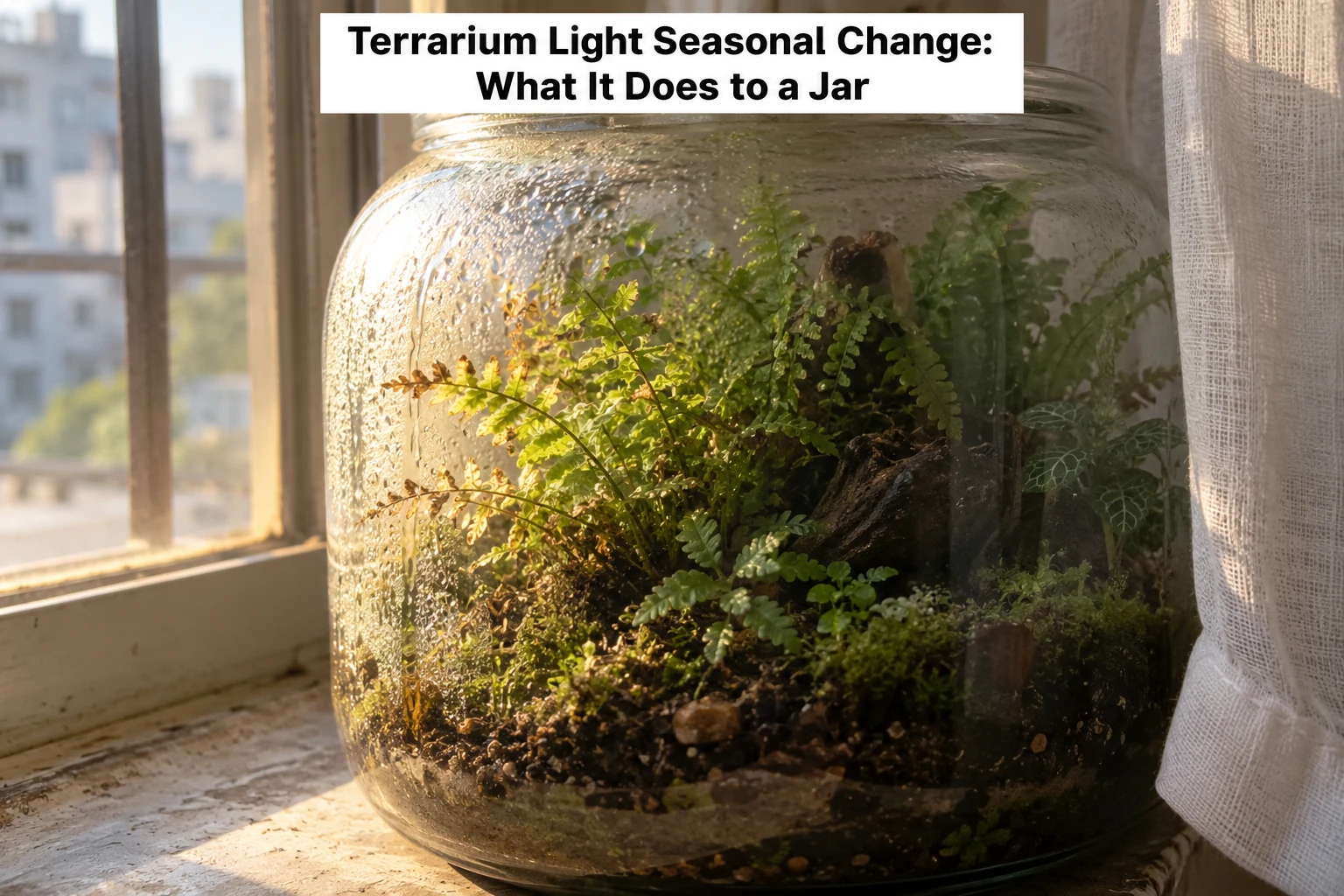
The water cycle speeds up or slows down with light and warmth. More sun means more evaporation and heavier condensation. Less sun means a slower cycle, damper soil and more time for mold to settle in. The fog you see on the glass is often the first visible sign that the season has moved, and reading the condensation on the glass tells you which way.
Terrarium plants are chosen for gentle light. Most closed-jar favorites, such as ferns, mosses, fittonia and small creeping figs, are forest-floor plants. They sit in a narrow band between “too dim to grow” and “scorched.” A seasonal shift that a pothos would shrug off can move them out of that band.
Signs the Season Has Changed the Light in Your Jar
You rarely see the sun’s path move day to day, but the jar shows it within a few weeks. Look for these patterns.
Signs of too much light or heat (often winter on a south sill, summer on a west sill)
- Leaves near the glass on the sunny side go pale, bleached or crispy at the edges.
- Moss browns or goes straw-colored on top while staying green underneath.
- Condensation becomes very heavy by early afternoon and clears in the evening.
- Plants wilt in the afternoon and recover overnight.
Signs of too little light (often the dark part of the year, heavy cloud, or a jar moved deeper into a room)
- New growth stretches toward the window with long gaps between leaves.
- Stems lean hard in one direction.
- Colorful foliage, such as fittonia veins, fades toward plain green.
- Condensation lingers all day and the soil surface stays wet, which invites mold.
None of these signs is unique to light. Overwatering, a bad seal and rot can all look similar, so change one thing at a time and watch for two to three weeks before deciding what worked.
The Low-Latitude Calendar: Why Temperate Advice Can Mislead You
Most terrarium lighting advice comes from shops and writers in the UK, northern Europe, Canada, Australia and the northern United States. Their seasonal pattern is roughly: bright long summers, dark short winters, so add a grow light in winter and pull the jar back from the window in summer.
At lower latitudes, such as Dhaka at around 23 degrees north, the pattern is less extreme in day length and more about sun angle and weather:
- The dry, clear months. In the cooler, drier part of the year the sun is lower in the southern sky and skies are often clearer. That low winter sun can reach deep across a south-facing sill, which is exactly the situation the Arizona Extension flags as giving more direct sun, not less. For a sealed jar, this can be the season with the highest risk of heat stress, even though it feels like “winter.”
- The pre-monsoon hot season. Rising temperatures mean a jar that coped with the same light a few weeks earlier can now overheat, because the room itself is warmer.
- The monsoon. Days are long, but heavy cloud and rain can dim the light for days at a stretch, while humidity in the room climbs. A jar that was bright enough in spring can drift toward too little light, and extra moisture raises the mold risk. Our guide to building a terrarium during monsoon season covers the humidity side of this.
The practical point: do not assume “winter means less light” if you live near the tropics. Watch your actual window through the year.
How to Adjust for a Terrarium Light Seasonal Change
Once you know which way the season is pushing, the adjustments are small and mostly about placement.
Re-read the window at the start of each season
Stand where the jar sits at a few different times of day and notice whether direct sun actually lands on the glass, and for how long. A patch of sun that did not exist in summer may now cross the sill for hours. A quick check like this is worth more than any generic “bright indirect light” rule.
Move the jar, not the plants
The New York Botanical Garden’s Houseplant Basics guide (read on 2026-09-27) recommends exactly this seasonal shuffle for houseplants: “Plants that fare well in a southern exposure during the winter may have to be moved to an east- or north-facing window in summer when the light is more intense.” For a sealed terrarium, apply the same logic in both directions. Pull the jar back from the glass, or to a gentler window, during the season when direct sun reaches it. Bring it closer when the light weakens.
The same NYBG guide describes a south-facing window as giving direct sun within 2 to 3 feet, bright indirect light up to 5 feet, and semi-shade up to 8 feet. Those distances were written for temperate homes, so treat them as a starting point, not a rule for every latitude. The useful takeaway is that a small move away from the window changes the light a lot.
Use a sheer curtain in the harsh season
A thin curtain or blind softens direct sun without plunging the jar into darkness. This is often easier than finding a new shelf.
Clean the glass, both sides of the window
The NYBG guide also notes that “dirty windows can block up to 50% of the light.” In a dim or cloudy season, a clean window and clean terrarium glass are free extra light. If the inside of the jar has clouded over, our guide on how to clean terrarium glass without wrecking the build walks through it.
Rotate the jar
Turning the jar a quarter turn every week or two keeps plants from leaning toward the light, which becomes more noticeable when the light source is lower and more one-sided.
Adjust watering expectations, not just light
A jar in weaker, cooler light uses water more slowly. A jar in stronger, warmer light cycles faster. If you are tempted to add water after a season change, check the soil and the condensation pattern first, because the light shift may be the real cause of what you are seeing.
When to Consider Artificial Light
If no spot in your home gives enough light during the dim season, a small grow light is the usual answer. Terrarium guides disagree on hours per day, and the right figure depends on the light, the distance and the plants, so start conservatively and watch the jar rather than trusting any single number. Keep any lamp and its cable clear of water and follow the manufacturer’s instructions for placement and heat. A grow light does not remove the seasonal question entirely: the window light still changes around it, so the total light the jar gets will still shift through the year.
A Simple Seasonal Checklist
| When | What to check | Likely adjustment |
|---|---|---|
| Start of the dry, clear season | Does low sun now cross the sill onto the jar? | Pull back from a south window or add a sheer curtain |
| Start of the hot season | Is the glass warm to the touch in the afternoon? | Move to a cooler, shadier spot |
| Start of the monsoon or cloudy season | Is condensation lingering all day? Are stems stretching? | Move closer to the window, clean the glass |
| Any time you move house or rearrange furniture | Where does direct sun land now? | Re-read the window from scratch |
Frequently Asked Questions
Why is my terrarium struggling when I have not changed anything?
The sun’s path has changed even if nothing in the room has. As the seasons move, direct sun can start or stop hitting the jar, and the day gets longer or shorter. A sealed jar reacts to that faster than a potted plant because heat and moisture stay trapped inside.
Does a terrarium get less light in winter?
Usually, but not always. The University of Arizona Extension notes that most plants get fewer hours of weaker sun in winter, yet a plant close to an unshaded south window can get more direct sun because the low winter sun shines straight in. For a closed jar on a south sill, winter can bring more heat risk, not less.
Should I move my terrarium to a different window each season?
Often, yes. The New York Botanical Garden suggests moving plants from a south window in winter to an east or north window in summer when light is stronger. For a terrarium, the goal is to keep it in bright light without direct sun hitting the glass for long.
How does the monsoon affect terrarium light?
Heavy cloud during the monsoon can dim the light for days at a time while room humidity rises. A jar that had enough light in spring may need to move closer to the window, and it is worth watching for lingering condensation and mold.
How long should I wait after moving a terrarium to see if it helped?
Give it two to three weeks and change only one thing at a time. Plants respond slowly, and changing light, water and position all at once makes it impossible to tell what worked.